
Affiliate disclosure: As an Amazon Associate, we earn from qualifying purchases, at no extra cost to you. We research rather than test, and commissions never change our rankings. This site is reader-supported: those commissions pay for hosting, research and keeping every guide up to date, so if a guide helped you, buying through our links is an easy way to support it. How we rank · Full disclosure
TL;DR
- Cost depends on how the joint mounts: bolt-in joints are the least labor, while press-in joints need a ball joint press or a complete control arm with the joint installed.
- Count the joints: an SLA front end has two per side, and a solid axle like the Wrangler JL's has an upper and a lower per side, so a full front job is four.
- Confirm wear by measurement, not noise: a dial-indicator play check against the maker's limit, or a wear-indicator boss that has gone flush (MOOG).
- Budget for an alignment afterward; ball joints are part of how camber and caster are set on some trucks.
- Prices vary too much by vehicle and region to quote, so compare estimates line by line: joints, labor, alignment.
| Tools needed | Floor jack and rated jack stands, Torque wrench, Ball joint press (C-frame and adapters) for press-in joints, Dial indicator for checking play |
|---|---|
| Difficulty | Moderate to advanced (DIY) |
At a Glance
| Your setup | What gets replaced | What drives the cost |
|---|---|---|
| Independent front suspension, bolt-in joint | The joint alone | Mostly the part; basic hand tools |
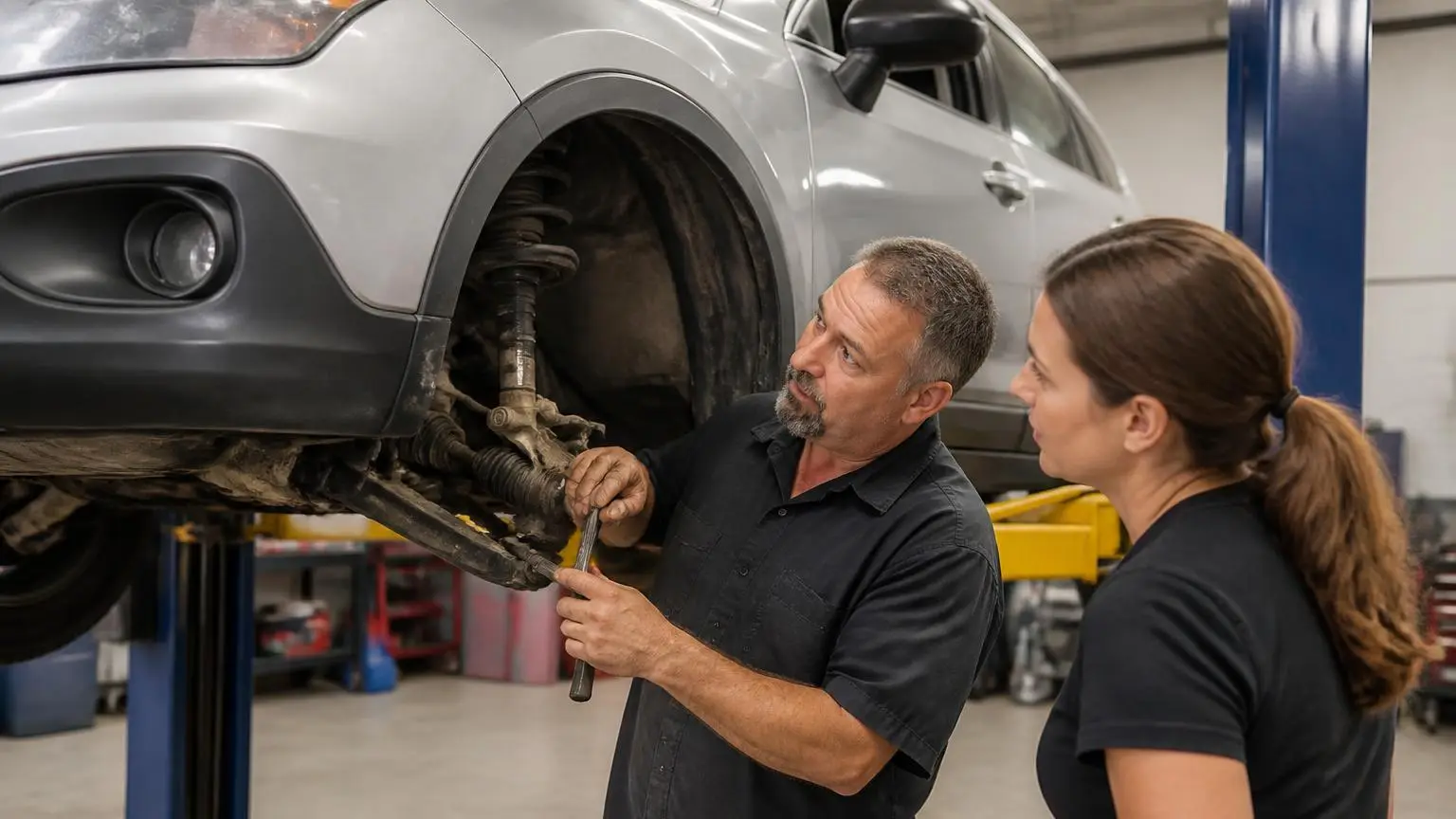
| Independent front suspension, press-in joint | The joint, or the whole control arm | A press (or shop labor) vs a higher-priced complete arm |
| Solid front axle (e.g. Wrangler JL Dana 30/44) | An upper and a lower joint per side | Four joints for a full front job |
| Any design | Alignment afterward | A separate line on the bill |
What a Ball Joint Does, and Which One Wears First
A ball joint is a ball-and-socket pivot that connects a control arm (or a solid axle's yoke) to the steering knuckle, letting the wheel steer and move up and down at the same time. MOOG divides them into two kinds. A load-carrying joint holds up the vehicle's weight and wears faster. A follower joint only locates the knuckle, so MOOG says it isn't as likely to wear out as quickly, although it still takes radial loads, impacts, vibration, heat and contamination. In a short-long-arm (SLA) suspension, the upper-and-lower A-arm layout Stellantis lists for the 2026 Ram 1500's front end, the upper joint is the follower; in a MacPherson strut design the lower joint is the follower. That matters for cost because the load-carrying joint is usually the one that fails first, and it is the one an estimate should name.
Press-In, Bolt-In or Complete Control Arm
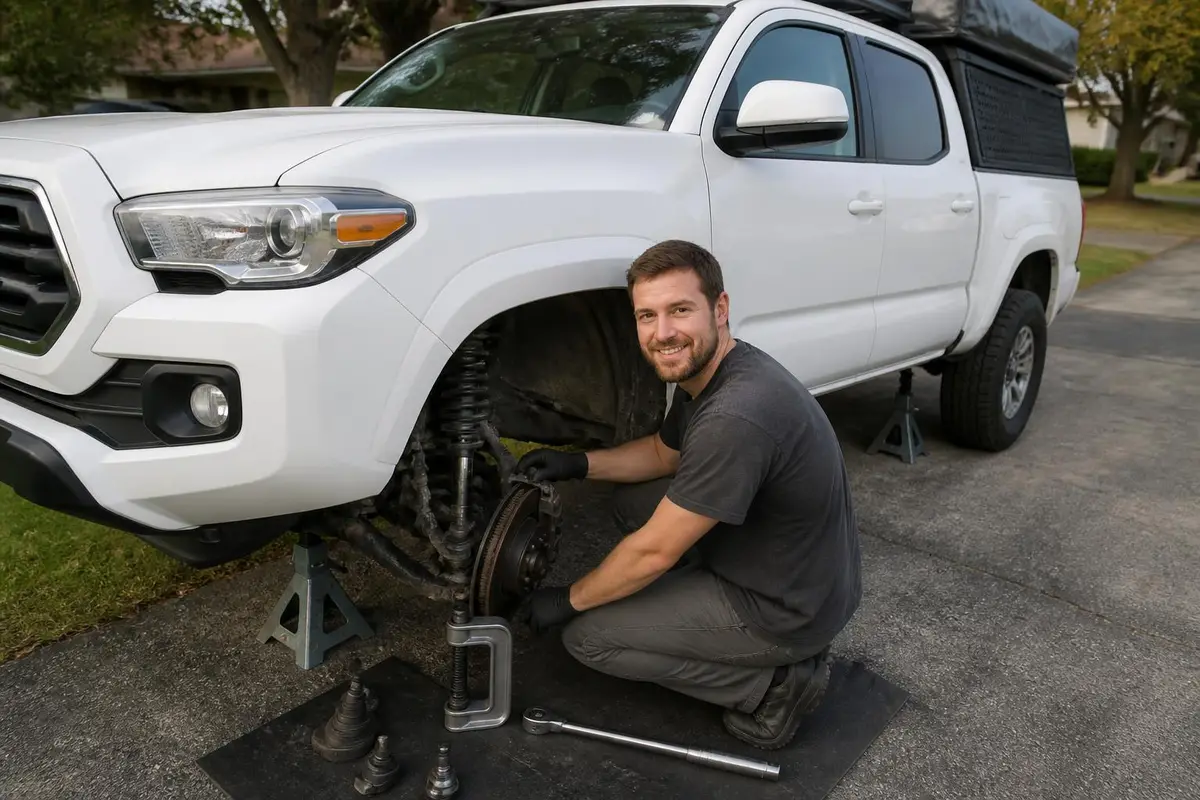
A press-in joint sits in an interference fit in the control arm or knuckle, so it has to be pressed out and the new one pressed in with a ball joint press. A bolt-in joint unbolts from the arm. The third route is a complete control arm with the joint already installed: a higher parts cost, but no pressing, which is why it is the common DIY choice for press-in designs. The procedure for that route is in how to replace upper control arms. On a solid front axle each steering knuckle rides on two joints; Spicer's ball joint kit for the Jeep Wrangler JL and Gladiator JT, for example, contains one upper and one lower joint per side and fits both the Dana 30 (Model 186) and Dana 44 AdvanTEK (Model 210) front axles.
How Wear Is Confirmed
The right check depends on the joint. For a standard joint without a wear indicator, MOOG's procedure lifts the vehicle so its weight is off the joint and measures vertical movement with a dial indicator; in one of its bulletins the limit is 0.020 inch, beyond which the joint is replaced. Limits are set by each vehicle maker, so use the figure for your vehicle. A wear-indicator joint is read differently: a small boss around the grease fitting protrudes from the housing when new and recedes as the joint wears, and MOOG says to replace it once the boss is flush or recessed. That check must be done with the vehicle resting on its tires at normal ride height, because lifting it unloads the joint's internal preload and makes a good joint look worn. States with safety inspections use the same standard: Pennsylvania's rule, 67 Pa. Code § 175.80(e)(3)(i), rejects a vehicle whose ball joint movement exceeds the manufacturer's specification.
What Drives the Price
- Joint count. An SLA independent front end has two joints per side, and a solid axle has an upper and lower per side. A quote for one joint and a quote for all four are different jobs.
- Mounting style. Bolt-in is the least labor. Press-in adds pressing time or pushes you toward a complete arm, which moves cost from labor to parts.
- Seized hardware. Rusted tapers, pinch bolts and press-fit joints that won't release add labor time, and occasionally a damaged knuckle or arm.
- Alignment. Because the job disturbs the parts the alignment is set against, budget for an alignment afterward.
- Part design. Greaseable joints can be serviced; Spicer says its performance joint adds a grease fitting to "purge contaminants", replacing the Wrangler JL's original plastic-on-plastic joint with a metal-on-metal design (a manufacturer claim).
DIY vs. Shop
A DIY job trades labor cost for tools and time. Bolt-in joints and complete control arms need only common hand tools, a torque wrench and safe jack stands. Press-in joints need a ball joint press with the right adapters for your vehicle. A shop is the better call if you don't have a press, if the old joint is seized in its bore, or if the axle needs its joints and knuckle bores checked after years of wear.
Replacing One Side or Both
The joints on both sides have the same age and mileage, and doing both at once means one alignment instead of two. The better basis for the decision is measurement: check the other side's joint against the maker's play limit or its wear indicator, and replace it if it's out or close.
Lifted Trucks and Heavier Tires
A lift changes the angles the joints work at, and larger, heavier tires add leverage on them. Pennsylvania's inspection rule also lists front-suspension lift limits alongside the ball joint check (for example, spring shackle kits more than 2 inches over original equipment and blocks on a front axle are rejected), which is a reminder to check your own state's rules before lifting. On a lifted truck with an out-of-range alignment, MOOG's adjustable ball joints are one way to add camber and caster adjustment.
Why It Shouldn't Wait
A ball joint is what holds the steering knuckle to the suspension. If a worn one separates, the wheel is no longer located, which takes away steering control. Once measurement confirms the joint is past its limit, treat the repair as due now.
Sources
- MOOG (Federal-Mogul Motorparts) — Follower Ball Joint Innovations — Load-carrying vs follower ball joints, which joint is the follower in SLA and MacPherson strut designs, and greaseable joint design.
- MOOG — Did You Know? DYK09-103: Ball Joint Inspection Procedure (PDF) — Dial-indicator play check with the joint unloaded (0.020 in limit in that bulletin), and reading a wear-indicator joint loaded at curb height, replacing it when the boss is flush.
- MOOG — Adjustable Ball Joints — Adjustable ball joints that add camber and caster adjustment, showing the ball joint's role in alignment.
- Spicer (Dana) — Performance Ball Joint Kit for Jeep JL and JT — One upper and one lower joint per side; fitment to Dana 30 Model 186 and Dana 44 AdvanTEK Model 210; grease zerk and metal-on-metal vs the original plastic-on-plastic design (manufacturer claim).
- Spicer (Dana) — Ball Joint Service Kit — Symptoms Spicer lists for worn ball joints: a popping sound when turning, a squeak when stopping, accelerating or hitting a bump.
- 67 Pa. Code § 175.80 — Inspection procedure (Cornell LII) — Inspection rejection when ball joint movement exceeds the manufacturer's specification, and the front-suspension lift limits (shackle kits, front-axle blocks).
- Stellantis Media — 2026 Ram 1500 Specifications — Upper and lower A-arm front suspension on the 2026 Ram 1500, the SLA layout example.