

Affiliate disclosure: As an Amazon Associate, we earn from qualifying purchases, at no extra cost to you. We research rather than test, and commissions never change our rankings. This site is reader-supported: those commissions pay for hosting, research and keeping every guide up to date, so if a guide helped you, buying through our links is an easy way to support it. How we rank · Full disclosure
Enter the stock tire diameter, new tire diameter and stock axle ratio below to see a recommended new ratio that restores the factory RPM-to-road-speed relationship.
How This Is Calculated
New ratio = stock ratio × (new tire diameter ÷ stock tire diameter). Ring-and-pinion sets come only in the ratios made for each axle; round the result to one that exists for yours.
Interco Tire's gear ratio calculator uses the same three inputs: new tire diameter, old tire diameter and current ratio.
This is a mathematical starting point, not axle-specific fitment confirmation. Confirm available ratios for the exact axle model before ordering a ring-and-pinion set.
TL;DR
- New ratio = stock ratio × new tire diameter ÷ stock tire diameter; published revolutions per mile give a more accurate result.
- A Rubicon moving from 33-inch to 35-inch tires needs about 4.32 to restore stock rpm; Jeep's own 35-inch packages use 4.56.
- Round to a ratio made for your axle; rounding up favors towing and crawling, rounding down favors highway rpm.
- Both axles on a 4WD must get the same ratio, because part-time 4WD turns the front and rear axles at the same speed (Jeep).
- Break new gears in and change the oil at 500 miles before towing (Yukon).
Why the Ratio Needs to Change
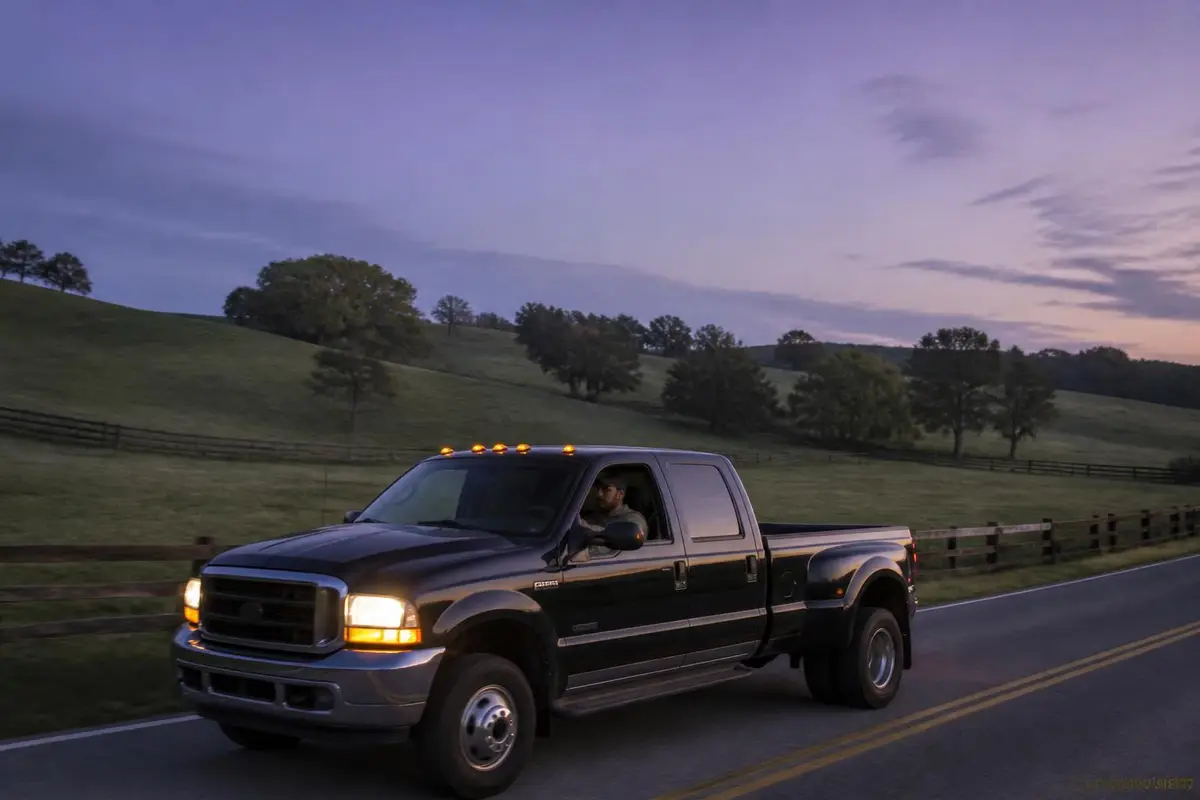
Engine rpm at a given speed is set by three things: the transmission gear, the axle ratio and how far the tire travels per turn. A bigger tire covers more ground per revolution, so at the same road speed the engine turns slower, the same effect as fitting a numerically lower (taller) axle ratio. The truck feels slower off the line, the transmission hunts for gears on grades, and low-range crawling gets faster. Regearing scales the axle ratio up by the same factor the tire grew, which restores the original rpm at every speed.
The RPM Formula, Worked Through
A mile is 63,360 inches, and a tire of diameter D inches travels π × D inches per turn. Put those together and engine rpm = mph × axle ratio × transmission gear ratio × 336 ÷ D. The constant 336 is 63,360 ÷ (60 × π). Tire makers also publish revolutions per mile, which is more accurate than the size on the sidewall; with it, rpm = mph × revs per mile ÷ 60 × axle ratio × gear ratio.
Here is that math with Jeep's published figures for the 2026 Wrangler: an eighth-gear ratio of 0.67, 637 revs per mile for the Rubicon's LT285/70R17 (about 33-inch) tire and 604 for the LT315/70R17 (about 35-inch) tire. All rpm figures are at 65 mph.
| Tire and axle ratio | Engine rpm at 65 mph in 8th | What it shows |
|---|---|---|
| LT285/70R17 with 4.10 (Rubicon as built) | ≈ 1,896 | The baseline |
| LT315/70R17 with 4.10 (bigger tires, no regear) | ≈ 1,797 | About 5% lower; the gearing is now taller |
| LT315/70R17 with 4.32 (calculated) | ≈ 1,894 | Back to the baseline, but not a ratio Jeep offers |
| LT315/70R17 with 4.56 (Jeep's 35-inch packages) | ≈ 1,999 | Slightly lower gearing than stock |
The calculated ratio is 4.10 × 637 ÷ 604 ≈ 4.32. For a Wrangler Sport moving from its P245/75R17 tire (666 revs per mile) and 3.45 gears to the 35-inch tire, it is 3.45 × 666 ÷ 604 ≈ 3.80.
Rounding to a Ratio You Can Buy
Ring-and-pinion sets are made in a fixed set of ratios for each axle family, so the calculated number is a target to round toward. Jeep's 2026 Wrangler lineup shows the steps: 3.45, 4.10, 4.56 and 4.88 depending on trim and package. Rounding up (numerically higher) gives more torque at the wheels, a lower crawl ratio and more rpm at cruise. Rounding down keeps highway rpm lower but leaves the truck slightly under-geared for its tires. The calculator's "nearest ratio" note uses a general reference list, so check the gear maker's catalog for your exact axle.
What a Regear Does to Crawl Ratio
Crawl ratio is first gear × transfer-case low range × axle ratio, and Jeep describes it as the measure of how well a vehicle can creep along at very low speed in low range. With the 2026 Wrangler's 4.71 first gear and the Rubicon's 4.0:1 Rock-Trac low range, a 4.10 axle gives 4.71 × 4.0 × 4.10 ≈ 77.2:1, 4.56 gives ≈ 85.9:1 and 4.88 gives ≈ 91.9:1. Bigger tires cancel part of that: the 35-inch tire travels about 5 percent farther per turn, so wheel speed at a given crawl ratio rises by the same amount.
Both Axles, Same Ratio
On a 4WD vehicle the front and rear axles are regeared together, to the same ratio. Jeep's 4x4 glossary explains that part-time 4WD locks the front and rear axles together so the front and rear wheels turn at the same speed, and that forcing them to scrub against each other causes binding and early part failure. Mismatched axle ratios would create that fight even in a straight line. This is why a 4WD regear is two ring-and-pinion setups, not one.
Installation Scope
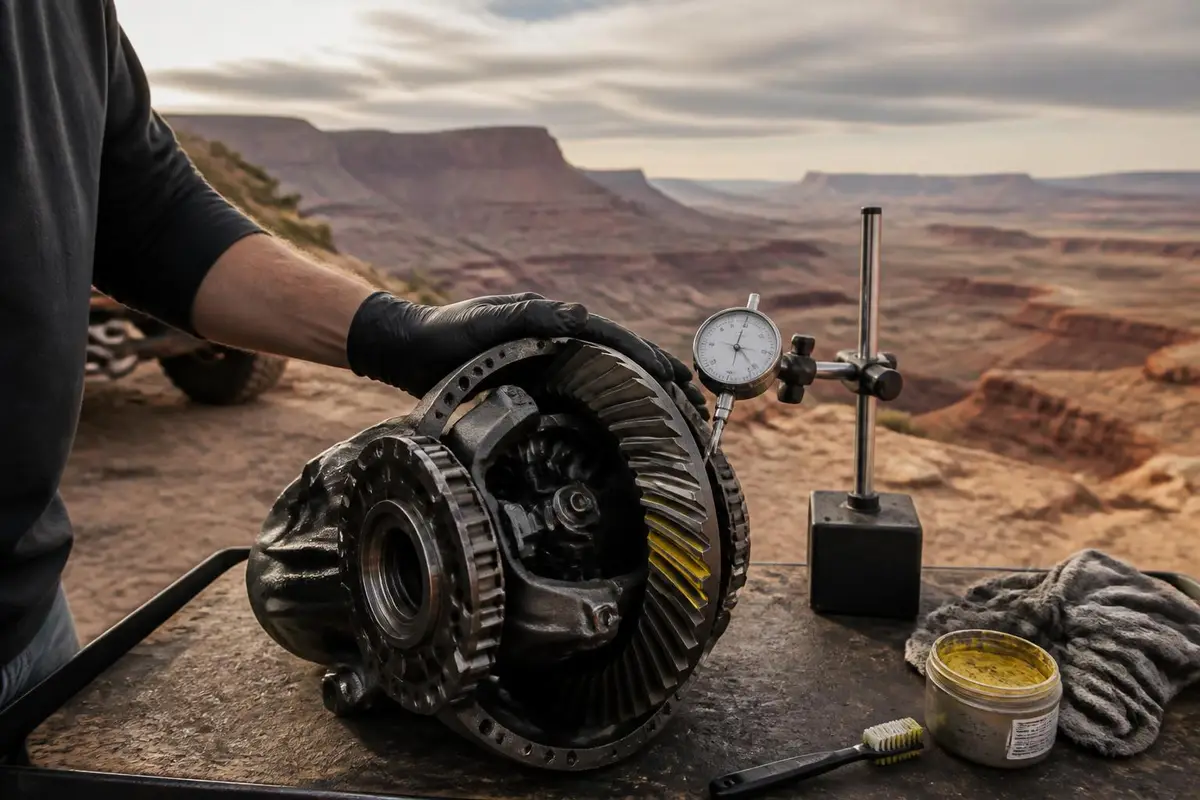
Setting up a ring and pinion means getting pinion depth, carrier bearing preload and backlash right, and confirming the gear contact pattern with marking compound. It needs measuring tools and experience that most home garages lack, so most owners pay an axle shop. See off-road maintenance and DIY for how this job compares with driveway-level maintenance.
Break-In After a Regear
New gears need controlled heat cycles to season their contact surfaces. Yukon Gear & Axle's procedure:
- Drive about 20 minutes at 15–20 mph, let the differential cool for about half an hour, and repeat.
- Then drive about 15 miles at 45–50 mph and cool for about 20 minutes, repeating for about 45 miles.
- Run 80W-90 conventional oil for the first 500 miles, then drain and refill.
- Repeat the same break-in the first time you tow, haul or drive off-road, even if the gears are already broken in unloaded.
Yukon warns that long-distance hauling on new gears generates heat without cooling, breaking down the oil and damaging the gear surfaces, and that skipping break-in can mean a complete redo. For fluid intervals afterward, see fluid change intervals for off-road driving.
Speedometer Check After the Job
Larger tires make an uncorrected speedometer read low. On the Wrangler example above, an indicated 60 mph on the 35-inch tires is actually 60 × 637 ÷ 604 ≈ 63.3 mph. A regear doesn't change that, because the speedometer counts output-shaft or wheel rotations, and the tire still travels farther per turn. Recalibrate for the new tire size, then compare the speedometer against GPS at a steady speed to confirm the calibration and the ratio are what you ordered.
Sources
- Interco Tire — Tire Size Change Gear Ratio Calculator — The same three inputs (new tire diameter, old tire diameter, current ratio) used to calculate a replacement gear ratio.
- Yukon Gear & Axle — How to Use an RPM Calculator to Find the Right Gear Ratio — Tire height and axle ratio together set engine rpm; tire sizes are classifications, so check the maker's measured figures.
- Yukon Gear & Axle — Breaking In Your Ring and Pinion — Break-in drive cycles and cool-downs, 80W-90 conventional oil changed at 500 miles, repeating break-in when first towing, and heat damage from skipping it.
- Stellantis Media — 2026 Jeep Wrangler Specifications — Axle ratios (3.45, 4.10, 4.56, 4.88), 8-speed gear ratios (4.71 first, 0.67 eighth), 4.0:1 Rock-Trac low range, and tire revolutions per mile used in the worked examples.
- Jeep — 4x4 FAQ & Glossary — Part-time 4WD locks the front and rear axles to turn at the same speed; binding leads to early part failure; crawl ratio definition.
- Spicer (Dana) — Transmission Ratio RPM Calculator — Engine rpm depends on transmission gear ratio, tire height, road speed and ring-and-pinion ratio.