
Affiliate disclosure: As an Amazon Associate, we earn from qualifying purchases, at no extra cost to you. We research rather than test, and commissions never change our rankings. This site is reader-supported: those commissions pay for hosting, research and keeping every guide up to date, so if a guide helped you, buying through our links is an easy way to support it. How we rank · Full disclosure
Enter your tank size, real-world fuel economy, reserve percentage and a towing/terrain penalty below to see your actual usable range for a remote trip, not just a raw tank-times-MPG number.
How This Is Calculated
Usable fuel (gal) = tank size × (1 − reserve %). Adjusted economy (mpg) = entered economy × (1 − towing/terrain penalty %). Usable range (miles) = usable fuel × adjusted economy.
This is a planning estimate from the figures you enter, not a guarantee — real economy varies with wind, elevation, tire pressure and load beyond what a single penalty percentage can capture. Build in more reserve, not less, for any route with a long or uncertain gap to the next fuel stop.
TL;DR
- Usable range = tank × (1 − reserve) × mpg × (1 − penalty); the default figures give about 300 miles from a 26-gallon tank.
- Towing a 3,500-lb enclosed trailer cost an SUV 30–50% of its fuel economy in ORNL testing, the biggest single penalty.
- The longest fuel gap on our routes is the Dalton Highway's roughly 239 miles, Coldfoot to Deadhorse (BLM).
- The BDR routes' longest fuel gaps run about 113–131 miles, shorter than their longest sections.
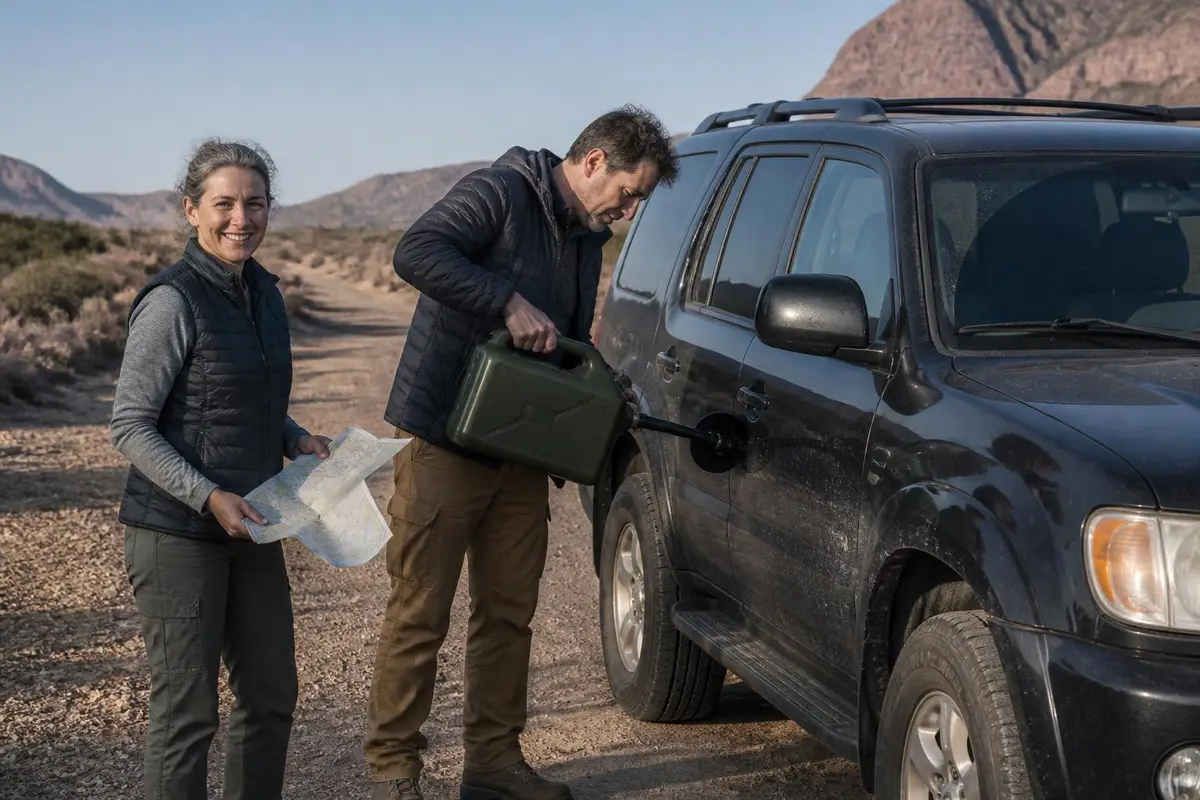
- Fill gas cans on the ground, never in a truck bed, and only about 95% full (NPS).
Worked Example: Does a Full Tank Cover the Dalton Highway?
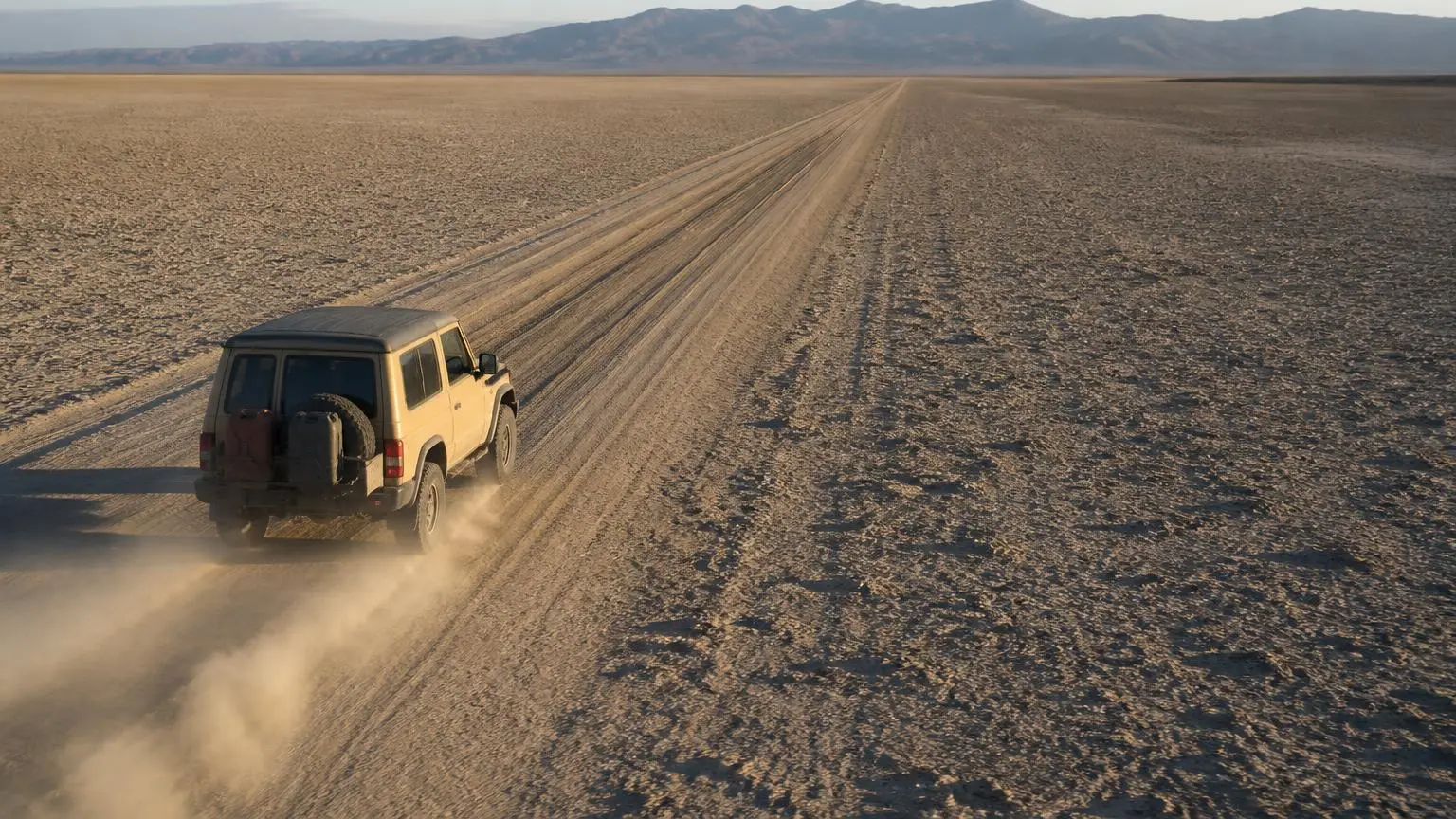
Take the calculator's default figures: a 26-gallon tank, 18 mpg observed on the highway, a 20 percent reserve and a 20 percent penalty for trail driving. Usable fuel is 26 × 0.8 = 20.8 gallons. Adjusted economy is 18 × 0.8 = 14.4 mpg. Usable range is 20.8 × 14.4 ≈ 300 miles, enough for the Dalton's 239-mile Coldfoot-to-Deadhorse gap with the reserve untouched. Now hitch up a large trailer: at a 50 percent penalty, the top of the range ORNL measured towing at 80 mph, economy drops to 9 mpg and usable range to about 187 miles. That falls short of the same gap, and the only fixes are carried fuel, a bigger tank or a smaller reserve you'd rather not cut.
Longest Fuel Gaps on Our Route Guides
These are the longest gaps between fuel stops that each route's managing agency or route publisher reports. A route section is not the same as a fuel gap: the Idaho BDR's longest section runs 205 miles, but fuel is available partway along it.
| Route | Longest gap between fuel | Distance |
|---|---|---|
| Dalton Highway, Alaska | Coldfoot (MP 175) to Deadhorse (MP 414) | ≈239 miles |
| Idaho BDR | Burgdorf Hot Springs to Elk City | ≈131 miles |
| Washington BDR | Packwood to Ellensburg (unless you fuel at Nile on Hwy 410) | ≈122 miles |
| Montana BDR | Thompson Falls to Libby (all of Section 7) | ≈113 miles |
BDR publishes these figures for adventure motorcycles on the route itself; a detour to a campsite or trailhead adds to them. See each route's guide, linked in the table and at multi-day routes, for section-by-section mileage.
What Cuts Real-World Range
The EPA figure on a window sticker is measured on a standard test cycle, not on a loaded truck on dirt. Fueleconomy.gov lists the factors that pull real mileage below it, and ORNL's measurements for the site put numbers on several:
| Factor | Effect on fuel economy |
|---|---|
| Towing a 3,500 lb enclosed cargo trailer (SUV) | 30% worse in city driving, up to 50% worse at 80 mph (ORNL) |
| Large roof-top cargo box | 2–8% city, 6–17% highway, 10–25% at 65–75 mph |
| Rear-mount cargo box or tray | 1–2% city, 1–5% highway |
| Extra weight | About 1% per extra 100 lb |
| Cold weather, 20°F vs 77°F (gasoline vehicle) | About 15% worse in city driving, up to 24% on short trips |
| Under-inflated tires | About 0.2% per 1 psi drop in average pressure |
| Aggressive driving | 15–30% worse at highway speeds |
| Idling (camp, recovery, winching) | A quarter to a half gallon per hour |
Fueleconomy.gov adds that unpaved and hilly roads and engaging four-wheel drive also lower economy, without a single figure, because terrain varies too much. The penalties compound: a roof box and a trailer on a cold morning stack on top of each other. That is why the calculator applies the penalty to every gallon, not as a fixed number of miles off the total.
Why a Bigger Reserve Beats a Bigger Tank on an Unfamiliar Route
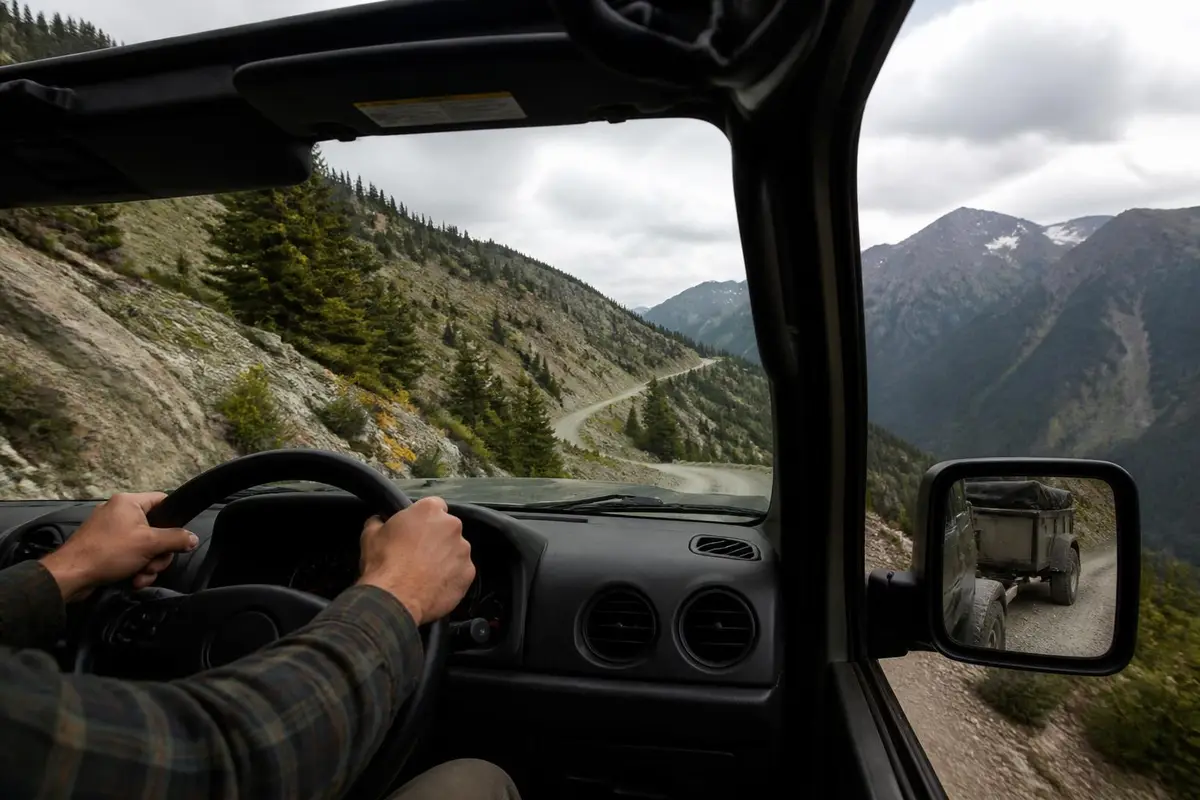
A long-range tank adds capacity, but it doesn't remove uncertainty about the miles. Wrong turns, washed-out detours, a closed station and slow technical driving all add miles or burn more fuel than planned. A reserve percentage covers them whatever the tank size. Keep the reserve larger on routes with one fuel stop and poor cell coverage than on routes with fuel every few dozen miles.
Bigger Tires Change the Numbers Too
A larger tire turns fewer times per mile, so an uncorrected speedometer and odometer under-read. Jeep's 2026 Wrangler spec sheet lists 637 revolutions per mile for the LT285/70R17 tire and 604 for the LT315/70R17. Fit the bigger tire without recalibrating, and the odometer under-reads distance by about 5 percent (604 ÷ 637). Fuel economy worked out from the trip meter then reads low by the same amount, and your actual miles between fuel stops are higher than the dash shows. Recalibrate after a tire change, or log fuel economy against GPS distance. The regear calculator covers the gearing side of a tire-size change.
Sources
- Bureau of Land Management — Dalton Highway Visitor Guide — Fuel at Coldfoot (milepost 175) and Deadhorse (milepost 414), the source of the roughly 239-mile gap.
- Bureau of Land Management — Dalton Highway — The highway's 414-mile length from Livengood to Deadhorse and its limited services.
- Backcountry Discovery Routes — Idaho BDR (IDBDR) — Longest gap between gas stations about 131 miles, Burgdorf Hot Springs to Elk City; Section 4 is 205 miles.
- Backcountry Discovery Routes — Washington BDR (WABDR) — Longest gap between gas stations about 122 miles, Packwood to Ellensburg, unless fueling at Nile on Hwy 410.
- Backcountry Discovery Routes — Montana BDR (MTBDR) — Longest distance between fuel about 113 miles, all of Section 7 from Thompson Falls to Libby; advice to top off and carry extra fuel.
- Oak Ridge National Laboratory — ORNL study pegs fuel economy costs of common practices — Towing a 3,500-lb enclosed cargo trailer cost an SUV 30% (city) to 50% (80 mph) in fuel economy.
- FuelEconomy.gov (U.S. DOE/EPA) — Driving More Efficiently — Roof-box and rear-box penalties, about 1% per extra 100 lb, aggressive driving 15–30% at highway speeds, idling a quarter to a half gallon per hour.
- FuelEconomy.gov — Fuel Economy in Cold Weather — Gasoline-vehicle city economy about 15% lower at 20°F than 77°F, up to 24% on short trips.
- FuelEconomy.gov — Keeping Your Vehicle in Shape — About 0.2% lower mileage for every 1 psi drop in average tire pressure.
- FuelEconomy.gov — Factors That Affect Fuel Economy — Unpaved and hilly roads, engaging 4WD, towing and roof cargo all reduce fuel economy.
- National Park Service — Fire Prevention 52: Gas Cans — Approved labeled cans, fill on the ground never in a vehicle or truck bed, fill about 95% full, secure the can, keep it out of the passenger compartment.
- Stellantis Media — 2026 Jeep Wrangler Specifications — Revolutions per mile for the LT285/70R17 (637) and LT315/70R17 (604) tires used in the odometer example.