
Affiliate disclosure: As an Amazon Associate, we earn from qualifying purchases, at no extra cost to you. We research rather than test, and commissions never change our rankings. This site is reader-supported: those commissions pay for hosting, research and keeping every guide up to date, so if a guide helped you, buying through our links is an easy way to support it. How we rank · Full disclosure
TL;DR
- SAE chain classes (S, U, W) are set by wheel-well clearance, not tire size — check the chain maker's fitment chart for the vehicle, not just the tire.
- A vehicle battery loses roughly 60% of its rated cranking power at 0°F versus 80°F, per AAA testing — a marginal battery that starts fine in summer often fails outright in a hard freeze.
- A block heater warms coolant, not the battery; NRCan's own guidance says two hours on a timer is usually enough before a cold-weather drive.
- Diesel fuel thickens toward its cloud point as temperature drops; winter-blend diesel and an anti-gel additive both lower that cloud point.
- Chain-control levels are route- and storm-specific, not year-round — check the state DOT page for the exact route before a trip.
- Neither 4WD nor AWD improves braking or cornering grip on snow or ice — both only help acceleration traction.
At a Glance
| Traction aid | Best for | What it costs you |
|---|---|---|
| Fabric snow sock | Occasional storm; fastest hand-fit, no tool needed | Least bite in deep or icy conditions; wears fast on bare pavement |
| Cable-style chain | Regular winter driving on mixed snow/cleared roads | Less deep-snow bite than a ladder-style link chain |
| Ladder-style link chain | Sustained deep, packed snow on mountain passes | Heaviest, slowest to install, roughest on bare pavement |
| Dedicated winter tire | A full snow season of daily driving | Highest upfront cost; needs a second tire set and storage |
Snow Chains, Traction and Chain Laws: Class, Clearance and Legal Use
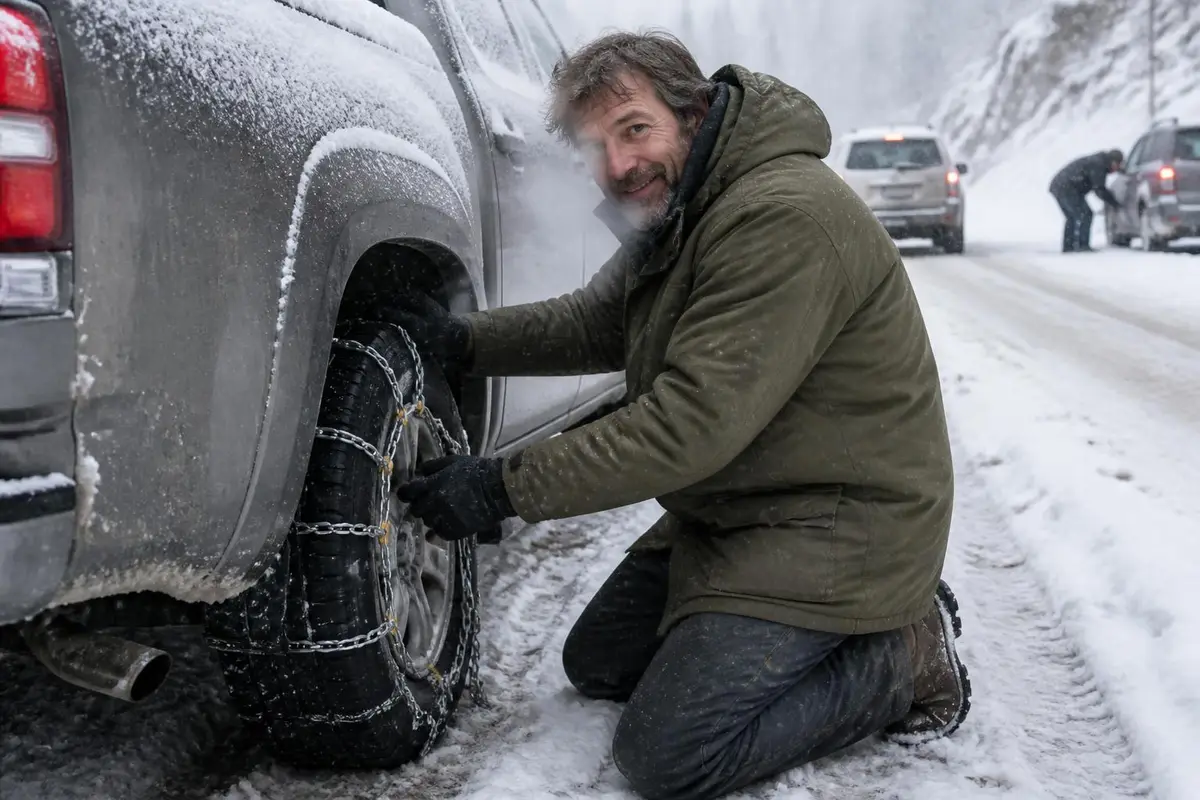
SAE chain classes are lettered — Class S, U or W — and defined by the clearance a chain needs inside the wheel well, not by tire size directly. The actual numbers: Class S needs 1.46 inches of tread-face clearance and 0.59 inches at the sidewall (restricted-clearance vehicles); Class U needs 1.97 inches / 0.91 inches (standard passenger vehicles); Class W — the class most light-truck chains use — needs 2.50 inches / 1.50 inches. A given tire size can still need a different class depending on how much room a specific truck's suspension and wheel-well leave at full lock, so fitting the wrong class either fails to seat correctly or rubs against suspension components at full steering lock. Cable-style chains are lighter, quicker to install and gentler on paved sections; traditional link chains bite deeper into packed snow and ice but ride rougher and wear faster on bare pavement.
Chain-control requirements are state- and route-specific, tied to posted winter-storm severity rather than a blanket rule. Caltrans uses three escalating levels on California mountain routes: R1 (chains required except for passenger vehicles/light trucks under 6,000 lb GVWR running snow tires on both drive wheels), R2 (chains or traction devices required except for 4WD/AWD vehicles with snow-tread tires on all four wheels), and R3 (chains or traction devices required on every vehicle, no exceptions — Caltrans notes highways typically close before conditions reach this level). Colorado runs a similar two-tier system: its Traction Law accepts AWD/4WD with mud-and-snow or winter tires at 3/16-inch tread, all-weather tires at that same depth, or chains/an approved alternative traction device; its stricter Passenger Vehicle Chain Law — the final tier before road closure — requires chains or an approved alternative traction device on every vehicle regardless of drivetrain, with fines of $100 plus a $33 surcharge (or $500 plus $157 if non-compliance causes a road closure).
Dedicated Winter Tires vs Chained All-Terrains: M+S vs 3PMSF
A dedicated winter tire's softer rubber compound stays pliable well below freezing, and its denser siping pattern is cut specifically for snow and ice grip; a general all-terrain tire's compound is tuned for a broader range of conditions and stiffens more in deep cold, even on a 3PMSF-rated all-terrain. The two sidewall marks aren't equivalent: FMVSS 139 (the federal tire safety standard) sets a specific, tested traction-index requirement a tire must pass on medium-packed snow, using the ASTM F1805 test method, before it may carry the three-peak-mountain-snowflake (3PMSF) symbol. The plain M+S ("mud and snow") mark that appears on most all-terrain and all-season tires carries no equivalent federally tested traction requirement in that standard — it is a much older, tread-pattern-based designation. That's the real-world reason a dedicated winter tire, and even a 3PMSF-rated all-terrain, can still behave differently on ice than a plain M+S tire despite both wearing a snow-related mark. Chains still out-perform any tire, winter or otherwise, in deep unpacked snow where mechanical bite matters more than compound softness. A daily winter-season driver avoids chains' roadside install and removal by running dedicated winter tires instead; a driver who only occasionally crosses a chain-controlled pass gets more value from carrying chains than from buying and storing a second tire set. See all-terrain and mud tires for how siping pattern affects snow performance on a tire not specifically rated for winter.
Cold Starts: Battery Capacity, Cold-Cranking Amps and Block Heaters
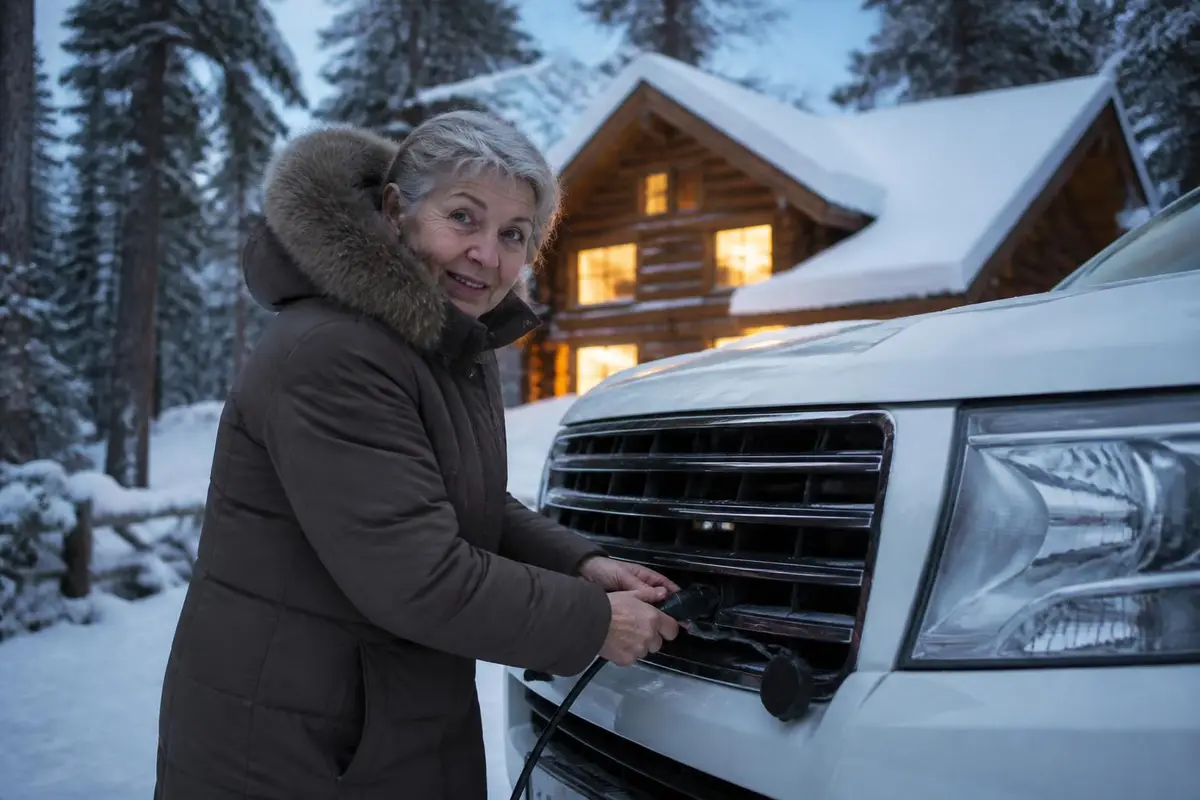
A vehicle battery loses a substantial share of its cranking amps as temperature drops. AAA testing puts a battery at roughly 60 percent capacity loss at 0°F versus its rating at 80°F — meaning only around 40 percent of rated capacity remains — which is why a marginal battery that starts fine in summer often fails outright in a hard freeze. A block heater (see FAQ) warms the coolant, easing the engine side of a cold start; a battery rated for cold-cranking amps (CCA) appropriate to the local climate, not just the vehicle's minimum factory spec, addresses the electrical side separately. The two problems are independent — a fully charged battery still loses the same percentage of cranking power in the cold, so climate-appropriate CCA headroom matters even with a heater installed.
Locking Hubs and 4WD Engagement in Snow
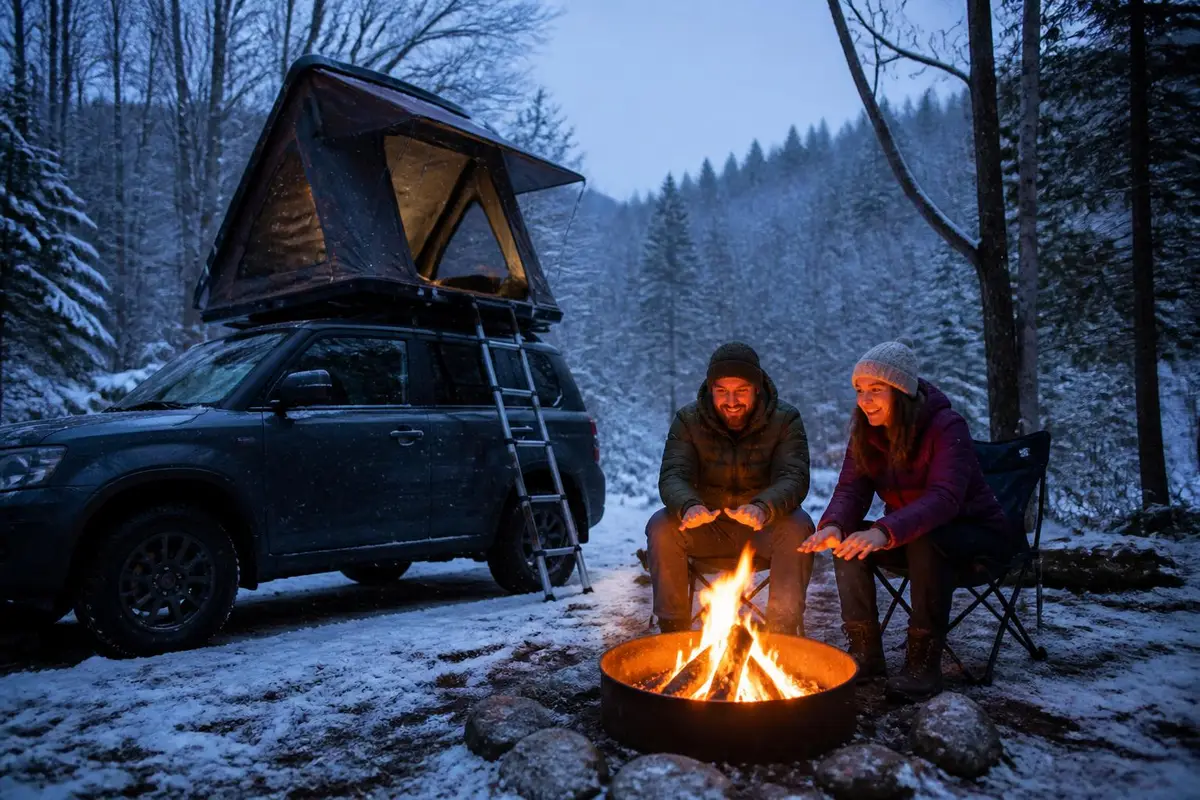
Manual locking hubs, found on some older or heavy-duty platforms, must be physically engaged before 4WD delivers power to the front wheels — shifting the transfer case into 4WD without locking the hubs first leaves the dash showing 4WD engaged while the front wheels turn freely. Automatic locking hubs and full-time 4WD systems avoid that specific failure mode by engaging on their own, at some cost to the fuel-economy benefit manual hubs offer when disengaged for highway driving. Checking which hub type a specific truck uses, rather than assuming every 4WD truck engages the same way, avoids a confusing "4WD isn't working" moment on the first icy morning of the season.
Cold-Weather Washer Fluid and Wiper Care
Summer-blend washer fluid freezes solid at freezing temperatures, and a frozen washer line or reservoir leaves a windshield unable to be cleared of road salt and slush spray at the worst possible time. NHTSA's winter-driving guidance recommends filling the reservoir with a winter-rated, lower-freezing-point fluid that includes de-icer before the first hard freeze, not after a line already needs thawing, and replacing worn wiper blades with winter-specific ones that shed ice buildup better than a standard blade.
Diesel Gelling and Winter Blend Diesel Fuel
Diesel gelling (see FAQ) is a diesel-specific cold-weather problem gasoline engines don't share. Winter-blend diesel and an anti-gel fuel additive both lower the fuel's effective cloud point — the temperature at which paraffin wax begins crystallizing out of the fuel — and a block heater or fuel-tank heater addresses the separate problem of warming the engine and fuel themselves. Confirming winter-blend diesel is actually available at the pump locally, rather than assuming it is stocked everywhere, matters most for anyone driving a diesel truck from a warmer region into a sudden cold snap.
Cold-Weather Recovery: What Changes Below Freezing
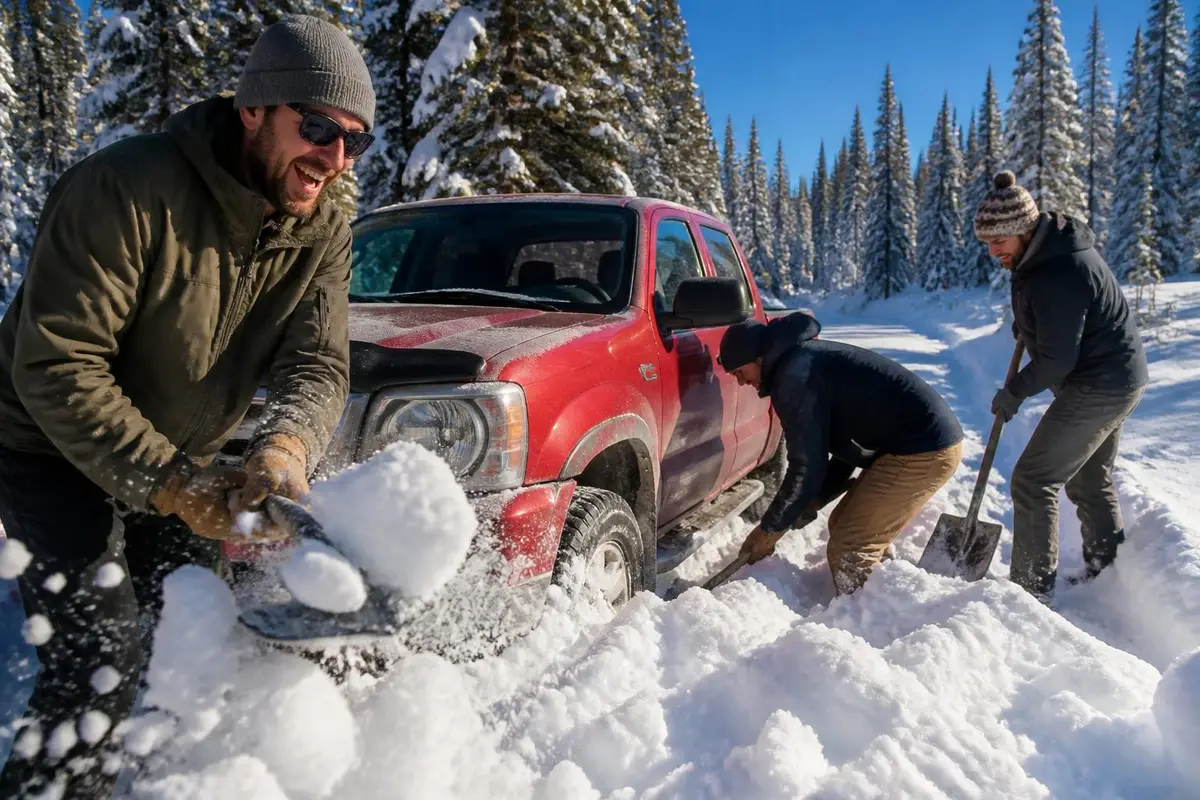
Synthetic winch rope and kinetic recovery ropes both stiffen in extreme cold, which reduces flexibility and raises the chance of a frozen rope's outer sheath cracking if it's coiled too tightly. A winch's hydraulic and electrical components draw more current to overcome cold-thickened grease, so sizing a winch with margin above the vehicle's GVWR (see recovery gear) matters even more in winter use. Traction boards remain effective in snow, though wet, heavy snow packs a board's teeth faster than dry sand does, reducing bite until the teeth are cleared — see traction boards for snow for placement technique.
Reading a Storm Forecast: NWS Watch, Warning and Advisory
The National Weather Service issues three escalating winter-weather products, and knowing the difference decides how much lead time you actually have to prep. A Winter Storm Watch means conditions are favorable for a significant event and is issued with the most lead time; a Winter Storm Warning is issued for a significant event already expected — snow, ice, sleet or blowing snow, alone or combined; a Winter Weather Advisory covers the same hazards when they're expected but shouldn't be severe enough to meet warning criteria. NWS issues separate Wind Chill Watch/Warning/Advisory products for dangerously cold air combined with wind, independent of snowfall. A Watch is the point to check chains, batteries and washer fluid are actually ready — not the night the storm arrives.
Buying Guide: How to Choose, Based on Owner Reviews — Not a Ranked List
This hub isn't a ranked list — it's a buying guide built from owner reviews across cold climates, not brand name. Chain laws determine what's legal before traction preference matters at all, so check the route's specific chain-control level first. A battery's cold-cranking amps drop with the same capacity loss curve regardless of a truck's age or price point, and diesel owners should confirm winter-blend diesel availability locally before the first hard freeze, not after.
How We Rank Winter & Snow 4WD Gear
Every product on this hub is weighed against its manufacturer-rated class, compound rating or cold-cranking-amp figure, cross-referenced with a wide base of verified owner reviews from cold-climate drivers. We do not buy, install or physically drive winter gear ourselves — see how we rank for the full method and affiliate disclosure for how the site is funded.
Sources
- Consumer Reports — Do You Really Need AWD in the Snow? — All-wheel drive improves acceleration traction but not braking or cornering grip; winter tires matter more on snow and ice.
- Caltrans — Chain Controls / Chain Installation — California's R1/R2/R3 chain-control level definitions (which vehicles are exempt at each level) and route-specific activation.
- Colorado DOT — Passenger Vehicle Traction and Chain Laws — Colorado's two-tier Traction Law (M+S/winter/all-weather tires at 3/16in tread, or chains/ATD) and stricter Passenger Vehicle Chain Law (chains/ATD on every vehicle, no exceptions); fine amounts.
- SAE J683 (via Laclede Chain — SAE Classifications) — Exact SAE chain-class clearance figures: Class S (1.46in tread-face/0.59in sidewall), Class U (1.97in/0.91in), Class W (2.50in/1.50in).
- Natural Resources Canada — Block Heaters Save Fuel and Help the Environment (archived; current oee.nrcan.gc.ca URL is dead) — A block heater warms coolant, which warms the engine block and lubricants, easing cold-weather starts; a timer set two hours before departure is usually enough.
- Cenex — Avoid Cold-Weather Diesel Problems — Diesel cloud point, paraffin-wax crystallization plugging filters, and winter-grade blends that lower cloud point.
- NHTSA — Winter Weather Driving Tips — Battery power drops as temperature drops; recommendation to use winter washer fluid with de-icer and replace worn wiper blades.
- AAA Oregon — Temperatures Are Dropping & So Is Your Car's Battery Power — At 0°F a car battery loses about 60% of its rated cranking power versus its rating at 80°F.
- Cornell LII — 49 CFR 571.139 (FMVSS 139) — FMVSS 139 defines and requires a tested ASTM F1805-20 snow-traction index before a tire may carry the three-peak-mountain-snowflake (3PMSF) symbol — the regulatory basis for the M+S-vs-3PMSF distinction (plain M+S carries no equivalent tested requirement in this standard).
- National Weather Service — Winter Weather Watches, Warnings and Advisories — Definitions of Winter Storm Watch, Winter Storm Warning, Winter Weather Advisory, Wind Chill Warning and Wind Chill Advisory.