

Affiliate disclosure: As an Amazon Associate, we earn from qualifying purchases, at no extra cost to you. We research rather than test, and commissions never change our rankings. This site is reader-supported: those commissions pay for hosting, research and keeping every guide up to date, so if a guide helped you, buying through our links is an easy way to support it. How we rank · Full disclosure
TL;DR
- Sand rewards the lowest tire pressures used off-road — commonly 12-18 PSI — for the biggest possible contact patch and flotation.
- BFGoodrich's own floor is 20 PSI on a standard wheel, and only under about 15 mph — pressures below that are realistically a beadlock-wheel range.
- Momentum, not raw speed, keeps a vehicle moving across sand; stopping mid-dune or mid-soft-patch causes most sand stucks.
- Major dune areas like BLM's Imperial Sand Dunes require an 8-foot whip flag with a 6×12 in. flag on every vehicle for blind-crest visibility.
- Scout a dune's crest before a first attempt — a soft or overhung crest can drop away unpredictably on the far side.
Airing Down for Flotation
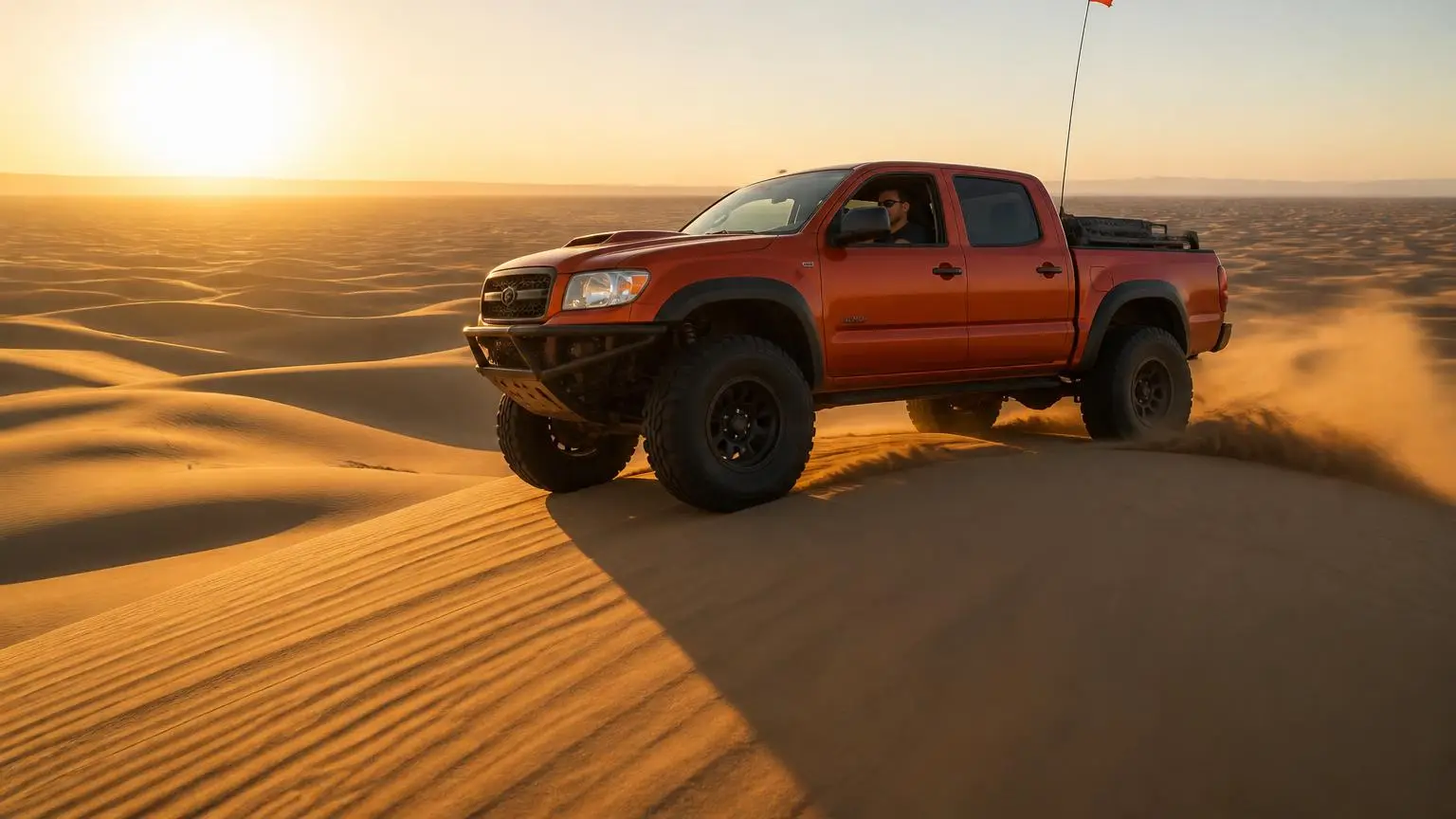
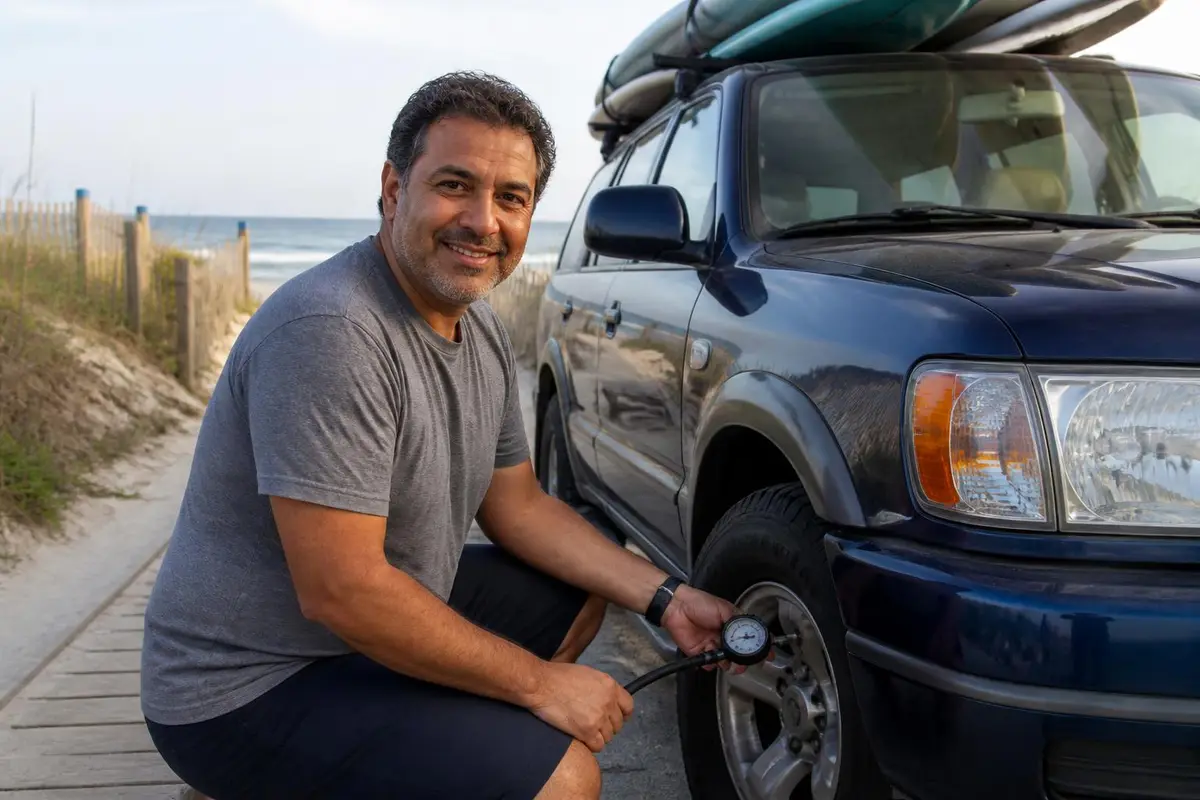
Lower tire pressure increases the tire's contact patch, spreading the vehicle's weight over more surface area so the tire floats across soft sand instead of digging straight in. Sand generally calls for the lowest pressures used off-road — commonly 12 to 18 PSI depending on tire size and vehicle weight — since flotation matters more here than sidewall protection does on a soft, yielding surface. That range runs below the roughly 20 PSI floor BFGoodrich recommends for a standard wheel, so pressures this low are realistically a beadlock-wheel range, and speed should stay low (BFGoodrich's own guidance is around 15 mph / 25 km/h or under) whenever aired down this far. See the airing-down guide for the full pressure-by-terrain breakdown and how to air back up safely before returning to pavement.
Momentum Over Raw Speed
Steady, controlled momentum is what actually keeps a vehicle moving across sand — once forward progress stalls, the tires stop rolling across the surface and start digging instead. This is different from simply driving fast: the goal is maintaining consistent speed matched to what can actually be seen ahead, not maximum throttle. Owners with extensive sand experience consistently report that a vehicle bogging down mid-dune traces back to losing momentum before the stuck happened, not to insufficient horsepower.
Dune Bashing: A Faster, More Committed Style
Dune bashing describes a more aggressive style of sand driving specifically for climbing and descending steep dune faces, common in large desert dune fields. It demands more speed and commitment than flat-sand driving to carry momentum up a steep face, along with a clear read of the dune's actual shape before committing, since a soft or overhung crest can drop away unpredictably on the far side. Owners who dune bash regularly report scouting a dune's crest on foot or from a known vantage point before a first attempt as the single habit that most reliably prevents a bad surprise at the top.

Reading the Surface Ahead
Firm, damp sand near a shoreline or a recent rain generally offers meaningfully more grip than dry, loose sand further inland, and the transition between the two isn't always visually obvious from inside the vehicle. Ripple patterns, vegetation and color changes are the visual cues experienced sand drivers report watching for to anticipate a softer patch before committing speed to it. Avoiding a sudden direction change on a soft patch — which can dig a tire in the way stopping does — matters as much as watching the surface itself.
Gear Selection and Wheel Spin
A slight amount of wheel spin is normal and often helpful in sand, unlike on rock or dirt, since it helps the tire dig to a firmer layer beneath a soft top surface. A taller gear than the lowest available, within 4-low or 4-high depending on speed, often delivers smoother, more consistent wheel speed than the most aggressive torque delivery, which can dig a tire in rather than translating power into forward motion. See 4 high vs 4 low for the full range breakdown. Matching gear to maintaining smooth momentum, rather than maximum torque at every moment, is a technique experienced sand drivers report refining over repeated trips.
A Guide to Sand Driving, Step by Step: Tire Pressure Tips
Sand driving, step by step: check tire pressure and air down first, scout the route ahead for soft patches, then commit to steady momentum without stopping. Quick tips beyond airing down: keep the wheel straight through a soft patch rather than overcorrecting, and know the return route back to firm ground before committing to a dune line.
Common Mistakes That Cause a Sand Stuck
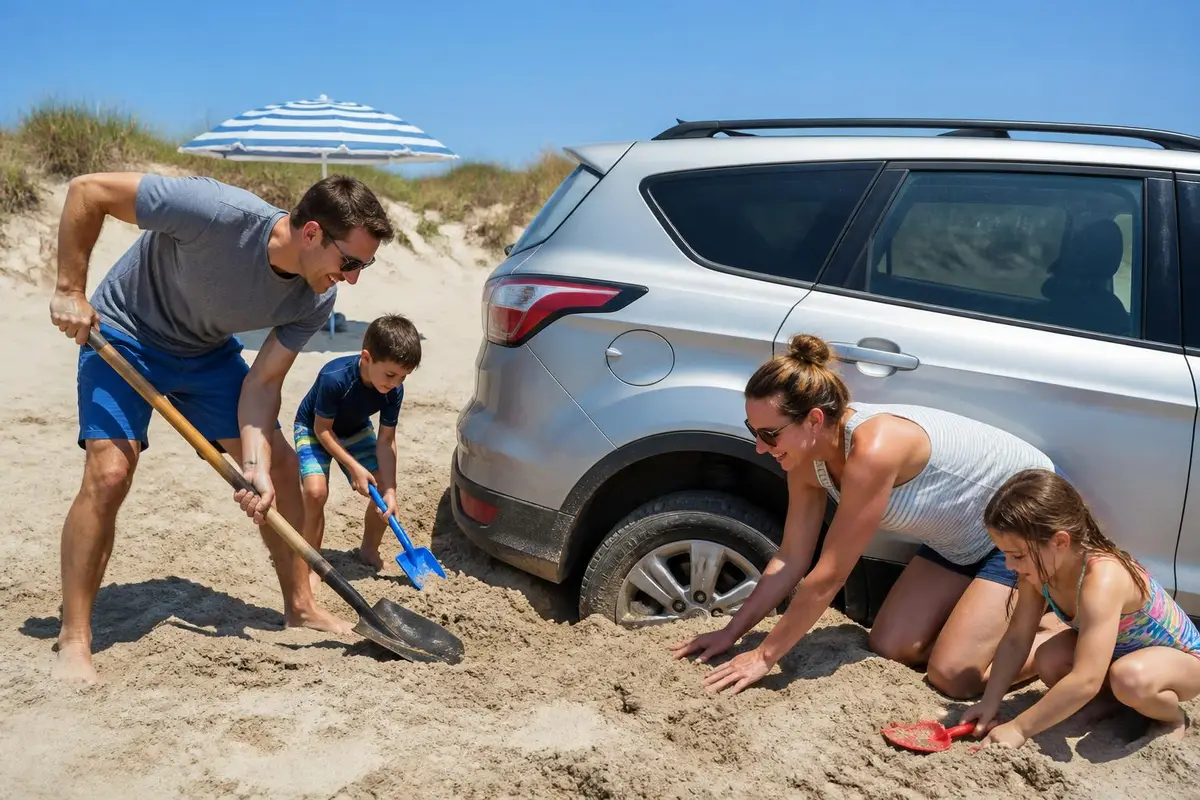
Stopping mid-dune or mid-soft-patch, then trying to restart from a dead stop, is the most frequently reported cause of a sand stuck — the momentum that was keeping the vehicle afloat is gone, and restarting on loose sand demands more traction than the surface usually provides. Running street pressure instead of airing down is a close second, since a smaller contact patch digs in rather than floating. Already stuck? See how to get unstuck in sand for the step-by-step recovery process.
Whip Flags: A Blind-Crest Safety Rule, Not a Suggestion
On large dune systems, a vehicle cresting a dune has no way to see another vehicle climbing the blind side until the two are already on top of each other — which is why major dune riding areas require a tall safety whip flag on every vehicle. At BLM's Imperial Sand Dunes Recreation Area in California, the rule is specific: a whip mast extending 8 feet from the ground with a 6-by-12-inch red or orange flag mounted within 10 inches of the tip, required on every vehicle including motorcycles. Rules and exact flag specs vary by dune area, but the underlying hazard — a blind crest with another vehicle already committed to the other side — is universal to dune driving, which is why scouting a dune's crest before a first attempt (see FAQ) matters as much as the flag itself.
Recommended gear
Gear for sand and beach driving
Affiliate disclosure: As an Amazon Associate, we earn from qualifying purchases, at no extra cost to you. Purchases through these links help keep this site running and up to date. Learn more

Best for airing all four tires down to a set pressure at once.
- Automatic deflators preset between 6 and 30 PSI.
- Air all four tires down at once, then stop at the set pressure.

Best for getting unstuck from sand, mud or snow without another vehicle.
- Nylon recovery boards that give spinning tires grip in sand, mud or snow.
- Double as a shovel to clear sand from in front of the tires.

Best for airing back up before you hit pavement.
- Portable 12V compressor rated to 150 PSI.
- Sized for truck and SUV tires.

Best for plugging a tread puncture on the trail.
- Reamer-and-plugger kit for tread punctures.
- Lets you plug a tire on the trail instead of changing it.
We research products from manufacturer specs and owner feedback; we don't test them ourselves. How we choose.
Sources
- BFGoodrich — Tire FAQ — 20 PSI floor on a standard wheel and the roughly 15 mph speed ceiling for lower pressures, cited for sand-specific airing down.
- BLM — Imperial Sand Dunes Recreation Area: Rules and Regulations — Whip-flag requirement for dune riding: an 8-foot mast with a 6×12 in. red/orange flag on every vehicle, including motorcycles.
- eCFR — 36 CFR §261.13, Motor vehicle use — Off-route travel on federal land under a Motor Vehicle Use Map is prohibited, relevant to staying on a marked dune route.
- Tread Lightly! — T.R.E.A.D. Principles — Travel responsibly and stay on designated routes/areas, the general land-ethic backdrop for dune driving.
- NHTSA — Tire Safety (TireWise) — General underinflation risk context for pressures run well below highway spec.