
Affiliate disclosure: As an Amazon Associate, we earn from qualifying purchases, at no extra cost to you. We research rather than test, and commissions never change our rankings. This site is reader-supported: those commissions pay for hosting, research and keeping every guide up to date, so if a guide helped you, buying through our links is an easy way to support it. How we rank · Full disclosure
TL;DR
- Lumens tell you how much light a lamp makes, not how far it reaches — for reach, compare candela or lux at a stated distance.
- Match reach to your speed: at 40 mph you need about 300 feet to stop (FHWA's formula), so fast gravel and desert driving needs a spot or combo bar.
- Slow rock crawling needs width, not distance: flood lights plus rock lights around the wheels.
- Low-mounted lights need at least IP67 waterproofing; IP68 or IP69K is better for rock lights.
- Watts ÷ 12 ≈ amps: a 120 W bar draws about 10 A, so it needs its own fuse and relay.
- Most off-road lights are for off-highway use — federal rule FMVSS 108 and state codes limit extra lamps on public roads.
At a Glance
| If you mostly… | The light to add | What to look for |
|---|---|---|
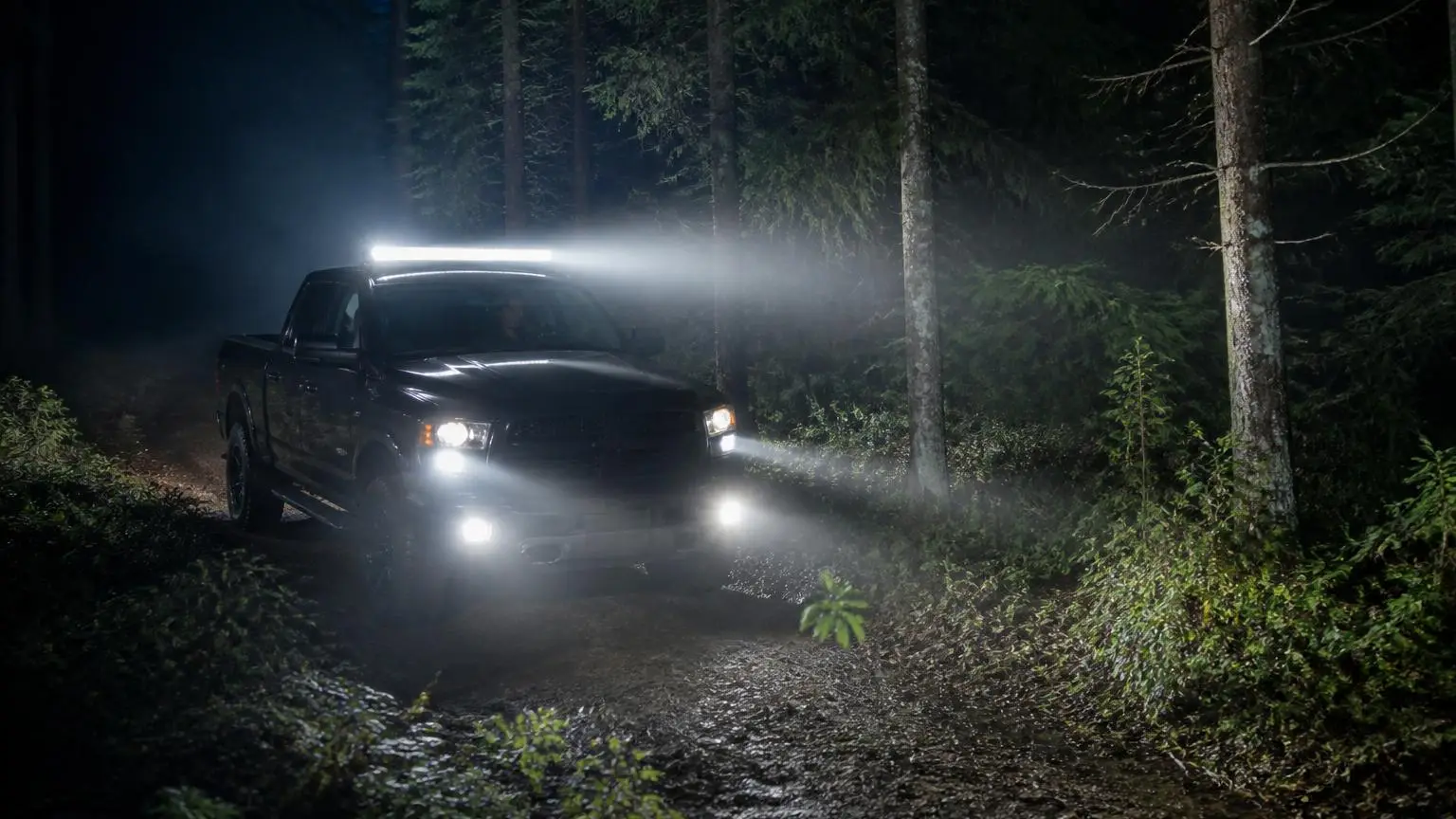
| Drive fast on gravel or desert roads at night | A spot or combo light bar | A narrow beam and a high candela number — it throws light farther |
| Crawl slowly over rocks | Rock lights under the truck, plus flood lights | Wide beams and a waterproof rating of IP68 or IP69K |
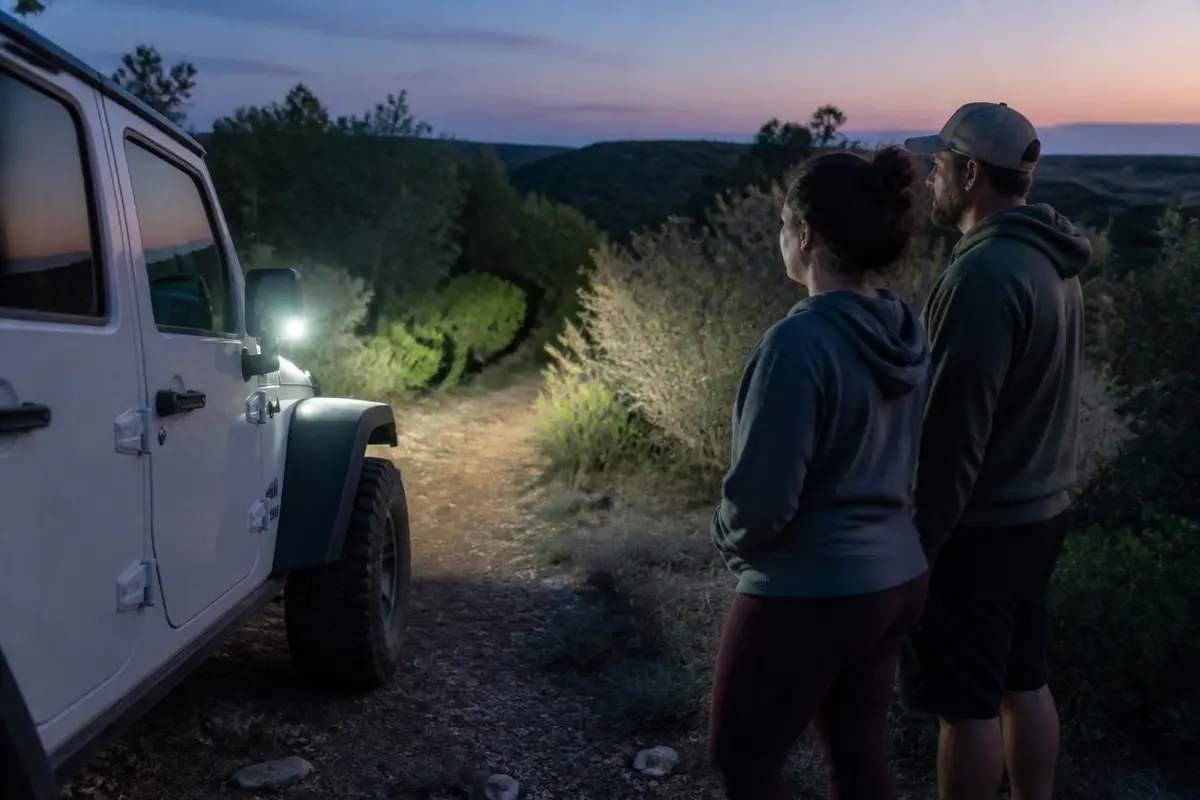
| Drive twisty trails where the edges are dark | Ditch lights at the front corners | A wide beam aimed outward, not forward |
| Set up camp or work around the truck | Flood or scene lights | A very wide beam (about 115° or more) |
| Drive in dust, fog or snow | Amber pods alongside white lights | Amber or selective-yellow output — less glare off dust and snow |
| On the box | What it means in plain words |
|---|---|
| Lumens | How much light the lamp makes in total |
| Candela | How concentrated the beam is — higher means it reaches farther |
| Lux | How bright it is where the light lands (1 lux is about a full moon) |
| IP67 / IP68 / IP69K | How waterproof it is — higher handles deeper water and pressure washing |
| Watts | How much power it uses — divide by 12 to get roughly how many amps it draws |
What Lumens, Lux and Candela Actually Measure
Three different units show up on lighting spec sheets, and they measure different things. A lumen (lm) is luminous flux — the total visible light a lamp puts out in every direction. The U.S. Department of Energy's federal buying guidance puts it plainly: lumens measure the total visible light a source emits, while watts measure power going in. A candela (cd) is luminous intensity in one direction: RIGID Industries describes it as telling you how concentrated the beam is. A lux (lx) is illuminance — how much light lands on a surface. NIST's SI tables tie them together: one lumen is one candela-steradian, and one lux is one lumen per square meter.
For off-road lighting the practical consequence is that two lamps with the same lumen rating can reach very different distances. A narrow spot optic packs its lumens into a small cone, so its intensity in candela — and the light it lands far down the trail — is much higher than a wide flood optic making the same lumens. A lumen figure also doesn't say how it was measured or what the optics lose, so a candela rating, or a lux reading at a stated distance, is the more useful number for comparing reach.
How Much Light Do You Need? Match Reach to Stopping Distance
A light needs to show you an obstacle while there's still room to stop. FHWA's stopping-sight-distance formula — the one behind the AASHTO Green Book design values — adds the distance covered during a 2.5-second perception-reaction time to the braking distance at a deceleration of 11.2 ft/s²: SSD = 1.47 × V × t + 1.075 × V² ÷ a, with V in mph. Worked through at common speeds:
| Speed | Stopping distance (FHWA formula) | Intensity for 1 lux there | Intensity for 5 lux there |
|---|---|---|---|
| 20 mph | ≈ 112 ft (34 m) | ≈ 1,200 cd | ≈ 5,800 cd |
| 30 mph | ≈ 197 ft (60 m) | ≈ 3,600 cd | ≈ 18,000 cd |
| 40 mph | ≈ 301 ft (92 m) | ≈ 8,500 cd | ≈ 42,000 cd |
| 50 mph | ≈ 424 ft (129 m) | ≈ 16,600 cd | ≈ 83,000 cd |
| 60 mph | ≈ 566 ft (173 m) | ≈ 29,900 cd | ≈ 150,000 cd |
The intensity columns come straight from the unit definitions: because a lux is a lumen per square meter, a beam's illuminance on its axis falls with the square of distance, so the candela needed for 1 lux at d meters is d². For scale, IIHS notes that a full moon on a clear night lights the ground to about 1 lux, and its headlight tests measure how far a vehicle's lights reach at least 5 lux. These are on-axis, clear-air figures; dust, rain, snow and a lamp aimed slightly low all cut real reach, so treat the table as a floor, not a target. The takeaway for buyers: a technical rock crawl at walking pace needs width and fill (flood, scene and rock lights), while a fast desert or gravel road needs intensity measured in tens of thousands of candela down the centerline.
Light Bars: Beam Pattern Decides Reach
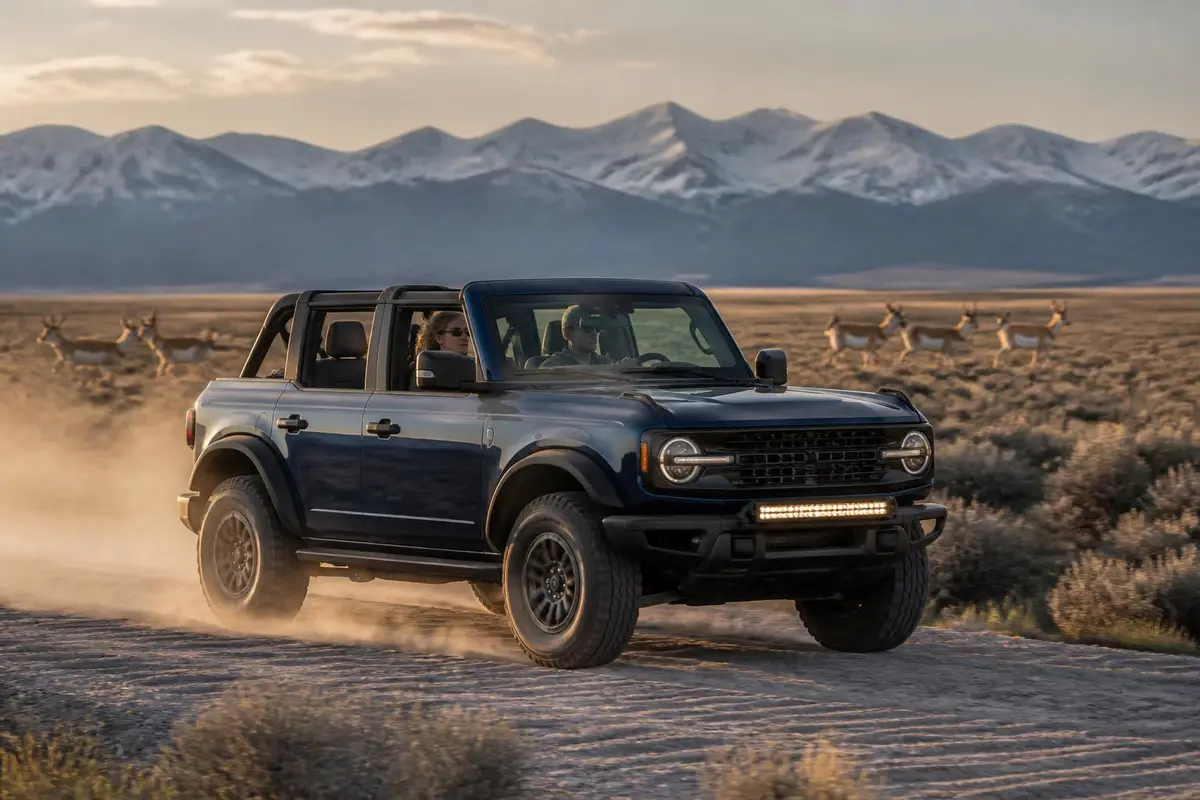
A light bar mounts on the roof, bumper or grille and combines many LEDs behind one or more optic types. RIGID Industries describes the common patterns by beam angle: a hyper-spot under about 5°, a spot at about 10° for long-distance reach, a flood at about 20°, a driving beam at about 45°, and scene or diffused beams at roughly 115–120° or wider for lighting a work area or camp. A combo bar puts spot optics in the center and flood optics at the ends. Because a narrower beam concentrates the same output into higher candela, a spot or spot-heavy combo bar suits higher-speed desert and gravel running, while flood and scene patterns suit slow technical driving where seeing the ground at the vehicle's sides matters more than reach.
Ditch Lights: Width at the Corners
Ditch lights are small pods mounted low near the outer edges of the front bumper or at the base of the A-pillars, aimed outward. Their job is coverage width: they light the shoulder, the ditch line and the inside of a turn at the vehicle's front corners — the zone a forward-aimed light bar or factory headlights leave darkest. Because they are aimed to the sides, a wide or driving-pattern pod usually fits the job better than a narrow spot. See what ditch lights are and ditch lights vs rock lights for placement detail.
Rock Lights: Seeing Where the Tires Land
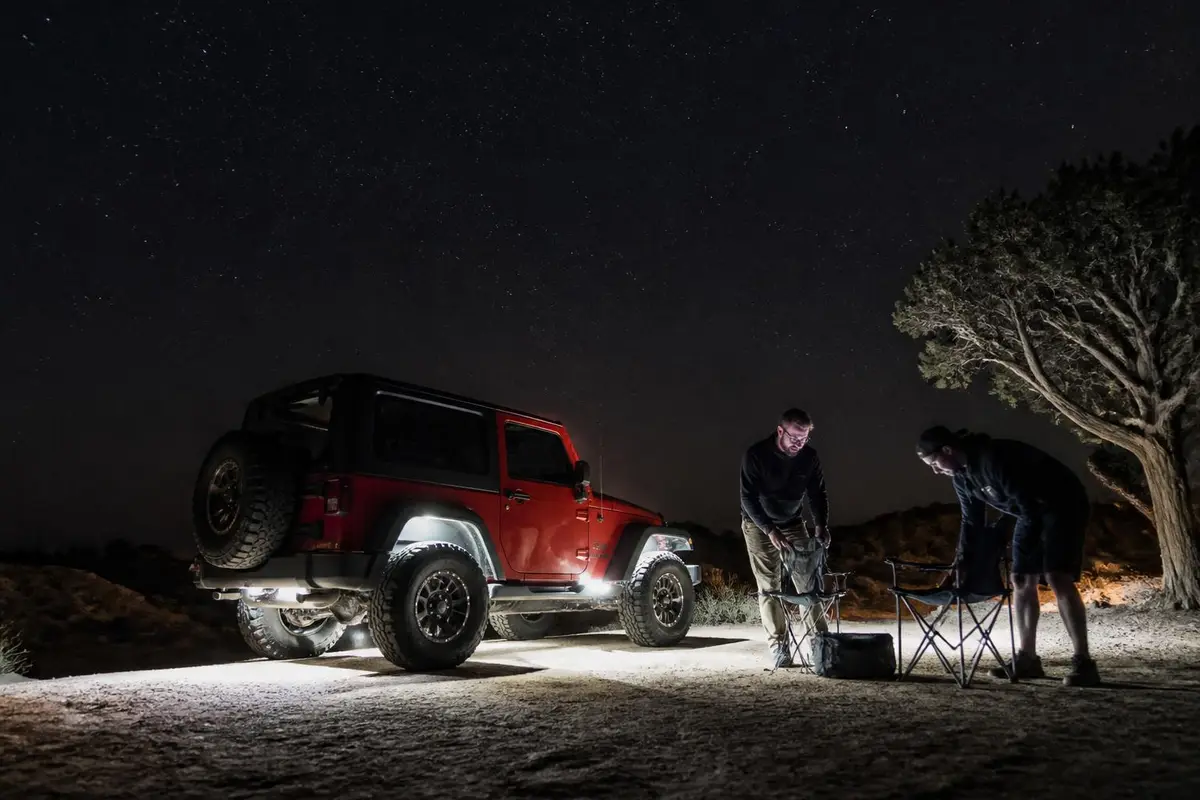
Rock lights are small, sealed pods mounted under the frame, rocker panels or bumpers, aimed down at the ground around each wheel. They are not for distance at all: they light the terrain right beside the tires so a driver or spotter can place a wheel precisely on a ledge or between rocks at night. Because they sit lowest on the vehicle they take the most mud, water and pressure-washing of any light — which is why their waterproof rating matters most.
Waterproofing: What IP67, IP68 and IP69K Mean
An IP code under IEC 60529 has two digits: the first rates protection against solid objects and dust (6 is dust-tight), the second against liquids on a scale that runs to 9, high-pressure hot water from different angles (7 covers temporary immersion to 1 meter; 8 is a tougher immersion rating). The "K" variant many light makers quote, IP69K, is defined in ISO 20653, the road-vehicle IP standard, and covers close-range high-pressure, high-temperature water jets like a pressure washer. IP67 is the practical floor for any light mounted low on a vehicle; rock lights and bumper-mounted pods benefit most from IP68 or IP69K. A sealed housing can still let water in through its connector, so seal the pigtail connection with dielectric grease or adhesive-lined heat shrink during install.
Power Draw, Fuses and Relays
Current draw decides the wiring. NIST's SI tables define the volt as a watt per ampere, so amps equal watts divided by volts. A 120-watt light bar on a 12-volt system draws about 10 amps; two 40-watt pods draw about 6.7 amps together. That current is well above what a small dash switch is built to carry, so auxiliary lights run through a relay: the switch carries only the small current that energizes the relay coil, while the relay feeds the lamp through its own fused line from the battery, as KC HiLiTES' wiring guidance lays out. Size the fuse to the harness wire and the lamp's draw rather than the largest fuse that fits, and add up every light on one circuit before choosing a harness. The full step-by-step is in how to wire a light bar.
White vs Amber Light
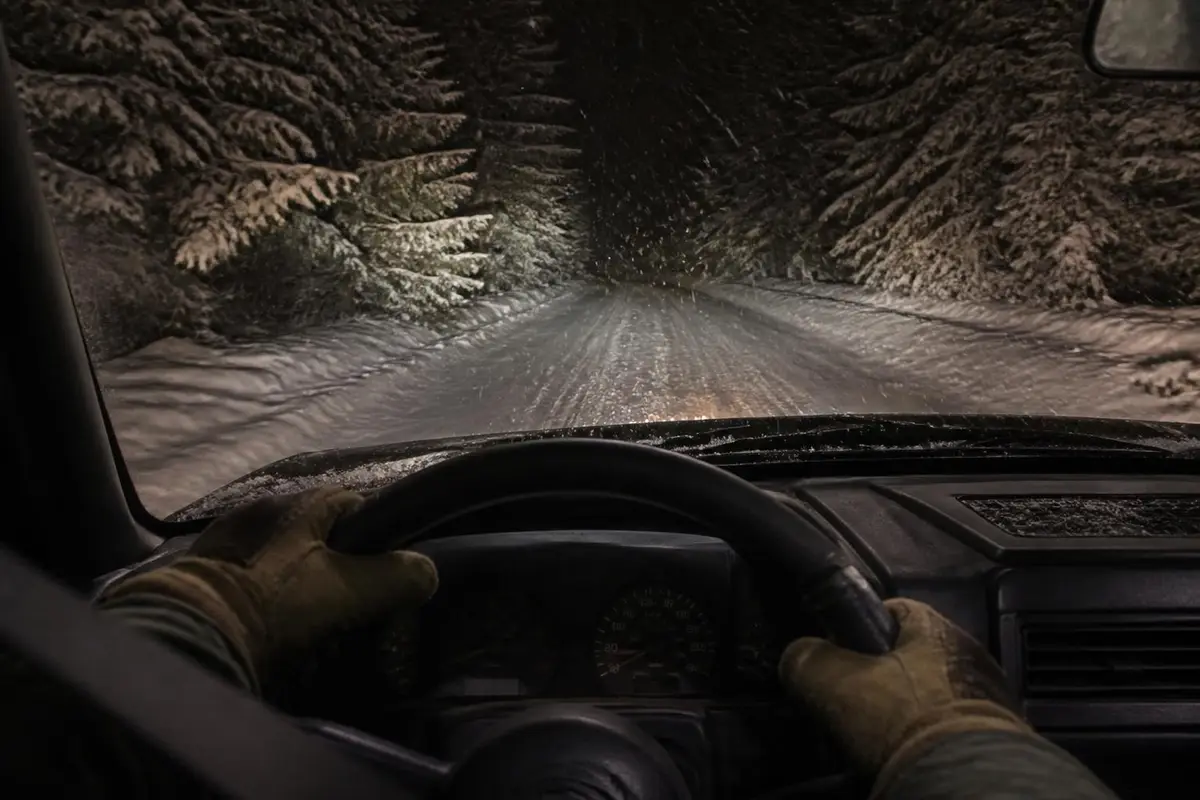
Color temperature, in kelvin, describes how warm or cool a white light looks; most off-road LEDs are cool white. Amber and selective-yellow lamps are a different color of light rather than a warmer white. RIGID Industries says yellow or amber light cuts through particles and reduces eye strain, and markets it for fog, dust, rain and snow. Treat that as the manufacturer's claim: the practical benefit most drivers describe is less glare bouncing back off dust and falling snow. Builds that run dusty desert or snowy roads often pair a white bar for reach with amber pods for poor-visibility conditions — see amber light bars.
Street Legality: Federal Rule and State Codes
Federal Motor Vehicle Safety Standard 108 sets the lighting every road vehicle must have, and it states that no additional lamp may be installed that impairs the effectiveness of that required lighting. States then regulate auxiliary lamps directly: California Vehicle Code §24402, for example, limits auxiliary driving and passing lamps by number and mounting height. The practical approach is to treat light bars, most pods and all colored rock lights as off-highway equipment, wire them on their own clearly labeled switch so they are never tied into the high beams, and check your own state's vehicle code before using any auxiliary light on a public road. More in are off-road light bars legal.
How to Choose Off-Road Lighting
Start with the speed and terrain you actually drive. Use the stopping-distance table above to set how far you need to see, and compare lamps on candela or lux-at-distance rather than lumens. Pick the beam angle for the job — spot or combo for speed, flood or scene for crawling and camp, ditch lights for the corners, rock lights for wheel placement. Check the IP rating against where the lamp will mount, add up the current draw before buying a harness, and confirm your state's auxiliary-lighting rules. Every product on this hub is weighed on its published specifications and owner-reported reliability; we don't buy or test lighting ourselves — see how we rank.
Sources
- NIST — SP 330, The International System of Units (Section 2) — Lumen = candela steradian (cd sr); lux = lumen per square meter (lm/m²); volt = watt per ampere (W/A), so amps = watts ÷ volts.
- U.S. Department of Energy (FEMP) — Purchasing Energy-Efficient Light Bulbs — Lumens measure the total visible light a source emits; wattage measures power input.
- RIGID Industries — EnLIGHTening Information — Definitions of lumens, lux and candela; beam angles for hyper-spot, spot, flood, driving, scene and diffused patterns; manufacturer claim that amber light cuts through particles and reduces eye strain; color temperature in kelvin.
- IIHS — About our headlight tests — Headlight reach measured to at least 5 lux at 10 inches above the ground; a full moon lights the ground to about 1 lux.
- FHWA — Self-Enforcing Roadways, Chapter 3 (FHWA-HRT-17-098) — Stopping-sight-distance formula used for AASHTO Green Book criteria (SSD = 1.47Vt + 1.075V²/a) and the 2.5-second perception-reaction time.
- FHWA — Driver, Vehicle and Roadway Characteristics Related to Driving in Wet Weather — Stopping-sight-distance assumptions: 2.5 s perception-reaction time and 11.2 ft/s² braking deceleration.
- IEC — Ingress Protection (IP) ratings (IEC 60529) — IP code structure: first numeral solids 0–6 (6 = no ingress of dust), second numeral liquids 0–9 (9 = high-pressure hot water).
- ISO 20653:2023 — Road vehicles, Degrees of protection (IP code) — Road-vehicle IP code standard that defines the IP69K high-pressure, high-temperature water-jet rating.
- KC HiLiTES — Light Bar Wiring Support — Relay harnesses and inline fuses for auxiliary lighting.
- 49 CFR 571.108 (FMVSS 108) — Lamps, reflective devices and associated equipment — S2 purpose; S6.2.1: no additional lamp may be installed that impairs the effectiveness of required lighting.
- California Vehicle Code §24402 (auxiliary driving and passing lamps) — Example of a state code limiting auxiliary lamps by number and mounting height.