
Affiliate disclosure: As an Amazon Associate, we earn from qualifying purchases, at no extra cost to you. We research rather than test, and commissions never change our rankings. This site is reader-supported: those commissions pay for hosting, research and keeping every guide up to date, so if a guide helped you, buying through our links is an easy way to support it. How we rank · Full disclosure
TL;DR
- GVWR has a federal definition (49 CFR §571.3): not less than curb weight plus rated cargo plus 150 lb per designated seating position.
- A tire's load index and load range are two separate ratings — same tire size, different load capacity, if the codes differ.
- Crawl ratio combines transfer case, axle and first-gear reduction into one number; higher means finer low-speed control.
- A locking differential and a limited-slip differential solve the same problem — one wheel losing traction — to different degrees.
- Don't confuse a winch's line-pull rating, a traction board's static load rating and a strap's working load limit — three different measurements, easy to mix up.

Drivetrain and Gearing Terms
Five drivetrain terms account for most of the confusion in off-road listings and forum posts.
- 4-low (4L)
- A transfer-case setting that multiplies torque and reduces top speed for slow, technical driving. See 4 high vs 4 low for the full comparison.
- Crawl ratio
- The combined gear reduction across the transfer case, axle and first gear, expressed as a single ratio number (see FAQ).
- Locking differential
- Forces both wheels on an axle to spin together regardless of individual traction.
- Limited-slip differential
- Offers a partial version of a locker’s effect without fully locking both wheels together (see FAQ).
- Regearing
- Swapping an axle’s internal ring-and-pinion gears to a different ratio, most often after a tire-size increase changes the effective final drive — see off-road maintenance and DIY.
Clearance and Geometry Terms
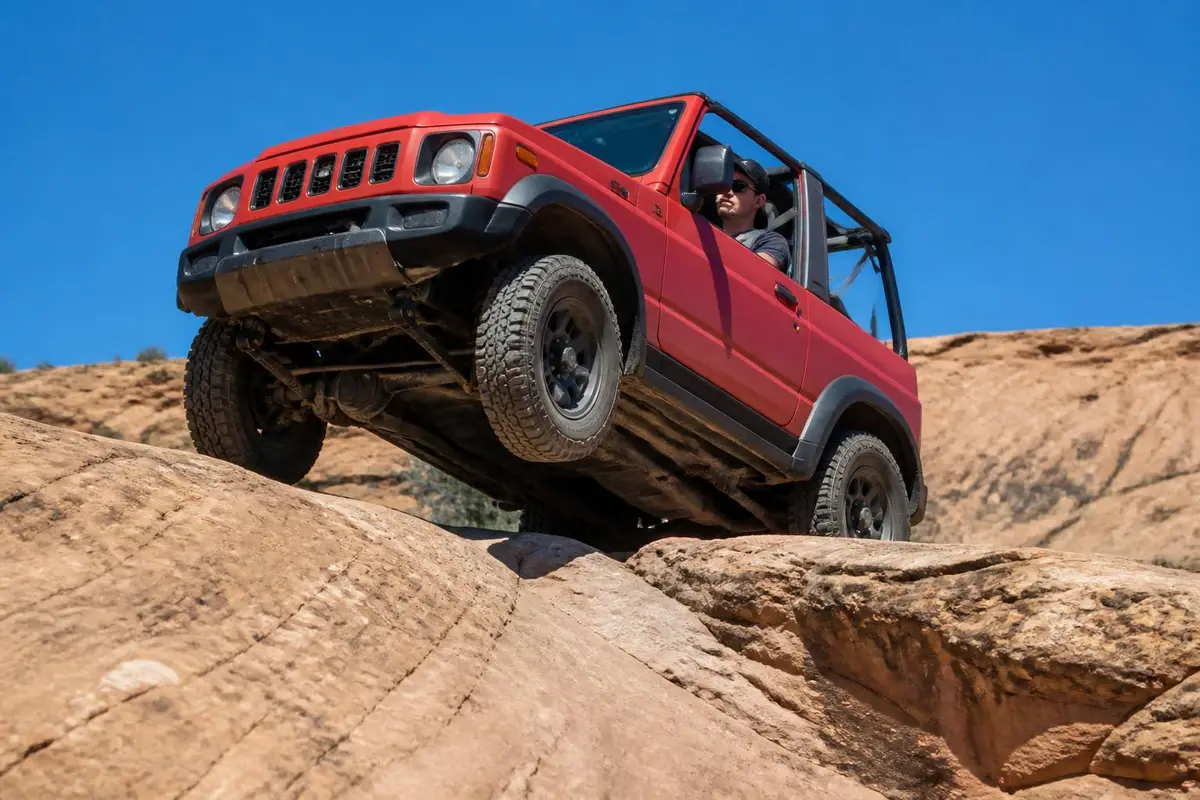
Three angle measurements determine what terrain a specific trim can physically clear.
- Ground clearance
- The distance from the ground to a vehicle’s lowest fixed point, usually the differential housing.
- Approach angle
- The steepest incline a vehicle can enter without its front bumper contacting the ground first.
- Departure angle
- The steepest decline a vehicle can exit without its rear bumper or hitch contacting the ground.
- Breakover angle
- The steepest peaked obstacle the undercarriage can cross without contacting the crest. See off-road driving tips for how these numbers apply on an actual trail.
Weight and Towing Terms
Three weight ratings decide how much a truck can safely carry and tow.
- GVWR
- Gross Vehicle Weight Rating — the maximum loaded weight the manufacturer rates the vehicle for, defined in federal regulation as not less than curb weight plus rated cargo load plus 150 lb per designated seating position (49 CFR §571.3) (see FAQ).
- GCWR
- Gross Combined Weight Rating — the maximum combined weight of a tow vehicle and trailer together, usually the true limiting number when towing near capacity.
- Payload
- GVWR minus a truck’s actual curb weight; it shrinks with every added option or accessory. See towing and payload for the full breakdown.
Tire Rating Terms: Load Index and Load Range
A tire's load index is a numeric code, printed after the size on the sidewall, that cross-references a standardized load-and-inflation table to the maximum weight that one tire can carry at its rated pressure — passenger and light-truck codes commonly run from the high 80s to around 130, and a higher number means a higher load-carrying capacity, per Michelin's own tire-rating reference. Load range is a separate letter code (C, D, E and up) descended from the older ply-rating system; a higher letter generally means a stiffer sidewall built to hold a higher maximum pressure and, at that pressure, a higher load. The two ratings work together: two tires of the same size can carry different maximum loads if they carry different load ranges, which is why a tire swap on a loaded work truck should match or exceed the original load index, not just the size.
4WD, AWD and Drive-Mode Terms
4WD and AWD (see FAQ) are frequently used interchangeably but describe meaningfully different systems.
- Part-time 4WD
- Lets a driver switch between 2WD and 4WD modes; generally not meant to be run in 4WD on dry pavement due to drivetrain binding. See 4WD on the highway.
- Full-time 4WD
- Stays engaged across all surfaces using a center differential to manage speed differences between axles.
- AWD
- Usually always-engaged with no low-range gear set, tuned for on-road traction rather than technical off-road terrain.
Recovery and Rated-Capacity Terms
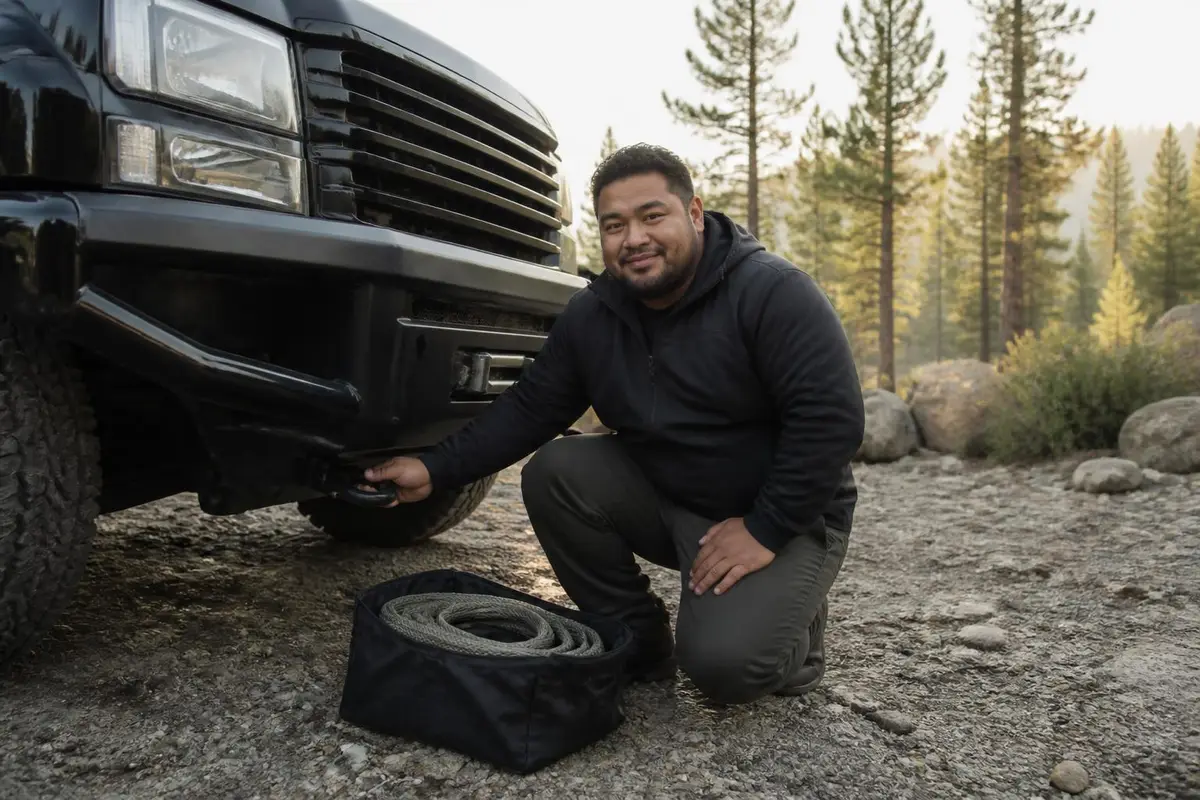
Three rated-capacity terms appear on nearly every piece of recovery gear sold.
- Working load limit (WLL)
- The maximum load a piece of rated recovery gear is designed to carry under normal use, always lower than its breaking strength for a safety margin.
- Line-pull rating
- A winch’s maximum pulling force, stated in pounds.
- Kinetic energy
- In a recovery context, the stretch-and-release mechanism a kinetic rope uses to snatch a stuck vehicle free. See recovery gear for how these ratings apply to specific products.
Tire and Wheel Terms
Load index and load range (above) cover load capacity; a third term describes tread behavior.
- Siping
- Thin slits cut into a tire’s tread blocks that improve grip on wet, icy or loose surfaces by adding extra biting edges. See all-terrain and mud tires for how load index and siping pattern affect a specific tire’s off-road behavior.

Suspension and Articulation Terms
Four suspension terms come up constantly once a build moves past stock ride height.
- Wheel travel
- The total distance a wheel moves from full droop to full compression; more travel generally means better articulation over uneven terrain.
- Articulation
- How far a suspension system can flex to keep all four tires in contact with uneven ground, often described by RTI (ramp travel index) score.
- Sway bar disconnect
- A mechanism, manual or electronic, that decouples the front sway bar to allow significantly more wheel travel at low speed off-road.
- Coilover
- A shock absorber and coil spring combined into one adjustable unit, common on aftermarket lift kits that allow ride-height and damping tuning. See suspension and lift kits for how these components are actually specced and matched.
Ratings That Get Confused With Each Other
A traction board's static load rating, a winch's line-pull rating and a snatch strap's working load limit are three different measurements that happen to all be numbers on a spec sheet — a board rated to several thousand pounds of static load says nothing about how much pulling force a winch on the same rig can generate, and a strap's working load limit (below its actual breaking strength) is a very different figure from a winch's rated line pull. Cross-reference an unfamiliar rating against the specific product category it came from, not just a number that looks similar, before buying or substituting one piece of gear for another.
Recommended gear
A first recovery kit for any 4WD
Affiliate disclosure: As an Amazon Associate, we earn from qualifying purchases, at no extra cost to you. Purchases through these links help keep this site running and up to date. Learn more

Best for a complete strap, shackle and glove kit in one bag.
- Straps, shackles, gloves, damper and a recovery bag in one kit.
- Covers most vehicle-to-vehicle recoveries without buying parts separately.

Best for getting unstuck from sand, mud or snow without another vehicle.
- Nylon recovery boards that give spinning tires grip in sand, mud or snow.
- Double as a shovel to clear sand from in front of the tires.

Best for airing all four tires down to a set pressure at once.
- Automatic deflators preset between 6 and 30 PSI.
- Air all four tires down at once, then stop at the set pressure.

Best for airing back up before you hit pavement.
- Portable 12V compressor rated to 150 PSI.
- Sized for truck and SUV tires.
We research products from manufacturer specs and owner feedback; we don't test them ourselves. How we choose.
Sources
- eCFR — 49 CFR §571.3, Definitions (GVWR) — GVWR's federal definition: not less than curb weight plus rated cargo load plus 150 lb per designated seating position.
- Michelin — Tire Load Rating & Speed Rating Explained — Load index definition and typical numeric range for passenger/light-truck tires.
- Goodyear — Tire Load Index & Chart — Load range (ply-rating-derived letter code) as a separate rating from load index.
- WARN Industries — Determine the Right Winch Capacity — Winch line-pull rating as a distinct measurement from a traction board's static load rating or a strap's working load limit.
- eCFR — 49 CFR §571.3, Definitions (GCWR) — GCWR definition as the combined tow-vehicle-plus-trailer weight rating, distinct from GVWR.