
Affiliate disclosure: As an Amazon Associate, we earn from qualifying purchases, at no extra cost to you. We research rather than test, and commissions never change our rankings. This site is reader-supported: those commissions pay for hosting, research and keeping every guide up to date, so if a guide helped you, buying through our links is an easy way to support it. How we rank · Full disclosure
TL;DR
- Size everything off your GVWR (the door-jamb label), not curb weight.
- Winch: at least 1.5 × GVWR of rated line pull (WARN), and remember the rating applies only on the first layer of rope.
- Strap or kinetic rope: a breaking strength of 2–3 × GVWR (ARB).
- Shackles: rated bow shackles of at least 3.25 t, or 4.75 t where two strap ends share one shackle (ARB).
- Never recover from a tow ball or tie-down point. ARB says tow balls have failed and become lethal projectiles.
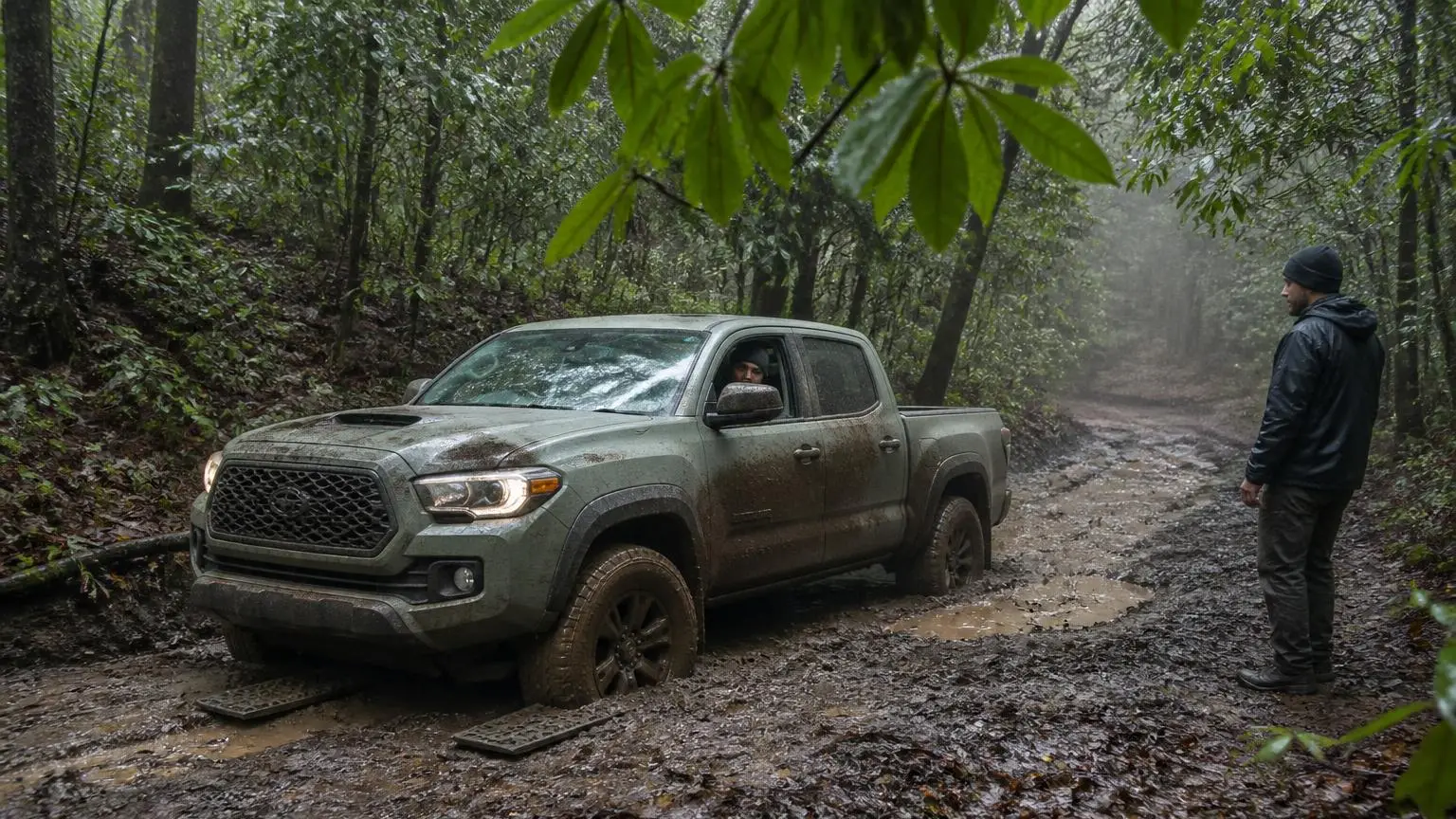
- Traction boards need the tire to grip and must not be spun on; MAXTRAX says wheelspin burns the teeth off.
At a Glance
| Piece of gear | What it does | How to size it |
|---|---|---|
| Traction boards | Give a spinning tire something to grip in sand, mud or snow | Check the maker's vehicle-weight guidance; MAXTRAX designs its boards for 4x4s of about 10,000 lb |
| Kinetic rope or snatch strap | Lets a second vehicle pull you out with a stretch-and-release tug | Breaking strength 2–3 × GVWR |
| Winch | Pulls the vehicle toward an anchor with no second vehicle and no traction needed | Rated line pull at least 1.5 × GVWR |
| Shackles | Join the rope or strap to a rated recovery point | At least 3.25 t (5/8-inch Crosby size); 4.75 t for two strap ends |
| Snatch block | Doubles a winch's pull or changes its direction | Rated for the combined load of both rope legs |
Start With GVWR: The Number Every Rating Is Based On
Gross vehicle weight rating is the maximum loaded weight your vehicle is designed to carry, and federal rule 49 CFR 567.4 requires it on the certification label, normally on the driver's door jamb. WARN tells buyers to use GVWR rather than curb weight, because a loaded truck carrying people, water, fuel and gear weighs close to it. Every rule on this page multiplies that one number. Here is a 7,000 lb GVWR worked through:
| Component | Rule | For a 7,000 lb GVWR | Source of the rule |
|---|---|---|---|
| Winch rated line pull | GVWR × 1.5 minimum | 10,500 lb | WARN |
| Strap or kinetic rope | Breaking strength 2–3 × GVWR | 14,000–21,000 lb | ARB |
| Bow shackle (one strap end) | At least 3.25 t rated | 3.25 t (about 7,165 lb) or more | ARB; Crosby 5/8-inch |
| Bow shackle (two strap ends) | At least 4.75 t rated | 4.75 t (about 10,470 lb) or more | ARB; Crosby 3/4-inch |
The recovery gear rating calculator runs these numbers for any GVWR.
Traction Boards: How They Work and Where They Fail
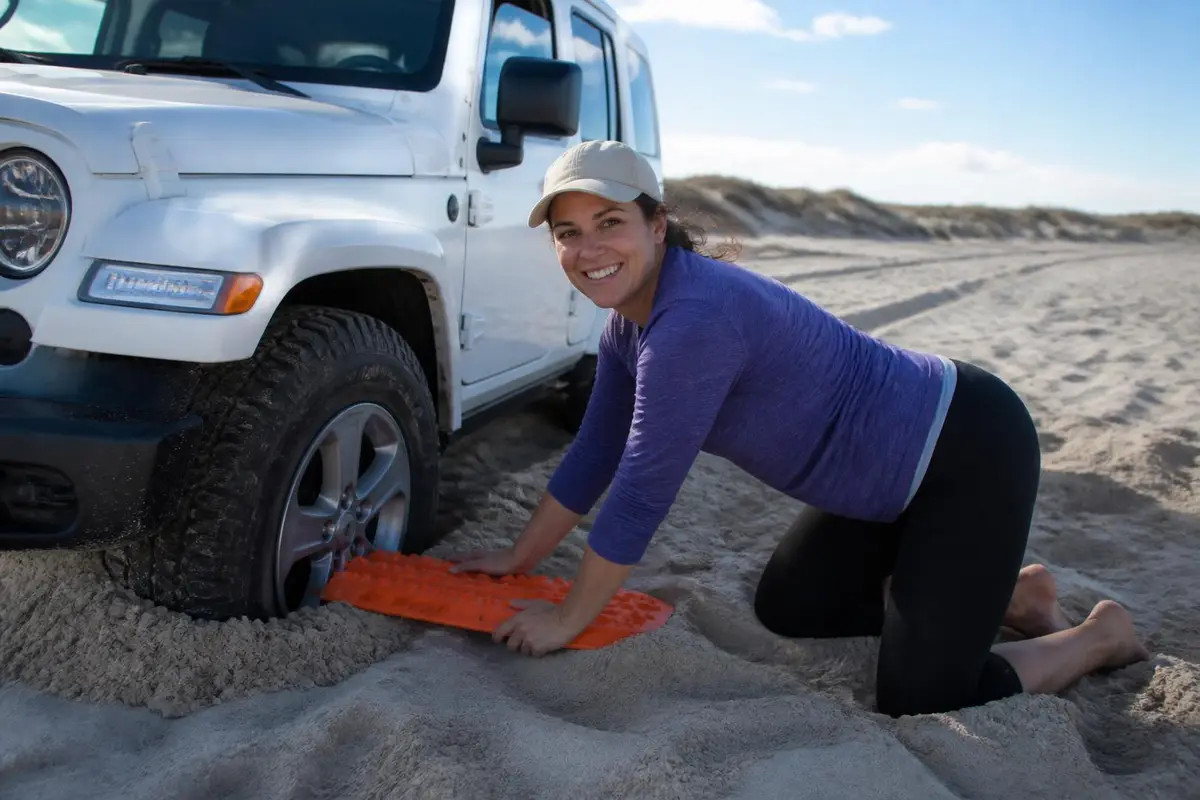
A traction board is a stiff, cleated ramp wedged in front of a stuck tire so the tread can climb onto it and drive out. MAXTRAX says its boards work in sand, snow, mud, slush and even pea gravel, and that they need all-terrain or mud-terrain tires; highway tires don't have the tread to grip the cleats. Its MKII board is 3.77 ft long, 13 in wide and 7.5 lb, made from reinforced nylon, and designed for 4x4s of around 10,000 lb. The Mini weighs 4.4 lb and the heavier Xtreme 10 lb.
The most common way to ruin a board is wheelspin. MAXTRAX's instruction is blunt: don't spin the wheels, or the teeth burn off. Ease on in low range and let the tire climb. MAXTRAX also says its boards aren't bridges or ramps and aren't jack bases, so using them across a gap or under a jack is outside what they're designed for.
Kinetic Ropes and Snatch Straps: Stretch and Breaking Strength
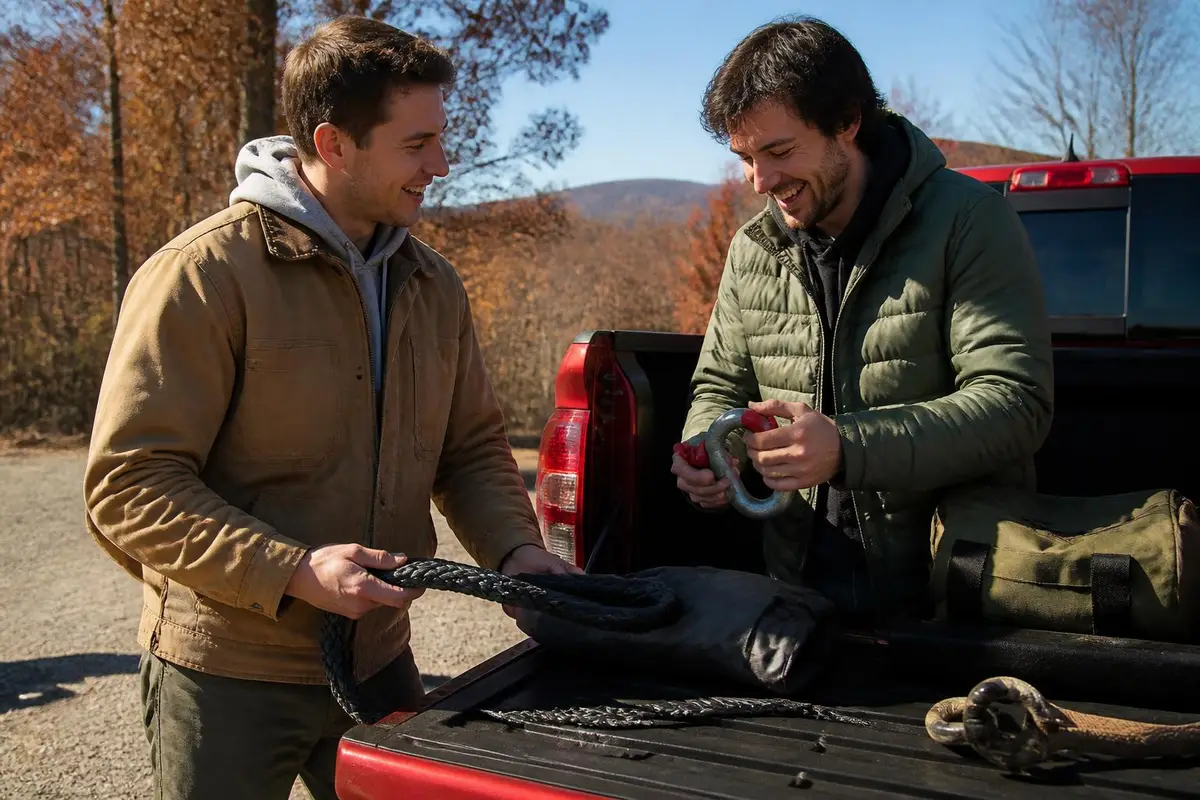
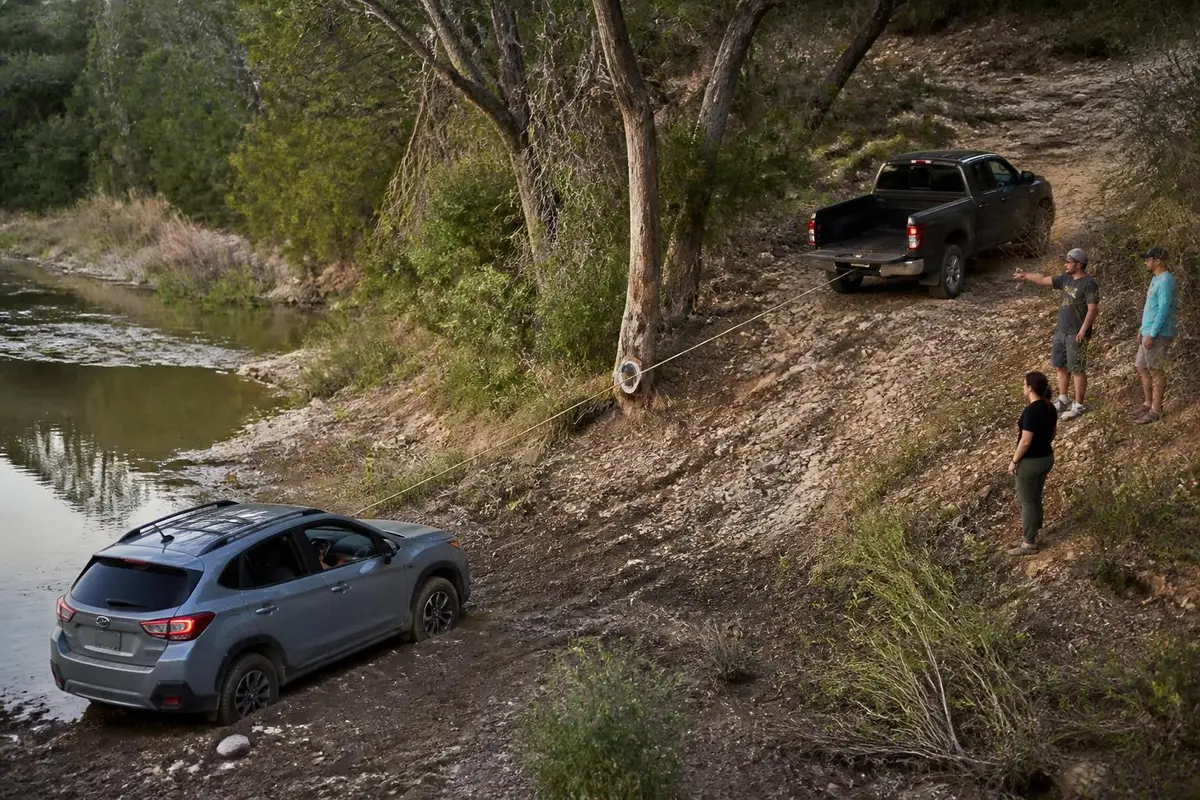
A kinetic rope is a thick, stretchy rope with a loop at each end. Yankum's 7/8-inch Python, for example, is rated to break at 28,600 lb. Makers rate these ropes to stretch up to about 30% of their length; Rhino USA contrasts that with about 8% for a tow strap. As the recovery vehicle drives away, the rope stretches and stores its energy, then contracts and tugs the stuck vehicle out. The energy involved rises with the square of speed, so doubling the run-up speed roughly quadruples the load. Yankum's instruction is not to exceed 5 mph, and to rethink the recovery if that doesn't work.
ARB's sizing rule is a minimum breaking strength of two to three times the vehicle's gross mass. Yankum publishes the same rule as a chart:
| Yankum rope diameter | Minimum breaking strength | Recommended recovery vehicle weight |
|---|---|---|
| 5/16 in | 12,600 lb | 2,500–4,200 lb |
| 7/16 in | 18,000 lb | 3,600–6,000 lb |
| 7/8 in | 28,600 lb | 5,000–7,200 lb |
| 1 in | 36,400 lb | 7,200 lb and up |
Two details change the math in the field. ARB warns that a strap can lose up to 20% of its strength when wet. Makers also quote a working load limit well below breaking strength: Rhino USA lists its 7/8-inch rope at 28,600 lb breaking strength and 9,533 lb WLL, a 3:1 ratio. Before a recovery, check the rope's printed rating rather than trusting its diameter.
Winches: Line Pull, Layers and Power
A winch is rated by its maximum line pull, and WARN's rule for trucks and SUVs is GVWR × 1.5 as the minimum. WARN's worked examples: a 2016 Toyota Tacoma with a 5,600 lb GVWR needs at least 8,400 lb, and a Chevrolet Silverado 2500 with a 9,900 lb GVWR needs at least 14,850 lb. WARN says going up a size from the minimum is fine.
That rating is a first-layer number. As rope stacks on the drum, the effective drum diameter grows and pulling power falls, like shifting to a taller gear. WARN's own figures for its ZEON 8:
| Rope layer on drum | WARN ZEON 8 rated pull |
|---|---|
| 1st layer | 8,000 lb |
| 2nd layer | 6,777 lb |
| 3rd layer | 5,878 lb |
| 4th layer | 5,189 lb |
That is about 15% lost per layer. WARN's advice is to pull out as much rope as the anchor allows, but never leave fewer than 5 wraps of steel rope or 10 wraps of synthetic rope on the drum, or the rope can pull loose. WARN also recommends a fully charged battery of at least 650 cold cranking amps, and says the rope must wind off the bottom of the drum or the automatic load-holding brake won't work. Smittybilt's XRC Gen2 9,500 lb winch, for scale, weighs 99 lb before any bumper or mounting plate.
Synthetic rope or steel? WARN says synthetic rope is light, stores less energy under load and doesn't develop burrs, but is more prone to abrasion and UV damage and needs a polished aluminum hawse fairlead. Steel resists abrasion and UV well but is heavier, can rust and can develop sharp burrs. See synthetic winch rope vs steel cable.
Snatch Blocks: Doubling the Pull
A snatch block is a pulley that opens on the side so a rope can be laid into it. Run the winch rope out to the block on an anchor and back to the vehicle, and WARN says the doubled line increases pulling power. It also means more rope is off the drum, so the winch works on a lower, stronger layer. A block can also redirect a pull when the only anchor isn't straight ahead. Because both legs of rope pull on the block, it carries roughly twice the winch's line pull. WARN rates its heavy-duty snatch block (15640) at 18,000 lb WLL for vehicle recovery with a 36,000 lb minimum breaking strength, limits it to winches up to 9,000 lb, and fits it to wire rope up to 1/2 inch only. See how to use a snatch block.
Shackles: Steel Bow Shackles vs Soft Shackles
A shackle joins a strap, rope or block to a recovery point. For steel bow shackles, Crosby's G-209 catalog gives the stamped working load limit by size and rates the line to a 6:1 design factor, so breaking strength is about six times the WLL:
| Crosby G-209 size | Working load limit | Weight each |
|---|---|---|
| 5/8 in | 3.25 t | 1.37 lb |
| 3/4 in | 4.75 t | 2.35 lb |
| 7/8 in | 6.5 t | 3.62 lb |
| 1 in | 8.5 t | 5.03 lb |
ARB's guidance is at least 3.25 t for attaching one strap end and 4.75 t where two strap ends share one shackle, as on a tree-trunk protector. A soft shackle is a loop of synthetic rope, usually Dyneema, a UHMWPE fiber its maker describes as 15 times stronger than steel yet light enough to float. See soft shackle vs steel shackle for ratings and failure modes.
Recovery Points: Where the Force Actually Goes
Every rating above assumes the rope is attached to something that can take the load. ARB says to use only correctly mounted, rated recovery points, and never a tow ball or tie-down point. Tow balls aren't made of high-tensile material and have failed under recovery loads, becoming lethal projectiles. A rated point is bolted to the frame and carries a stated capacity. A winch-ready bumper with rated shackle mounts is the usual way to add them; see bumpers, skid plates and rock sliders and what are recovery points.
Safety Rules for Any Recovery
- Keep people back. ARB says bystanders should stand at least 1.5 times the unstretched strap length away.
- Use a damper. ARB fits its recovery damper to the middle third of a strap or winch cable; WARN places a damper midway between the winch and the anchor.
- Leave slack, not a run-up. ARB suggests about 2–3 m of slack strap between vehicles, and Yankum says not to exceed 5 mph.
- Protect the anchor. Wrap trees with a tree-trunk protector. ARB's are rated to a 12,000 kg minimum break strength.
- Wear gloves on the rope. WARN repeatedly calls for leather gloves when handling winch rope.
A Complete Recovery Kit
For a vehicle with a 7,000 lb GVWR, the rules above add up to this kit:
- two traction boards;
- a kinetic rope or snatch strap rated to break at 14,000–21,000 lb;
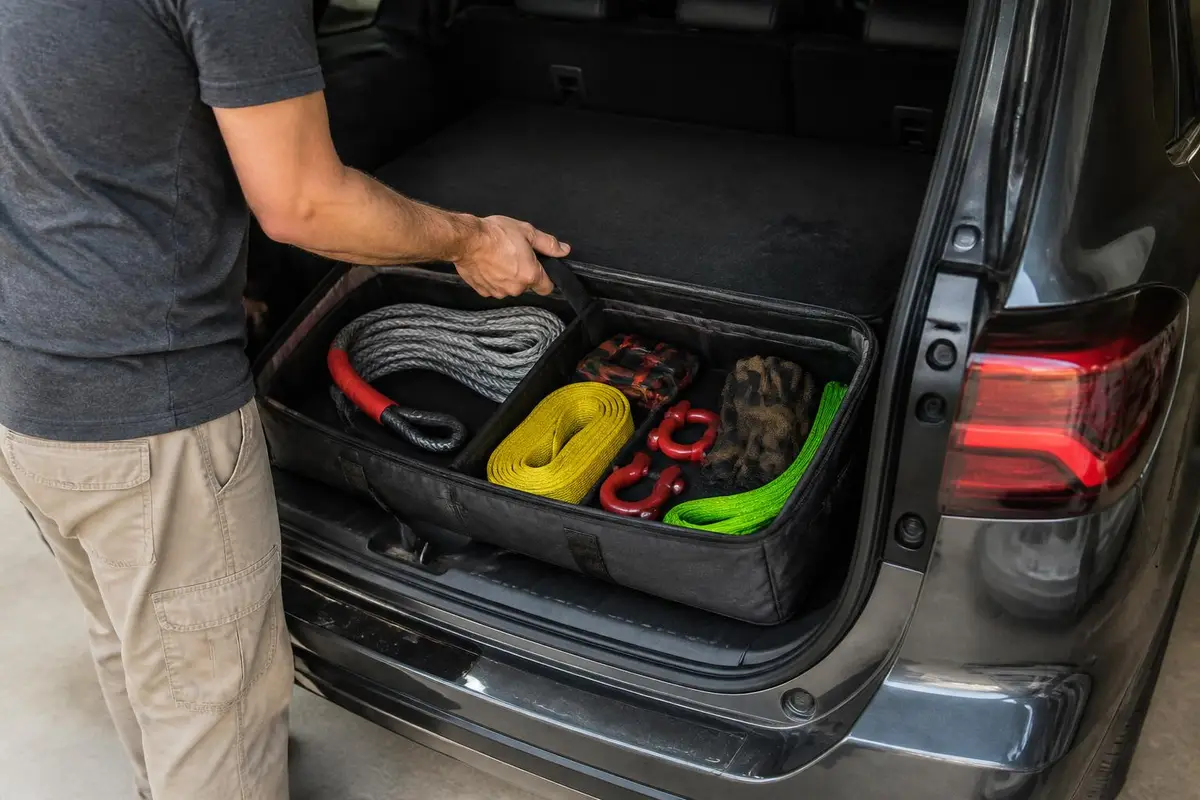
- at least two rated bow shackles of 3.25 t or more, or soft shackles of matching rating;
- a tree-trunk protector;
- a damper;
- gloves;
- rated recovery points front and rear.
A winch rated to at least 10,500 lb, and a snatch block rated for doubled-line loads, adds self-recovery with no second vehicle. Whether that is worth the cost and weight is covered in is a winch worth it.
How We Rank Recovery Gear
Products on this hub are weighed on the manufacturer's rated capacity and published specifications, alongside owner-reported reliability. We don't buy, install or use recovery gear ourselves. See how we rank and the affiliate disclosure.
Sources
- eCFR — 49 CFR § 567.4 (Vehicle certification label) — GVWR appears on the federally required certification label, normally on the driver's door jamb.
- WARN — Determine the Right Winch Capacity for Your Truck or SUV — Minimum winch line pull = GVWR × 1.5, using GVWR rather than curb weight; worked examples for a 2016 Tacoma (5,600 lb → 8,400 lb) and a Silverado 2500 (9,900 lb → 14,850 lb); going above the minimum is fine.
- WARN — Winch Performance Specifications: Pulling Capacity by Layer — ZEON 8 rated pull by drum layer (8,000 / 6,777 / 5,878 / 5,189 lb), about 15% lost per layer; minimum 5 wraps steel and 10 wraps synthetic.
- WARN — Basic Guide to Winching — Maximum pull on the first layer; snatch block doubles the line and increases pull; 5/10 minimum wraps; 650 CCA battery; rope must wind off the bottom of the drum; pull straight ahead; damper midway; leather gloves; idling engine may not keep the battery charged; motor heat on long pulls.
- WARN — Synthetic Rope vs Steel Rope: Which One Is Best? — Synthetic rope is lighter, stores less energy and doesn't burr but abrades and needs UV inspection and a hawse fairlead; steel resists abrasion and UV but is heavier, rusts and burrs.
- WARN — Heavy-Duty Snatch Block (15640) — 18,000 lb WLL for vehicle recovery, 36,000 lb minimum breaking strength, winches up to 9,000 lb, wire rope up to 1/2 in; doubles pulling power and reduces heat and amp draw.
- ARB — Getting Started: Recovery Techniques & Equipment — Snatch strap MBS of 2–3× gross vehicle mass; 8,000/11,000/15,000 kg straps; shackles of at least 3.25 t (4.75 t for two strap ends); no tow balls or tie-downs as recovery points; damper in the middle third; bystanders 1.5× strap length; 2–3 m slack; up to 20% strength loss when wet; 12,000 kg tree-trunk protector; winch when a snatch strap fails.
- The Crosby Group — G-209 Screw Pin Anchor Shackles (catalog page 24) — Working load limit and weight by size (5/8 in 3.25 t, 3/4 in 4.75 t, 7/8 in 6.5 t, 1 in 8.5 t) and the 6:1 design factor.
- MAXTRAX USA — FAQs — Boards work in sand, snow, mud, slush and pea gravel with AT/MT tires; designed for 4x4s of about 10,000 lb; MKII 3.77 ft × 13 in, 7.5 lb; Mini 4.4 lb; Xtreme 10 lb; not a bridge, ramp or jack base; wheelspin burns the teeth off.
- Yankum Ropes — Python 7/8″ Kinetic Recovery Rope — Rope sizing chart (5/16 in 12,600 lb to 1 in 36,400 lb) by recovery-vehicle weight; stretches up to 30%; do not exceed 5 mph.
- Rhino USA — Kinetic Energy Recovery Rope — Stretches up to 30% vs about 8% for a tow strap; 7/8 in rope 28,600 lb break strength and 9,533 lb WLL (3:1).
- Rhino USA — Recovery Strap vs. Tow Strap — Never use a tow strap with metal hooks for a recovery.
- Factor 55 — Tow Strap vs. Recovery Strap/Kinetic Rope — Kinetic ropes are designed to stretch, up to 30% for Factor 55's rope; tow straps are low-stretch for steady towing.
- Dyneema — The World's Strongest Fiber — Dyneema is UHMWPE fiber, which its maker calls 15 times stronger than steel yet light enough to float.
- Smittybilt — XRC Gen2 9,500 lb Winch — 9,500 lb rated line pull, 99 lb winch weight, series-wound motor, 650 CCA minimum battery.