
Affiliate disclosure: As an Amazon Associate, we earn from qualifying purchases, at no extra cost to you. We research rather than test, and commissions never change our rankings. This site is reader-supported: those commissions pay for hosting, research and keeping every guide up to date, so if a guide helped you, buying through our links is an easy way to support it. How we rank · Full disclosure
Enter your vehicle's GVWR from the door-jamb label to see the minimum breaking strength for a recovery strap or kinetic rope, the minimum shackle rating, and the minimum winch line pull.
How This Is Calculated
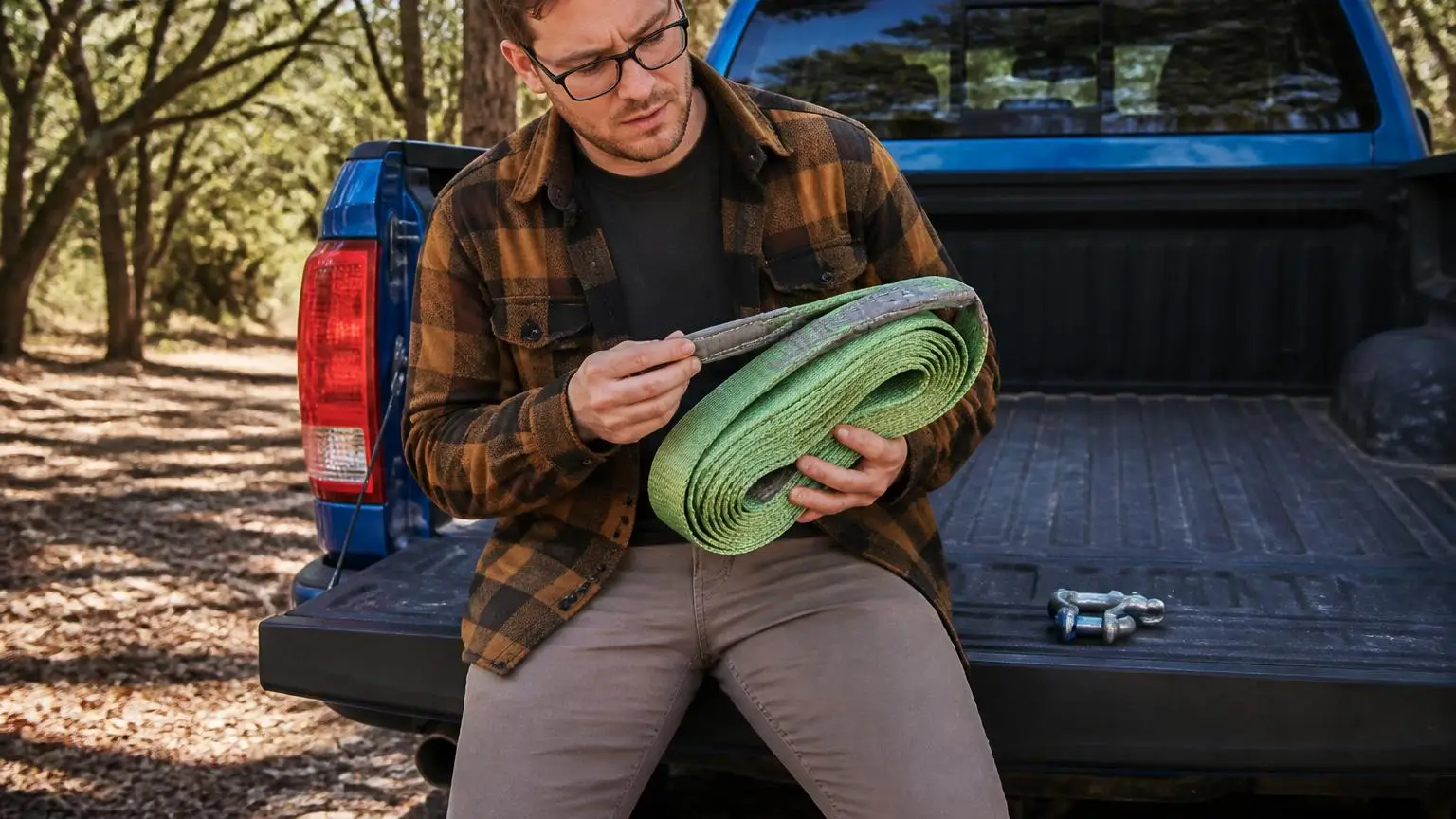
Strap or rope minimum breaking strength = GVWR × 2 to GVWR × 3, ARB's rule. Winch minimum rated line pull = GVWR × 1.5, WARN's rule. Shackle minimum stamped WLL = the larger of 7,165 lb (ARB's 3.25 t minimum) and the strap's upper breaking strength ÷ 6 (GVWR × 3 ÷ 6 = GVWR ÷ 2). Crosby rates its bow shackles at a 6:1 design factor, so a shackle meeting that figure breaks at or above the strap's own breaking strength and isn't the weak link.
The rules come from ARB's recovery-equipment guidance, WARN's winch-sizing guidance and Crosby's G-209 shackle catalog. They are manufacturer guidance, not a regulatory standard.
This is a sizing starting point, not an engineering certification. Follow the rating printed on each piece of gear and your vehicle maker's recovery-point ratings.
Worked Examples
| GVWR | Strap / rope breaking strength (2–3 ×) | Shackle stamped WLL (one strap end) | Winch line pull (1.5 ×) |
|---|---|---|---|
| 5,600 lb (WARN's 2016 Tacoma example) | 11,200–16,800 lb | 7,165 lb (3.25 t) | 8,400 lb |
| 7,000 lb | 14,000–21,000 lb | 7,165 lb (3.25 t) | 10,500 lb |
| 7,800 lb (2026 Ram 1500 RHO) | 15,600–23,400 lb | 7,165 lb (3.25 t) | 11,700 lb |
| 9,900 lb (WARN's Silverado 2500 example) | 19,800–29,700 lb | 7,165 lb (3.25 t) | 14,850 lb |
| 15,000 lb | 30,000–45,000 lb | 7,500 lb | 22,500 lb |
For the strap, pick a product whose printed breaking strength falls inside the range. Yankum's chart maps these ranges onto rope sizes. Its 7/8-inch rope (28,600 lb) is recommended for 5,000–7,200 lb recovery vehicles, and its 1-inch rope (36,400 lb) for 7,200 lb and up.
Why the Ratings Exceed GVWR
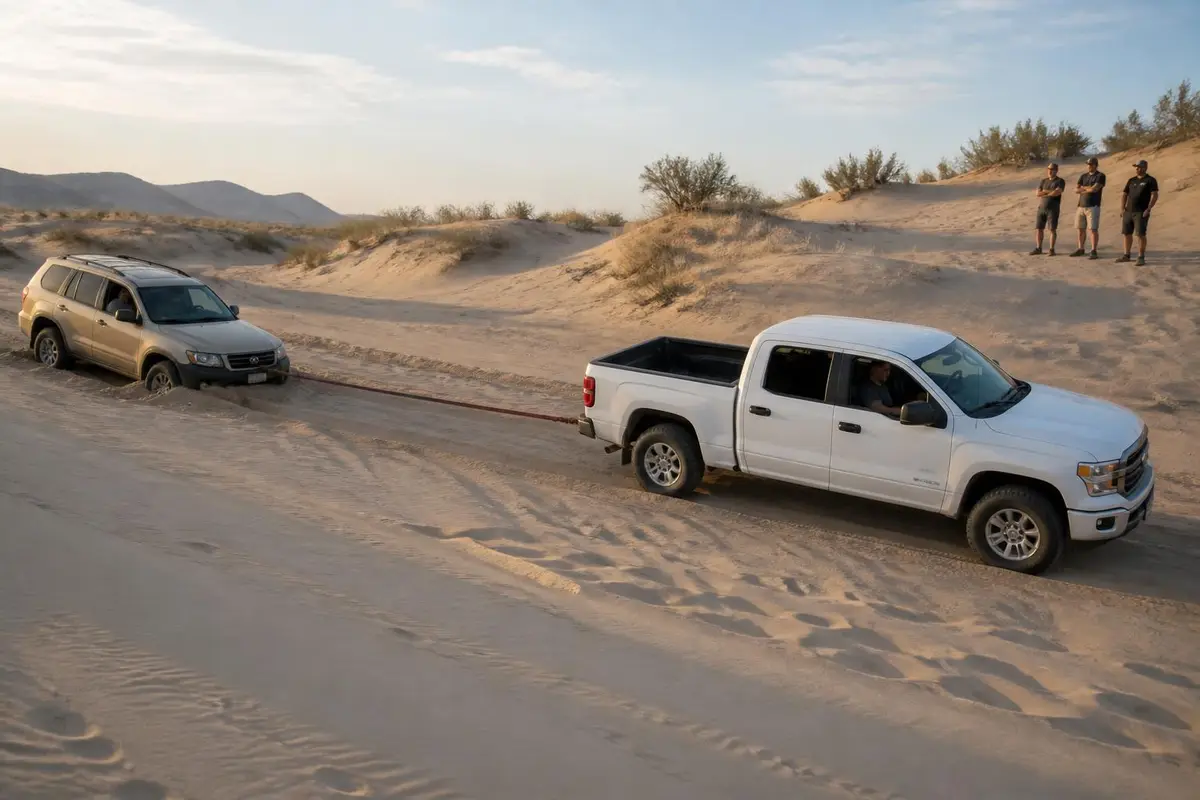
GVWR describes the vehicle's maximum loaded weight, set on the certification label required by 49 CFR 567.4. A stuck vehicle takes much more than that to move. The strap has to overcome suction and drag from mud or sand and any slope, and in a kinetic recovery it also absorbs the moving recovery vehicle's energy. That energy rises with the square of speed, which is why Yankum says not to exceed 5 mph. ARB's 2–3 × margin exists to keep that peak below the strap's breaking strength. The margin shrinks in real conditions: ARB warns a strap can lose up to 20% of its strength when wet, and a worn or cut strap loses more.

Working Load Limit vs Breaking Strength
Recovery gear is labeled two ways, and mixing them up is the most common sizing error. Straps and kinetic ropes are usually sold by minimum breaking strength. ARB sells its snatch straps at 8,000, 11,000 and 15,000 kg MBS. Shackles are stamped with a working load limit. Crosby's G-209 table lists WLL by size, with breaking strength about six times higher:
| Crosby G-209 size | Stamped WLL | Approximate breaking strength (6:1) |
|---|---|---|
| 5/8 in | 3.25 t (7,165 lb) | 19.5 t (about 43,000 lb) |
| 3/4 in | 4.75 t (10,470 lb) | 28.5 t (about 62,800 lb) |
| 7/8 in | 6.5 t (14,330 lb) | 39 t (about 86,000 lb) |
| 1 in | 8.5 t (18,740 lb) | 51 t (about 112,400 lb) |
Some rope makers also print a WLL, on their own ratio. Rhino USA's 7/8-inch rope is 28,600 lb MBS and 9,533 lb WLL, a 3:1 ratio. Compare like with like: strap breaking strength against the vehicle rule, and shackle stamped WLL against ARB's minimum.
Gear This Calculator Doesn't Size
- Tree-trunk protector. It wraps an anchor tree so a winch line or strap doesn't cut into the bark. ARB's are rated to a 12,000 kg minimum break strength and come in 3 and 5 m lengths. Both ends meet on one shackle, so ARB calls for a 4.75 t shackle there.
- Snatch block. In a doubled-line pull, both rope legs load the block, so it carries about twice the winch's line pull. WARN rates its heavy-duty block (15640) at 18,000 lb WLL for vehicle recovery and limits it to winches up to 9,000 lb.
- Traction boards. These are rated by the maker for vehicle weight, not sized by a multiplier. MAXTRAX designs its boards for 4x4s of around 10,000 lb.
Checking Gear You Already Own
Enter your current vehicle's GVWR and compare the results with the ratings printed on your strap and stamped on your shackles. A kit bought for a lighter vehicle can fall short. At the 2× floor, a 7/8-inch rope rated at 28,600 lb covers vehicles up to 14,300 lb GVWR, but a 5/16-inch rope rated at 12,600 lb stops at 6,300 lb. Retire any strap with cuts, burns or damaged eyes, and any shackle without a legible stamped rating. For how each piece fits into a full kit, see recovery gear. For when a winch's rating matters more than a strap's, see is a winch worth it.
How We Research This
The multipliers and minimums come from ARB's recovery-equipment guidance, WARN's winch-sizing guidance and Crosby's G-209 catalog. Rope examples come from Yankum's and Rhino USA's published ratings. See how we rank for the site's research method.
Recommended gear
Core recovery gear
Affiliate disclosure: As an Amazon Associate, we earn from qualifying purchases, at no extra cost to you. Purchases through these links help keep this site running and up to date. Learn more

Best for a complete strap, shackle and glove kit in one bag.
- Straps, shackles, gloves, damper and a recovery bag in one kit.
- Covers most vehicle-to-vehicle recoveries without buying parts separately.

Best for getting unstuck from sand, mud or snow without another vehicle.
- Nylon recovery boards that give spinning tires grip in sand, mud or snow.
- Double as a shovel to clear sand from in front of the tires.

Best for vehicle-to-vehicle snatch recoveries.
- 1 in x 30 ft kinetic rope that stretches to ease a stuck vehicle out.
- Gentler on recovery points than a static tow strap.
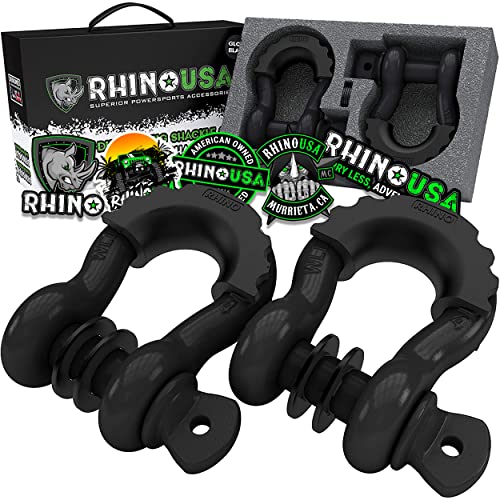
Best for rated connection points for straps and ropes.
- 3/4 in D-ring shackles, 41,850 lb listed break strength (2-pack).
- Connect straps to rated recovery points.
We research products from manufacturer specs and owner feedback; we don't test them ourselves. How we choose.
Sources
- eCFR — 49 CFR § 567.4 (Vehicle certification label) — GVWR appears on the federally required certification label, normally on the driver's door jamb.
- ARB — Getting Started: Recovery Techniques & Equipment — Snatch strap MBS of 2–3× gross vehicle mass; 8,000/11,000/15,000 kg straps; shackles of at least 3.25 t (4.75 t for two strap ends); no tow balls or tie-downs as recovery points; damper in the middle third; bystanders 1.5× strap length; 2–3 m slack; up to 20% strength loss when wet; 12,000 kg tree-trunk protector; winch when a snatch strap fails.
- WARN — Determine the Right Winch Capacity for Your Truck or SUV — Minimum winch line pull = GVWR × 1.5, using GVWR rather than curb weight; worked examples for a 2016 Tacoma (5,600 lb → 8,400 lb) and a Silverado 2500 (9,900 lb → 14,850 lb); going above the minimum is fine.
- WARN — Heavy-Duty Snatch Block (15640) — 18,000 lb WLL for vehicle recovery, 36,000 lb minimum breaking strength, winches up to 9,000 lb, wire rope up to 1/2 in; doubles pulling power and reduces heat and amp draw.
- The Crosby Group — G-209 Screw Pin Anchor Shackles (catalog page 24) — Working load limit and weight by size (5/8 in 3.25 t, 3/4 in 4.75 t, 7/8 in 6.5 t, 1 in 8.5 t) and the 6:1 design factor.
- Yankum Ropes — Python 7/8″ Kinetic Recovery Rope — Rope sizing chart (5/16 in 12,600 lb to 1 in 36,400 lb) by recovery-vehicle weight; stretches up to 30%; do not exceed 5 mph.
- Rhino USA — Kinetic Energy Recovery Rope — Stretches up to 30% vs about 8% for a tow strap; 7/8 in rope 28,600 lb break strength and 9,533 lb WLL (3:1).
- MAXTRAX USA — FAQs — Boards work in sand, snow, mud, slush and pea gravel with AT/MT tires; designed for 4x4s of about 10,000 lb; MKII 3.77 ft × 13 in, 7.5 lb; Mini 4.4 lb; Xtreme 10 lb; not a bridge, ramp or jack base; wheelspin burns the teeth off.
- Stellantis Media — 2026 Ram 1500 Trailer Towing Charts — Worked weight example: 4x4 Crew Cab 5'7" straight-six, front GAWR 3,900 lb vs 3,100 lb base front weight, 1,840 lb payload; RHO GVWR 7,800 lb.