
Affiliate disclosure: As an Amazon Associate, we earn from qualifying purchases, at no extra cost to you. We research rather than test, and commissions never change our rankings. This site is reader-supported: those commissions pay for hosting, research and keeping every guide up to date, so if a guide helped you, buying through our links is an easy way to support it. How we rank · Full disclosure
TL;DR
- An open differential sends power to the wheel that turns most easily. A locker forces both wheels on an axle to turn together, and a limited-slip biases torque toward the wheel with grip.
- The transfer case drives both axles. Part-time cases lock front and rear together and must stay off dry pavement; full-time cases can run in 4WD anywhere.
- Crawl ratio = first gear × low range × axle ratio. A 2026 Wrangler runs from about 44:1 (Sport, automatic) to 100:1 (Rubicon, manual, 4.88 axles).
- A sway bar disconnect lets the front axle articulate. Jeep's disconnects only in 4L below 18 mph.
- Axle names like Dana 44 identify a family; Spicer rates its current Dana 44 at 8,200 Nm of torque capacity.
At a Glance
| Problem on the trail | System that addresses it | How |
|---|---|---|
| One wheel lifts or spins and the vehicle stops | Locking differential | Locks both wheels on the axle together |
| Wheelspin on slippery roads, but you want normal handling | Limited-slip differential or brake traction control | Shifts torque toward the wheel with grip |
| Too fast or too little torque on steep, rocky ground | Transfer case low range | Gear reduction multiplies torque and slows the wheels |
| Front wheels can't droop into holes | Sway bar disconnect | Unlinks the front anti-roll bar at low speed |
| Bigger tires and more load stressing parts | Stronger axle | Larger gears, heavier shafts and housings |
Differentials and Lockers
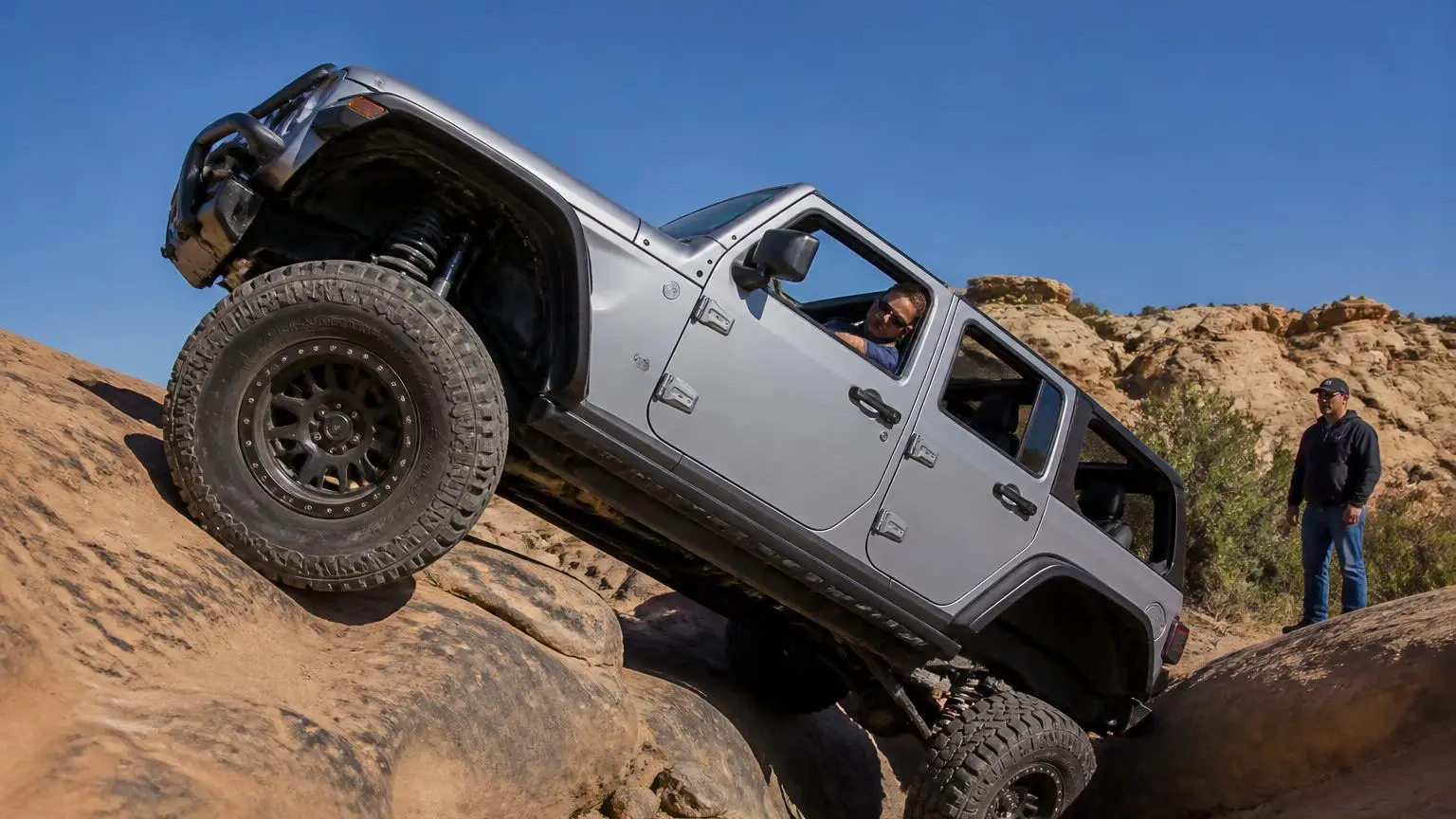
A differential lets the two wheels on an axle turn at different speeds so the vehicle can corner. Jeep describes the catch with an open differential: on a loose patch it sends power to the wheel with the least resistance, so that wheel spins while the one with grip barely moves. A locking differential locks the axle shafts together so both wheels turn at the same speed. There are two kinds:
- Selectable lockers are switched on by the driver. Jeep fits Tru-Lok electronic lockers front and rear on the Wrangler Rubicon (Sport and Sahara are open). ARB's aftermarket Air Locker uses compressed air, sent through a nylon line to the differential when you flip a dash switch.
- Automatic lockers engage on their own. Eaton says its Detroit Locker keeps both wheels driving, even with one wheel off the ground, and permits wheel speed differences as needed.
See what is a locking differential and is a locker worth it.
Limited-Slip Differentials
A limited-slip differential doesn't lock. When one wheel starts to spin, it sends extra torque to the wheel with more traction. Designs differ: some use clutch packs, and Eaton's Detroit Truetrac uses helical gears. Eaton says the Truetrac can send up to 3.5 times more torque to the high-traction wheel. Because that is a multiple of what the slipping wheel can hold, a wheel with almost no grip leaves little for a gear-type limited-slip to multiply. A locker doesn't depend on the other wheel's grip. See locker vs limited-slip.
Transfer Cases: Part-Time, Full-Time, High and Low
Jeep defines the transfer case as the unit that sends power from the transmission to the front and rear driveshafts, with high and low ranges. High range is 1:1. Low range adds a reduction. The current Wrangler offers four cases:
| Case | Type | Modes | Low range |
|---|---|---|---|
| NV241 Command-Trac (Sport, Sahara) | Part-time | 2WD High, 4WD High, Neutral, 4WD Low | 2.72:1 |
| MP3022 Selec-Trac (Moab 392) | Full-time | 4WD Auto, 4WD High, Neutral, 4WD Low | 2.72:1 |
| NV241OR Rock-Trac (Rubicon, standard) | Part-time | 2WD High, 4WD High, Neutral, 4WD Low | 4.0:1 |
| MP3022OR Rock-Trac (Rubicon, optional) | Full-time | 2WD High, 4WD Auto, 4WD High, Neutral, 4WD Low | 4.0:1 |
A part-time case has no center differential, so in 4WD the front and rear turn at the same speed. Jeep and Ford both say to keep part-time 4H and 4L off dry, hard surfaces. Full-time systems use a clutch or center differential and can stay engaged. Neutral disconnects the driveline; Jeep uses it for flat towing and for shifting into low range. See how a transfer case works and part-time vs full-time 4WD.
Crawl Ratio: The Number That Combines the Gearing
Crawl ratio is first gear × transfer case low range × axle ratio. Jeep defines it as what lets the vehicle creep along at very low speed in low range and lowest gear, and says higher is better off-road. Worked through with Stellantis's 2026 Wrangler figures:
| Configuration | 1st gear × low range × axle | Crawl ratio |
|---|---|---|
| Sport, 8-speed automatic, 3.45 axles | 4.71 × 2.72 × 3.45 | 44.2:1 |
| Sport, 6-speed manual, 3.45 axles | 5.13 × 2.72 × 3.45 | 48.1:1 |
| Rubicon, 8-speed automatic, 4.10 axles | 4.71 × 4.0 × 4.10 | 77.2:1 |
| Rubicon, 6-speed manual, 4.88 axles | 5.13 × 4.0 × 4.88 | 100.1:1 |
The last row is the "up to 100:1" figure Jeep advertises. Taller tires make every ratio effectively taller, which is one reason builders re-gear axles after a tire upgrade; see the cost to regear.
Sway Bar Disconnects
A front sway (anti-roll) bar links the left and right sides of the suspension to limit body roll on the road. Off-road, the same link stops one front wheel from dropping into a hole while the other climbs. A disconnect unlinks the bar at low speed. Jeep's Rubicon system disengages the front sway bar only in 4 Low below 18 mph. Ford's Bronco disconnect works in 4H and 4L and reconnects above 20 mph. See what is a sway bar disconnect.
Axles: What "Dana 44" Tells You
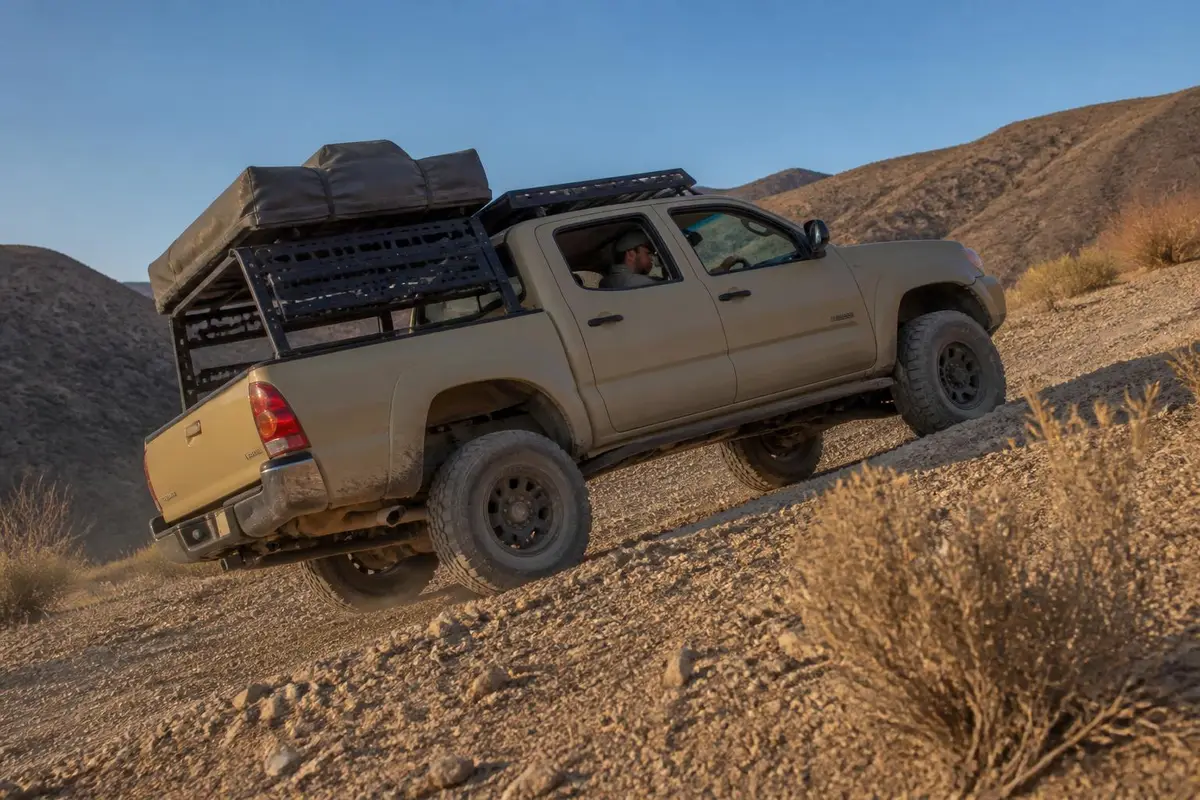
Names like Dana 30, Dana 44 and Dana 60 identify axle families from Dana's Spicer brand. Spicer lists its earlier Dana 44 with a 226 mm ring gear and its current AdvanTEK Dana 44 with a 220 mm ring gear, both rated at 8,200 Nm of torque capacity, and says the Wrangler JL and Gladiator use AdvanTEK axles. Jeep fits a Dana 44 front axle only on the Wrangler Rubicon (other trims get a Dana 30), and Stellantis lists a Dana 44 HD full-float rear on Rubicon models. See what is a Dana 44 axle and what is axle wrap.
Locking Hubs
Some trucks with solid front axles disconnect each front wheel from its axle shaft at the hub, so the front axle doesn't spin in 2WD. WARN says Arthur Warn developed its locking hub in 1948, and the company still sells manual hubs that you turn to LOCK at each wheel. Ford's 2017 Super Duty used auto-locking hubs with a manual LOCK override and says both hubs must be set to the same position. See what locking hubs do.
Brake Traction Control vs Mechanical Lockers
Jeep describes brake traction control as using the antilock brake system to brake a wheel that has lost traction, which transfers torque to the other wheel. It reacts once a wheel starts to slip. A mechanical locker drives both wheels from the start. Jeep's 4x4 systems page says its vehicles use mechanical, electronic or brake-assisted differentials, depending on the model.
How to Choose: Start With the Numbers You Already Have
Before buying drivetrain parts, pull your vehicle's spec sheet and note four things: transfer case type (part-time or full-time), low-range ratio, axle ratio and differential type front and rear. Multiply first gear by low range by axle ratio to get your crawl ratio. If the vehicle stalls with one wheel spinning, the fix is at the differential: a locker or limited-slip. If it's geared too tall to crawl slowly, the fix is gearing (low range or axle ratio). If a front wheel hangs in the air on uneven ground, the fix is articulation (sway bar disconnect or suspension).
Sources
- Jeep — 4x4 FAQ & Glossary — Definitions of open, limited-slip and locking differentials, transfer case, crawl ratio, brake traction control and front axle disconnect; part-time 4WD has no center differential and causes crow hop on dry pavement; don't use lockers on dry paved roads; neutral for flat towing and low-range shifts.
- Jeep — 4x4 Systems — Command-Trac 2.72:1, Rock-Trac 4:1, Selec-Trac full-time; Rubicon front sway bar disconnect below 18 mph in 4 Low; Dana 44 front standard only on Rubicon, Dana 30 otherwise; mechanical, electronic or brake-assisted differentials.
- Stellantis Media — 2026 Jeep Wrangler Specifications — 2026 Wrangler transfer case models, types, modes and low-range ratios; Tru-Lok front and rear on Rubicon; Dana 44 HD full-float rear; gear and axle ratios for the crawl-ratio table.
- Stellantis Media — Press Kit: What's New for 2026: Jeep Wrangler — Jeep's claim of maximum crawl ratios up to 100:1.
- Ford Owner's Manual — Using Four-Wheel Drive (2017 Expedition) — Ford: no 4H or 4L on dry, hard-surfaced roads.
- Ford — Bronco: How to Disconnect the Front Stabilizer Bar — Bronco front stabilizer bar disconnect works in 4H/4L and reconnects above 20 mph.
- Eaton — Detroit Locker Automatic Locking Differential — Detroit Locker is a 100% automatic locker that keeps both wheels driving even with one wheel lifted and permits wheel speed differences as needed.
- Eaton — Detroit Truetrac Limited-Slip Differential — Detroit Truetrac is a helical-gear limited-slip that can transfer up to 3.5 times more torque to the high-traction wheel.
- Spicer (Dana) — AdvanTEK Axle Technology — Dana 44 ring gear 226 mm (earlier) and 220 mm (AdvanTEK), both 8,200 Nm torque capacity; AdvanTEK on Wrangler JL and Gladiator JT.
- ARB — Air Locker — ARB Air Locker is a selectable locker switched by compressed air through a nylon line and can be activated at any speed.
- WARN Industries — The Benefits of Manual Locking Hubs — Arthur Warn developed the WARN locking hub in 1948; manual hubs let the wheels turn without the front driveline.
- Ford Owner's Manual — Using Four-Wheel Drive (2017 Super Duty) — 2017 Super Duty auto-locking hubs with manual LOCK override; both hubs must be set the same.