
Affiliate disclosure: As an Amazon Associate, we earn from qualifying purchases, at no extra cost to you. We research rather than test, and commissions never change our rankings. This site is reader-supported: those commissions pay for hosting, research and keeping every guide up to date, so if a guide helped you, buying through our links is an easy way to support it. How we rank · Full disclosure
TL;DR
- A locking hub connects or disconnects a front wheel from its axle shaft; the transfer case and the hubs are separate controls.
- With manual hubs in FREE, shifting into 4WD doesn't drive the front wheels. Turn both hubs to LOCK first.
- WARN says manual hubs cut front-driveline wear and improve fuel economy, and that automatic hubs don't fully disconnect the driveline.
- Ford's 2017 Super Duty auto-locking hubs have a manual override; set both to the same position, and don't drive in 4H or 4L with them in FREE.
- Many newer 4x4s have no hubs to turn and use a front axle disconnect instead.
At a Glance
| Setup | How you engage 4WD | Front driveline in 2WD |
|---|---|---|
| Manual hubs | Turn both hub dials to LOCK, then shift the transfer case | Stops turning when hubs are FREE |
| Automatic hubs with manual override (e.g., 2017 Ford Super Duty) | Shift the transfer case; hubs lock themselves, or set both to LOCK | WARN says auto hubs don't fully disconnect it |
| Front axle disconnect, no hubs to turn | Shift the transfer case; the vehicle disconnects the axle itself | Disconnected at the axle when back in 2WD (Jeep) |
What a Locking Hub Does
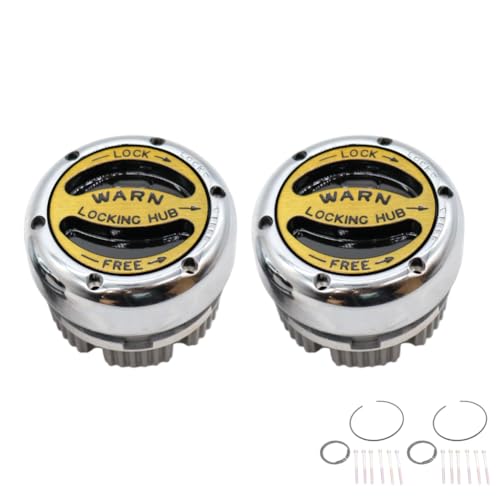
On a solid front axle, each axle shaft runs from the front differential out to the wheel hub. With a fixed hub, the wheel always turns the axle shaft, which turns the differential, which turns the front driveshaft, even in 2WD. A locking hub adds a clutch between the wheel and the shaft. WARN describes the benefit as letting the wheels rotate without turning the front driveline, which saves wear on the axles, differential and driveshaft and improves fuel economy.
WARN says Arthur Warn developed the first WARN locking hub in 1948 so that surplus World War II Jeeps could perform better on pavement. On WARN's Premium hubs, the dial takes nine-tenths of a turn to fully engage the inner drive gear with the clutch ring.
Manual Hubs vs Automatic Hubs
Manual hubs have a dial on each front wheel center marked FREE and LOCK. You have to get out and turn both before 4WD will drive the front wheels. Automatic hubs lock themselves when you shift into 4WD. WARN's position is that auto hubs trade some benefit for convenience: they don't completely disconnect the front driveline, so the axles, differential and driveshaft still turn in 2WD.
Some trucks combine the two. Ford's 2017 Super Duty manual describes hub locks that engage automatically with the 4x4 mode selected, plus a manual override. Its instructions:
- Turn the hub lock fully clockwise for LOCK, fully counterclockwise for AUTO.
- Make sure each hub is fully engaged, and set both hubs to the same position.
- Shift from 2H to 4H at a stop or while driving. For 4L, slow to 3 mph or less and put the transmission in neutral.
Hubs and the Transfer Case Are Separate Controls
The transfer case decides whether power goes to the front driveshaft, and in which range. The hubs decide whether that power reaches the wheels. With manual hubs in FREE and the transfer case in 4H, the front driveshaft and differential turn but the front wheels aren't driven. With hubs locked and the transfer case in 2H, the front wheels turn the front axle shafts and differential, but no power is sent forward. You need both for 4WD. See 4 high vs 4 low for the transfer case side.
Why Many Modern 4x4s Have No Hubs to Turn
Many newer 4x4s disconnect the front of the driveline in other ways. Jeep's glossary describes a front axle disconnect that separates the front axle from the front driveline when you shift from 4WD to 2WD, to cut front driveline wear, noise and fuel use. Full-time 4WD and AWD systems don't disconnect at all; they use a clutch or center differential so the front can turn at a different speed from the rear. A vehicle's owner's manual will say which system it uses.
Common Mistakes
- Shifting into 4WD with manual hubs still in FREE. The transfer case engages, but the front wheels aren't driven.
- Setting one hub to LOCK and the other to AUTO or FREE. Ford's instructions require both hubs in the same position.
- Driving in 4H or 4L with auto-locking hubs set to FREE. Ford's Super Duty manual warns this may damage driveline components.
- Leaving a part-time system in 4WD on dry pavement. Ford says it causes noise and tire wear and may damage drive components, whatever the hubs are set to.
See the WARN locking hubs review for one hub maker's range, and part-time vs full-time 4WD for how the transfer case type changes things.
Recommended gear
Lockers and hubs for your drivetrain
Affiliate disclosure: As an Amazon Associate, we earn from qualifying purchases, at no extra cost to you. Purchases through these links help keep this site running and up to date. Learn more
We research products from manufacturer specs and owner feedback; we don't test them ourselves. How we choose.
Sources
- WARN Industries — The Benefits of Manual Locking Hubs — What manual hubs do; wear and fuel-economy benefit; WARN's claim that automatic hubs don't fully disconnect the front driveline; 1948 origin for surplus WWII Jeeps.
- WARN Industries — Premium Manual Hubs for D44 (Internal Mount) — WARN Premium hub dial takes 9/10ths of a turn to engage the inner drive gear with the clutch ring.
- WARN — Premium Hubs — WARN's manual locking hub product range.
- Ford Owner's Manual — Using Four-Wheel Drive (2017 Super Duty) — 2017 Super Duty hub locks: LOCK clockwise, AUTO counterclockwise, both set the same; don't drive in 4H/4L with hubs in FREE; 2H to 4H on the move; 4L at 3 mph or less in neutral.
- Ford Owner's Manual — Using Four-Wheel Drive (2017 Expedition) — Ford: no 4H or 4L on dry, hard-surfaced roads.
- Jeep — 4x4 FAQ & Glossary — Front axle disconnect separates the front axle from the front driveline in 2WD; full-time 4WD uses a clutch or center differential.