
Affiliate disclosure: As an Amazon Associate, we earn from qualifying purchases, at no extra cost to you. We research rather than test, and commissions never change our rankings. This site is reader-supported: those commissions pay for hosting, research and keeping every guide up to date, so if a guide helped you, buying through our links is an easy way to support it. How we rank · Full disclosure
TL;DR
- A compressor 12V fridge is the efficient choice for trips longer than a weekend: Dometic measured under 24 Ah a day for a 40 L compressor unit, against about 94 Ah for thermoelectric and 168 Ah for absorption.
- Keep the fridge at 40°F or below and the freezer at 0°F or below, the USDA's food-safety limits; without power a closed fridge keeps food safe for about 4 hours.
- Carry at least one gallon of water per person per day (Ready.gov), and up to double that in heat.
- Awnings have no standard wind rating; follow the maker's instructions, use guy ropes and stow them in strong wind.
- Any weight on the roof raises the center of gravity and rollover risk, so mount water, fuel, batteries and tools low.
- Never run a heater or lantern inside a tent, camper or vehicle while sleeping; the CPSC warns of carbon monoxide poisoning.
12V Fridges: Compressor vs Thermoelectric vs Absorption
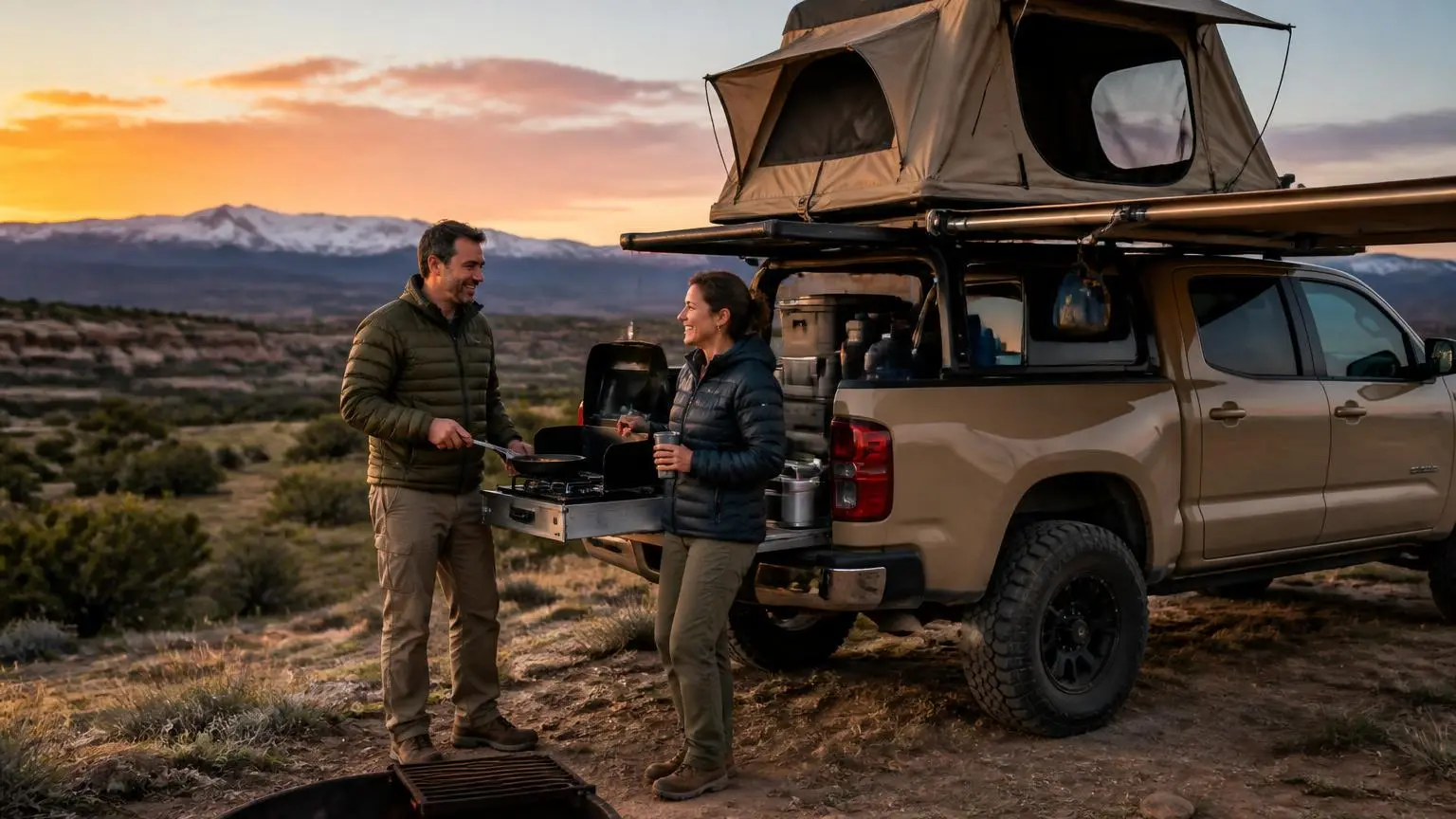
Portable powered coolers use one of three cooling methods, and they differ hugely in how much battery they use. Dometic published a side-by-side comparison of its own units on 12 volts:
| Cooling type | Dometic example | Power input | Energy per day |
|---|---|---|---|
| Compressor | CoolFreeze CFX 40W | 48 W (about 3.75 A), running about 22% of the time | Under 24 Ah |
| Thermoelectric | CoolFun SC 30 | 85 W | About 94 Ah |
| Absorption | CombiCool ACX 40 | 85 W | About 168 Ah |
The compressor unit wins because it cycles: once the box reaches its set temperature, the compressor switches off and only restarts when the inside warms. The math follows Dometic's figures: 3.75 A × 24 hours × 22% ≈ 20 Ah, inside its under-24 Ah claim. Dometic concludes that trips longer than about two days call for compressor technology. Duty cycle rises with outside temperature, how empty the fridge is and how often the lid opens, so a fridge in a hot vehicle in summer will use more than the published figure. Size the battery to the fridge's daily amp-hours plus a margin for cloudy days; the dual-battery and portable power hub covers that sizing, and best 12V fridges compares models.
Whatever the cooler, the target temperatures come from USDA's Food Safety and Inspection Service: 40°F or below for refrigerated food and 0°F or below for frozen food. FSIS recommends an appliance thermometer to confirm it, and says perishable food in a closed refrigerator stays safe for only about 4 hours without power, while a full freezer holds for about 48 hours (24 if half full). A plain ice cooler needs no battery but has to be topped up with ice to stay at or below 40°F, which is the real trade-off on a short trip.
Awnings: Weight, Guy Ropes and Wind
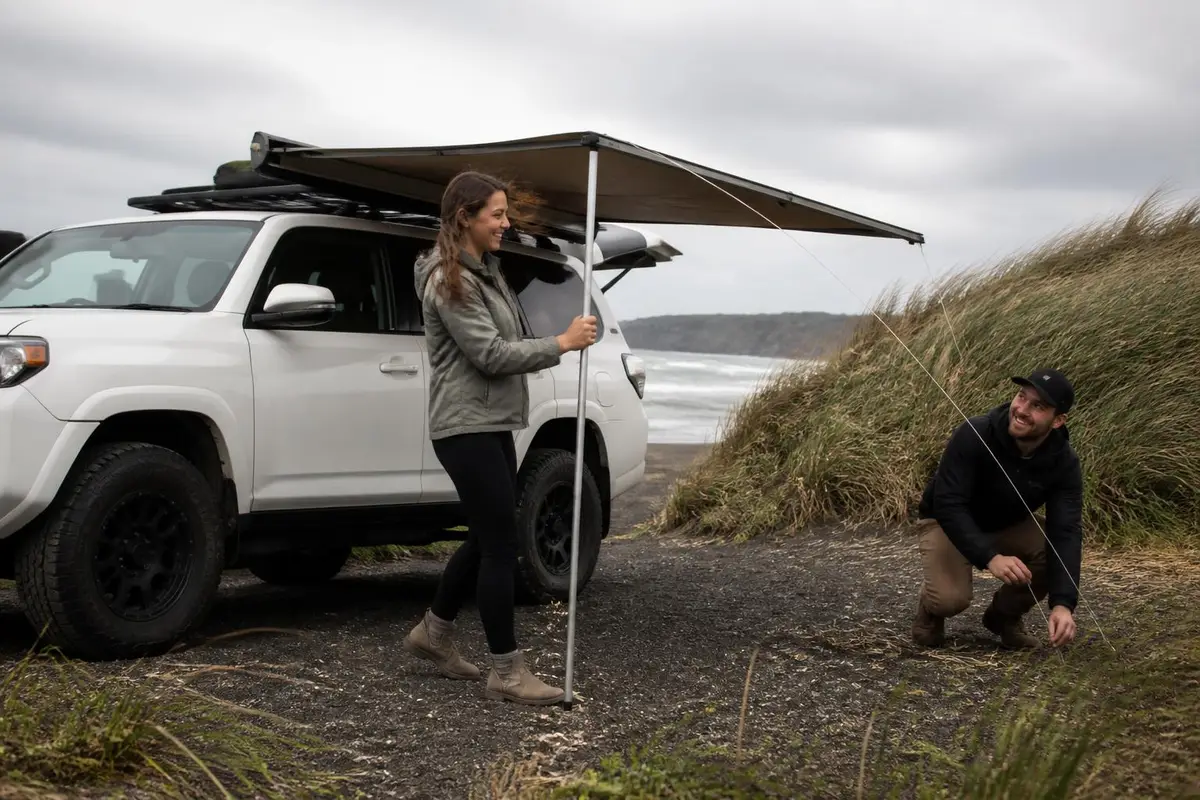
A vehicle awning bolts to roof-rack crossbars, a platform rack or a bracket and rolls out to give shade and rain cover beside the vehicle. Check its weight first, because it counts against your rack's load rating. Rhino-Rack's Batwing, for example, weighs about 20 kg (44 lb) with its mounting brackets, and the company tells owners to reduce the crossbar load capacity by that amount. Its instructions also set rules most awnings share: always use the guy ropes when it is deployed, stow it in strong winds, don't leave it open unattended, don't hang weight or strap loads on it, dry it before storing it, and remove it before an automatic car wash. Rhino-Rack also notes that shade does not block all UV, because some reflects off surrounding surfaces. There is no industry-standard wind rating for awnings, so follow the limit in your own awning's manual. Best vehicle awnings compares models.
Water: How Much to Carry and How to Keep It
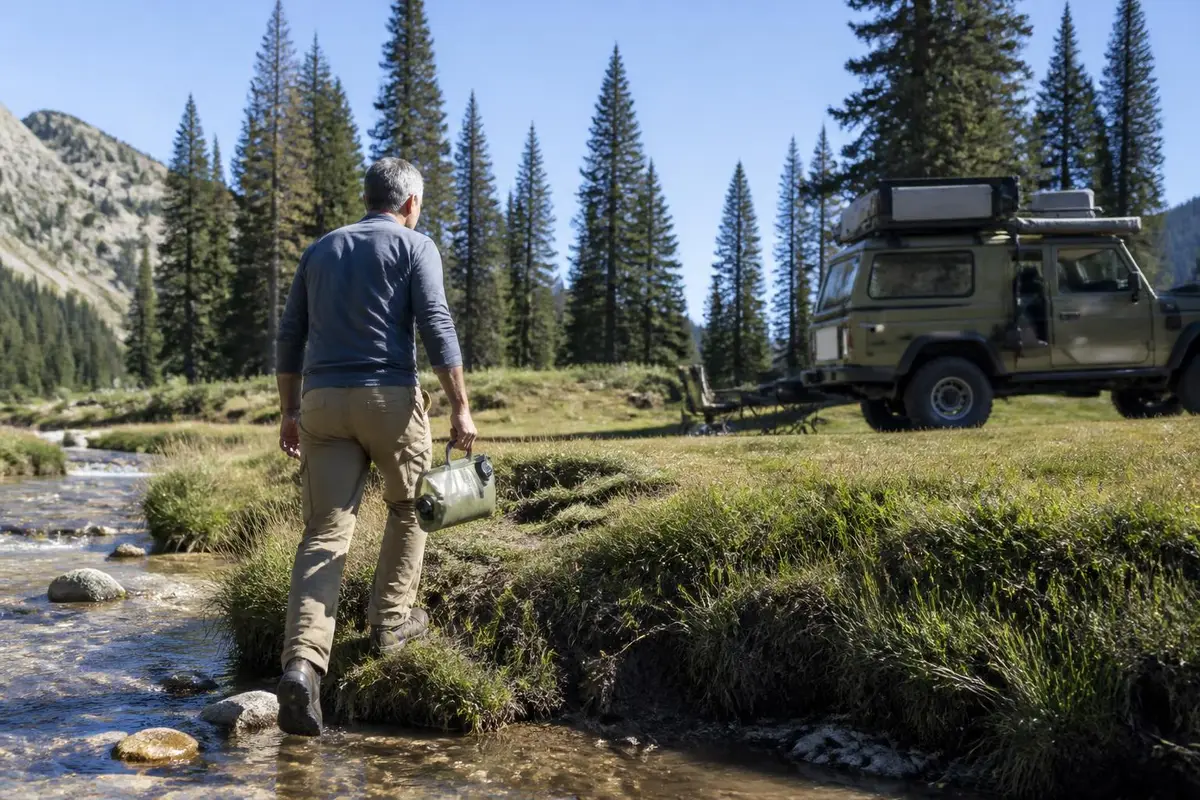
Ready.gov (FEMA) sets the planning baseline at one gallon of water per person per day for drinking and sanitation, and notes that very hot temperatures can double it. That gives a simple formula: people × days × 1 gallon, doubled for desert heat. Two people on a four-day trip need at least 8 gallons, or 16 in the heat. Water is also heavy: USGS lists water at 62.4 lb per cubic foot, about 8.34 lb per gallon, so 16 gallons weighs about 133 lb, which is why water belongs low in the vehicle.
For storage, Ready.gov says to use food-grade water containers, to replace water that is not commercially bottled every six months, and to treat questionable water with 1/8 teaspoon of unscented household bleach (5.25–6.0% sodium hypochlorite) per gallon, stirred and left 30 minutes. Never put drinking water in a container that has held fuel. The overlanding water storage guide compares rigid tanks and collapsible jugs.
Weight: Payload First, Heavy Items Low
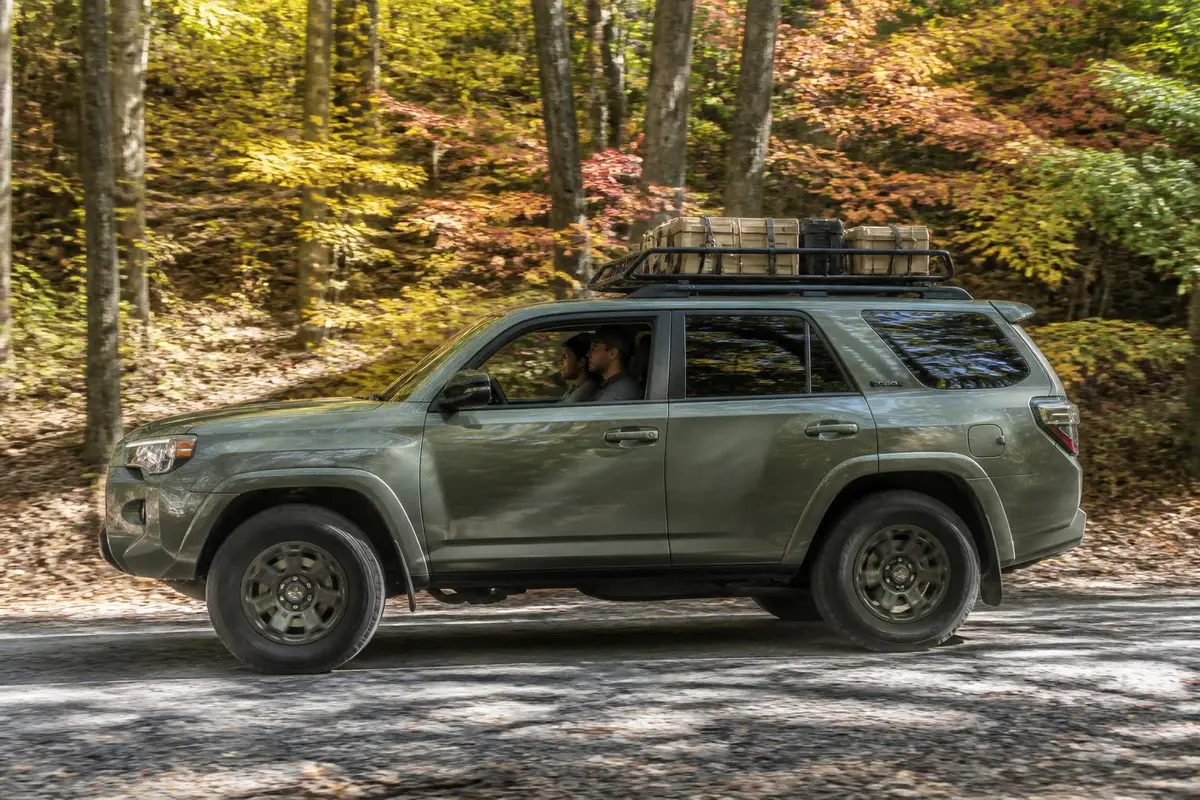
Every piece of camp gear comes out of the same payload budget as the passengers. Federal rule 49 CFR 575.6 requires the owner's manual to explain the steps: find the combined occupant-and-cargo limit on the door placard, subtract the weight of everyone riding, and what remains is your cargo capacity. Where that weight sits matters too. NHTSA's rollover information explains that rollover resistance depends on center-of-gravity height relative to track width, and that any load on the roof sits above the vehicle's center of gravity and increases the likelihood of rolling over. Put the heaviest items (water, fuel, batteries, tools and recovery gear) low and centered in the bed or cargo area, and use the roof for light, bulky items. For the roof itself, Thule defines the dynamic load as the combined weight of the tent or cargo and the racks while driving, and that is the rating to check.
Camp Kitchen: Chuck Box vs Slide-Out Drawer
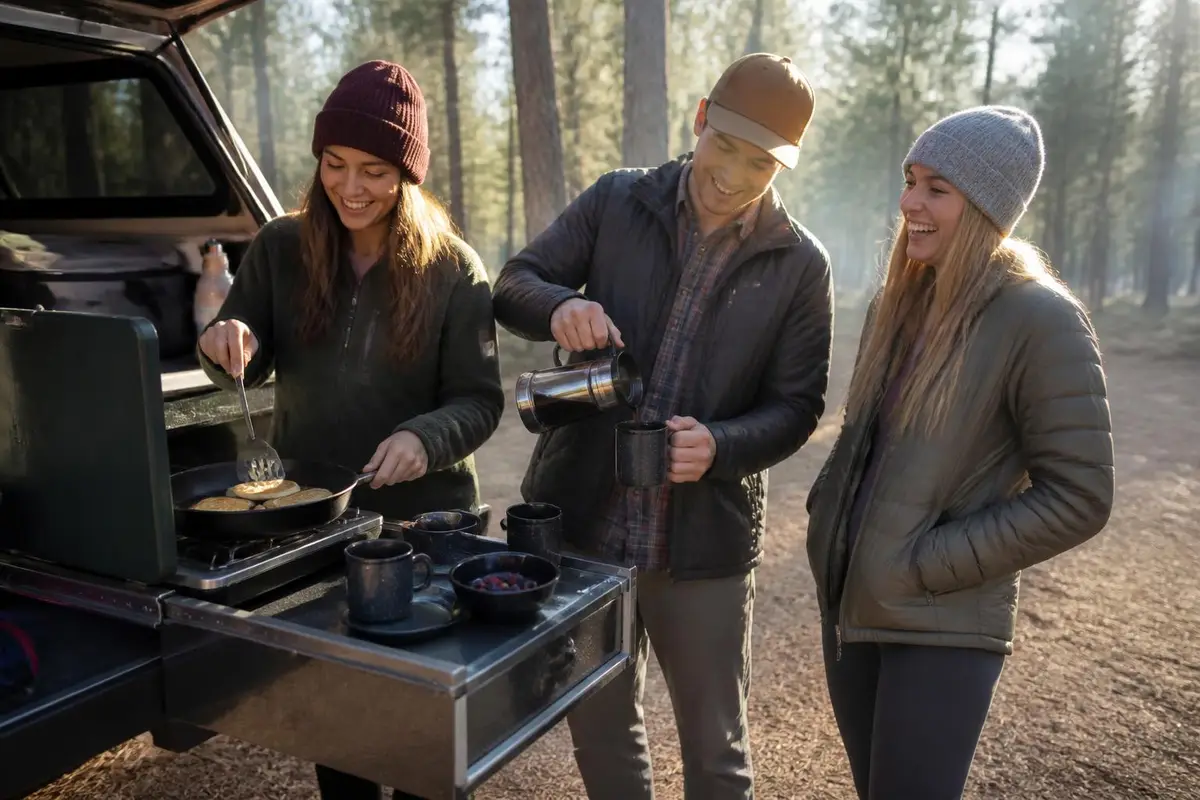
A chuck box is a self-contained box holding a stove, utensils and a prep surface that lifts out of the vehicle when you are not camping. A slide-out drawer system bolts into the truck bed or SUV cargo floor for faster access at camp, but it takes that space permanently. The choice is removability against setup speed; see camp kitchen boxes and camp kitchen setup. Whatever you cook on, the CPSC's rule for fuel-burning camping equipment applies: never use portable heaters or lanterns while sleeping in enclosed areas such as tents, campers and vehicles, because of carbon monoxide, and the risk is greater at high altitude. Cook outside the tent, and treat headache, dizziness, nausea, sleepiness or confusion at camp as possible CO warning signs.
Trash, Dishwater and Human Waste
The Leave No Trace principles, as published by the National Park Service, are specific. Pack out all trash and leftover food. To wash dishes, carry water at least 200 feet from streams or lakes, use small amounts of biodegradable soap, strain out the food scraps (they go out with the trash) and scatter the strained water. Bury solid human waste in catholes 6 to 8 inches deep, at least 200 feet from water, camp and trails, and pack out toilet paper and hygiene products. Camp at least 200 feet from lakes and streams. On BLM land, the agency's camping rules add pack-it-in, pack-it-out and the use of existing campsites. Some permit areas require you to carry out all gray water and use a portable toilet instead, so check the local rule for your route.
Camp Lighting and Power
Lighting wired to the vehicle's auxiliary battery draws from the same battery as the fridge, so add it to the daily budget: amps equal watts divided by volts, so a 12 W LED strip on 12 V draws 1 A, or 5 Ah over a five-hour evening. Added to a compressor fridge's roughly 24 Ah, that is about 29 Ah a day before charging. Rechargeable lanterns and headlamps carry their own batteries and move around camp freely.
How to Choose Overlanding Gear
Work from the numbers above. Size the fridge's daily amp-hours against your battery, size water to people × days × one gallon (more in heat), add the weight of the fridge, water, awning and kitchen to your passengers and check the total against the door-placard limit, and put the heavy items low. Choose an awning whose weight your rack can carry. Products on this hub are weighed on their published specifications and owner-reported reliability; we do not buy or test this gear ourselves. See how we rank and the affiliate disclosure.
Sources
- Dometic Support — What Is the Most Energy Efficient Cooler? — Daily energy use of Dometic's compressor (under 24 Ah, 48 W at about 22% duty), thermoelectric (about 94 Ah) and absorption (about 168 Ah) coolers, and its advice to use compressor units for trips over two days.
- USDA Food Safety and Inspection Service — Keep Your Food Safe During Emergencies — Refrigerator at 40°F or below and freezer at 0°F or below; food safe about 4 hours in a closed fridge without power; full freezer about 48 hours (24 if half full); keep ice coolers at 40°F or below.
- Rhino-Rack — Batwing Awning Fitting Instructions (PDF) — Batwing weighs about 20 kg with brackets and reduces crossbar load capacity; always use guy ropes, stow in strong winds, don't leave open unattended, don't load the awning, dry before storing, remove for car washes; shade doesn't block all UV.
- Ready.gov (FEMA) — Water — At least one gallon per person per day, doubling in very hot conditions; food-grade containers; replace non-commercial stored water every six months; 1/8 teaspoon of 5.25–6.0% bleach per gallon, 30 minutes.
- U.S. Geological Survey — Water Density — Water density of about 62.4 lb per cubic foot, or about 8.34 lb per gallon, used for the water-weight example.
- 49 CFR 575.6 — Owner's manual load-limit steps (Cornell LII) — Steps for finding cargo capacity from the door-placard occupant-and-cargo limit.
- National Academies (TRB Special Report 265) — Rollover Information from NHTSA — Rollover resistance depends on center-of-gravity height and track width; any roof load sits above the center of gravity and increases the likelihood of rolling over.
- Thule — What Roof Racks Do I Need for a Rooftop Tent? — Definition of dynamic load: the combined weight of the tent and the racks while driving.
- CPSC — Portable Heaters & Camping Equipment (Carbon Monoxide) — Never use fuel-burning heaters or lanterns while sleeping in tents, campers or vehicles; greater risk at altitude; CO symptoms.
- National Park Service — Leave No Trace Seven Principles — Pack it in, pack it out; dishwater carried 200 feet from water, strained and scattered with minimal biodegradable soap; catholes 6–8 inches deep and 200 feet from water, camp and trails; camp 200 feet from lakes and streams.
- Bureau of Land Management — Camping on Public Lands — Pack-it-in, pack-it-out trash rule and use of existing campsites on BLM public land.