

Affiliate disclosure: As an Amazon Associate, we earn from qualifying purchases, at no extra cost to you. We research rather than test, and commissions never change our rankings. This site is reader-supported: those commissions pay for hosting, research and keeping every guide up to date, so if a guide helped you, buying through our links is an easy way to support it. How we rank · Full disclosure
TL;DR
- Budget from real numbers: Dometic rates its CFX3 55IM fridge at 82 kWh a year, about 19 Ah a day on a 12 V battery.
- Size an AGM bank at twice the capacity you plan to use (Lifeline's rule); Battle Born says a LiFePO4 battery can use 80 to 100 percent of its rating.
- A voltage-sensitive relay only switches the batteries together; a DC-DC charger regulates voltage and current, which Victron calls indispensable with smart alternators.
- A 100 Ah LiFePO4 battery weighs about half as much as a similar AGM (31 lb for Battle Born's BB10012 vs 64 lb for Lifeline's 105 Ah GPL-31T), but it won't charge below freezing.
- Portable power stations charge slowly from a 12 V socket: about 90 W on average for Jackery's 1,070 Wh Explorer 1000 v2.

At a Glance
| Setup | How it charges while driving | Best for | Main limit |
|---|---|---|---|
| Second battery + voltage-sensitive relay | A relay joins the batteries once the alternator raises the voltage | An AGM second battery on a fixed-voltage alternator | No current or voltage control; may not switch on with a smart alternator |
| Second battery + DC-DC charger | The charger turns alternator power into a set charge profile | Lithium batteries, smart alternators and long cable runs | Output is capped by the charger's rating (for example 18 A or 30 A) |
| Portable power station | Plugs into a 12 V socket | Occasional trips, and power you carry away from the vehicle | Slow charging from the vehicle; AC use adds inverter losses |
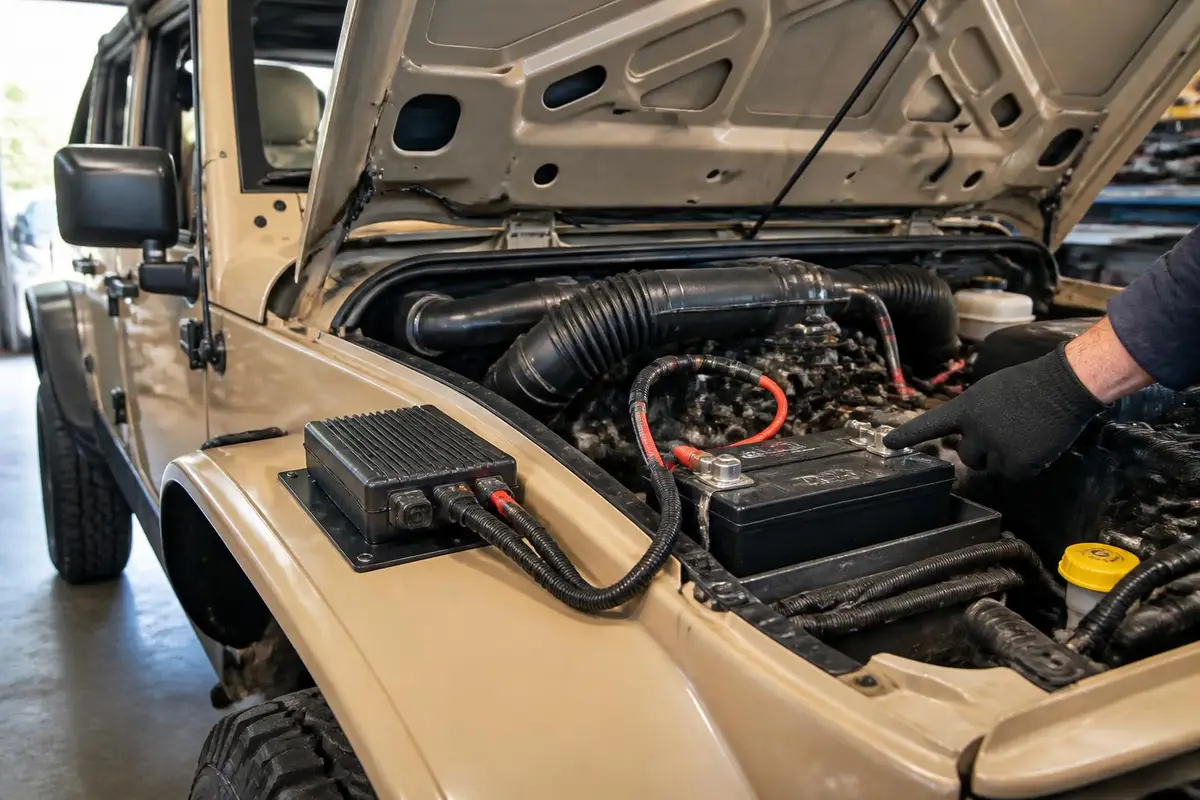
What a Dual-Battery System Does
A dual-battery system adds an auxiliary battery to run camp loads, and keeps the starting battery separate so the engine can still start. Dometic's CFX3 manual shows the trade-off of skipping it. The fridge has three battery-protection levels, which switch it off at 10.1 V (LOW), 11.2 V (MEDIUM) or 11.8 V (HIGH) on a 12 V supply and restart it at 11.4, 12.2 or 12.6 V. Dometic says to use MEDIUM or HIGH on a starter battery and LOW on a dedicated supply battery. On a starter battery, then, the fridge shuts off long before the battery's capacity is used.
Charging the Second Battery: Relay or DC-DC Charger
Blue Sea Systems describes automatic charging relays (also called combiners or voltage-sensitive relays) as switches that close when one battery rises to about 13.2 to 13.7 V, a sign it is being charged, and open again at about 12.4 to 13.1 V. Its SI-ACR, for example, combines at 13.0 V held for 90 seconds or 13.6 V for 30 seconds, separates at 12.75 V for 30 seconds or 12.35 V for 10 seconds, and is rated for 120 A continuously. Older diode isolators do the same job with one-way diodes but lose about 0.7 V across them, so the second battery sees a lower charging voltage. See how a dual-battery isolator works.
A DC-DC charger sits between the batteries and runs its own bulk, absorption and float stages. Victron gives two reasons to use one: smart alternators vary their output between about 12.5 V and 15 V, and a lithium battery's low impedance can overload an alternator when it is connected directly. Victron's Orion-Tr Smart 12/12-18 and 12/12-30 deliver 18 A and 30 A continuously at 40°C, at 87 percent efficiency.
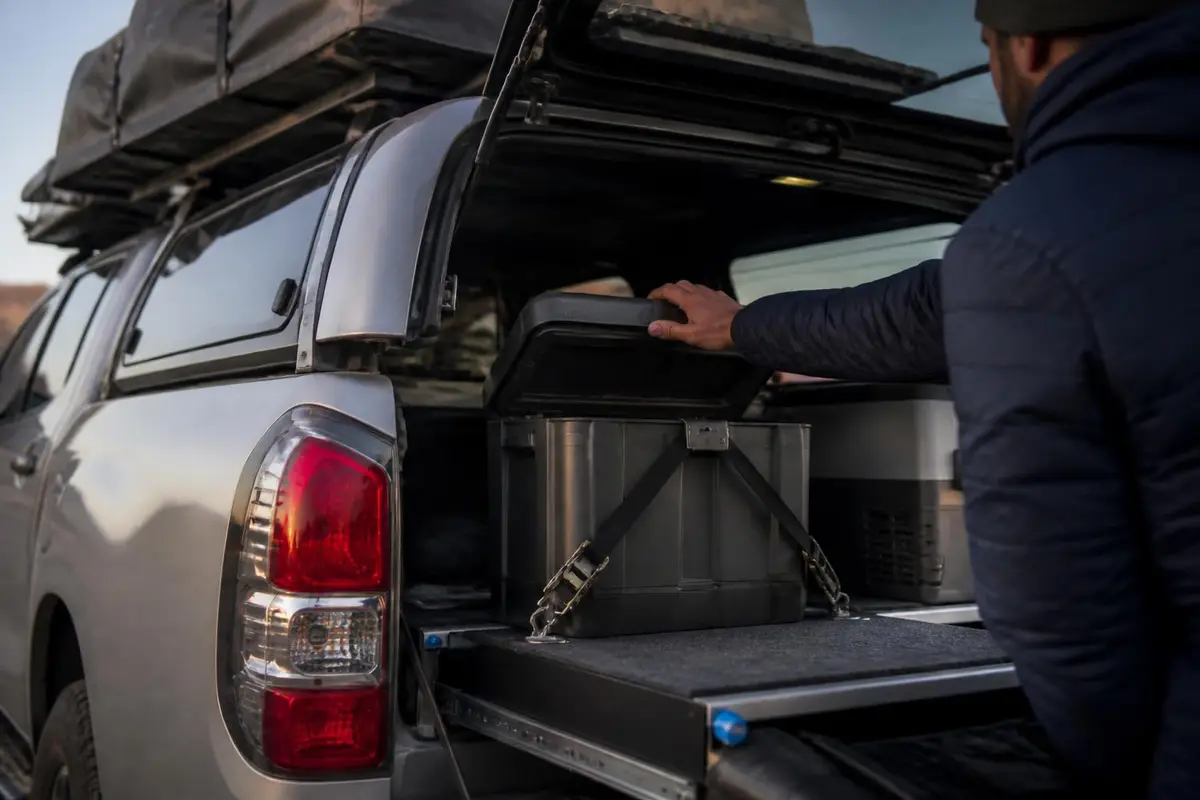
Portable Power Stations: Watt-Hours and Inverter Losses
A portable power station packs a battery, a charge controller and an inverter into one case, and is rated in watt-hours. Jackery's Explorer 1000 v2, for example, is rated at 1,070 Wh with 1,500 W of AC output and LiFePO4 cells. Jackery quotes 1.7 hours to charge it from a wall outlet but 12 hours from a car, which works out to about 90 W on average from a 12 V socket. Power used through the AC outlets also passes through the inverter. Victron lists maximum efficiencies of 87 to 92 percent for its own 250 VA to 1,600 VA inverters, and an inverter uses some power just by being switched on. Running 12 V devices from the station's DC ports avoids that conversion.

Sizing a Real Power Budget
Start with the fridge. Dometic lists the annual energy use of each CFX3 model; dividing by 365 days and 12 volts gives a daily figure in amp-hours:
| Dometic model | Rated energy use | Per day at 12 V | Rated current when running |
|---|---|---|---|
| CFX3 45 | 79 kWh/year | ≈ 18 Ah | 8.2 A |
| CFX3 55IM | 82 kWh/year | ≈ 19 Ah | 8.9 A |
| CFX3 75DZ | 108 kWh/year | ≈ 25 Ah | 9.6 A |
| CFX3 95DZ | 111 kWh/year | ≈ 25 Ah | 10.4 A |
These are standardized ratings; heat and frequent lid opening push real use higher. For every other device, amps × hours of use gives amp-hours per day. Then turn the daily total into a battery size. Lifeline, an AGM maker, says to choose a rated capacity at least twice what the load needs, which keeps the average depth of discharge at 50 percent. Battle Born says its LiFePO4 batteries can use 80 to 100 percent.
Worked example: a CFX3 55IM (19 Ah) plus 15 Ah of lights and charging is 34 Ah a day, and two days without charging is 68 Ah. That calls for about 136 Ah of AGM, or about 85 Ah of lithium used to 80 percent. The sizing calculator runs this for your own numbers, and the runtime calculator works it backward for a battery you already own.
AGM vs LiFePO4: The Numbers
| AGM (Lifeline GPL-31T) | LiFePO4 (Battle Born BB10012) | |
|---|---|---|
| Rated capacity and weight | 105 Ah, 64 lb | 100 Ah, 31 lb |
| Recommended use per cycle | About 50% (rate the battery at twice the load) | Up to 100% usable |
| Cycle life | About 1,000 cycles at 50% depth of discharge (Lifeline chart) | 3,000–5,000 cycles (Battle Born's claim) |
| Charging in the cold | Charges below freezing, at a higher voltage as it gets colder | The BMS blocks charging below freezing |
| Charge voltage | 14.3 V absorption, 13.3 V float at 77°F | 14.2–14.6 V absorption, 13.4–13.8 V float, no temperature compensation |
Lifeline's chart shows how steeply AGM life depends on depth of discharge: roughly 5,000 cycles at 10 percent but only about 350 at 100 percent. There is more detail in choosing a lithium battery for a truck.

Solar Input: Rated Watts vs Real Sun
A panel's watt rating is measured at Standard Test Conditions: 1,000 W/m² of sunlight at a cell temperature of 25°C. Daily sunlight is measured in kWh per square meter per day, which is the same number as "peak sun hours." NLR (formerly NREL) data for a flat, horizontal surface show how widely it varies: about 8.0 in Moab in June, 2.5 there in December, and 0.84 in Seattle in December. Hot panels also lose output; Victron's BlueSolar panels lose 0.45 percent of their power for each degree Celsius above 25°C. The solar sizing calculator shows what those numbers mean for panel size.
Battery Mounting and Ventilation
AGM batteries are sealed but not gas-free. Lifeline's manual says all lead-acid batteries, AGM included, release small amounts of hydrogen and oxygen through the relief valve during charging. Hydrogen can ignite at concentrations as low as 4 percent in air, so Lifeline says never to put its AGM batteries in a sealed or airtight container. Heat matters too: Lifeline's self-discharge chart shows a stored AGM falling to about 50 percent charge in roughly 15 months at 68°F, but in about 5 months at 104°F. Battle Born says its BB10012 can be mounted in any orientation, and it specifies a Type 3R enclosure when the battery is used outdoors.
Fusing and Cable Size
Every cable from a battery needs a fuse near the battery, rated to protect that cable. Victron's Wiring Unlimited guide recommends keeping voltage drop to 2.5 percent or less — 0.3 V on a 12 V system — and shows why. A 2,400 W inverter drawing 200 A through two 1.5-meter, 16 mm² cables loses 0.64 V, about 5 percent of the energy, as heat. For lithium banks, Victron adds that at least one fuse must have an interrupt rating equal to or greater than the battery's maximum short-circuit current, because lithium can deliver very high fault currents. For its 12 V Orion-Tr Smart chargers, Victron specifies a 60 A fuse and at least 10 mm² cable for 1–2 m runs, or 16 mm² for 5–10 m runs.
How We Rank Dual-Battery and Power Station Products
Products on this hub are compared on their manufacturer ratings — amp-hours or watt-hours, charge method, charge current and inverter efficiency — alongside aggregated owner reviews. We do not buy or physically test this gear; see how we rank and our affiliate disclosure.
Sources
- Dometic — CFX3 Mobile Cooling Operating Manual (CFX3 25/35/45/55IM/75DZ/95DZ/100) — CFX3 battery-protection cutoffs (10.1/11.2/11.8 V, restart 11.4/12.2/12.6 V at 12 V), the advice to use MEDIUM or HIGH on a starter battery, and each model's rated current and annual energy use used for the daily amp-hour table.
- Blue Sea Systems — Battery Isolators and Automatic Charging Relays — How automatic charging relays combine at about 13.2–13.7 V and open at about 12.4–13.1 V, and the ~0.7 V drop across diode isolators.
- Blue Sea Systems — SI-ACR Automatic Charging Relay 12/24V DC 120A (7610) specifications — SI-ACR combine and open voltages and times, and its 120 A continuous rating.
- Victron Energy — Orion-Tr Smart DC-DC Charger Isolated manual: Introduction — Controlled charging is indispensable with smart alternators and protects the alternator in lithium systems, where the battery's low impedance can overload it.
- Victron Energy — Orion-Tr Smart DC-DC Charger Isolated manual: Engine shutdown detection — Smart alternators produce a variable 12.5–15 V instead of a fixed voltage.
- Victron Energy — Orion-Tr Smart DC-DC Charger Isolated manual: Specifications — Orion-Tr Smart 12/12-18 and 12/12-30 continuous output (18 A and 30 A at 40°C) and 87% efficiency.
- Victron Energy — Orion-Tr Smart DC-DC Charger Isolated manual: Installation — 60 A fuse and minimum 10 mm² (1–2 m) or 16 mm² (5–10 m) cable for 12 V Orion-Tr Smart chargers.
- Victron Energy — Inverter VE.Direct 250VA–1600VA datasheet — Maximum efficiency of 87–92% across Victron's 250–1,600 VA inverters, and the 12/800's 6.5 W no-load and ~1 W ECO-mode draw.
- Jackery — Explorer 1000 v2 Portable Power Station — Explorer 1000 v2 rated 1,070 Wh, 1,500 W AC output, LiFePO4, with charging times of 1.7 hours from a wall outlet and 12 hours from a car.
- Lifeline Batteries (Concorde) — Technical Manual for Lifeline AGM batteries, Doc. 6-0101 Rev. F — Rate an AGM battery at twice the load (50% average depth of discharge); cycle life vs depth of discharge chart; 14.3 V absorption and 13.3 V float at 77°F; hydrogen release, 4% ignition threshold and the ban on sealed containers; self-discharge vs storage temperature chart.
- Lifeline Batteries — GPL-31T AGM battery specifications — GPL-31T AGM: 105 Ah at the 20-hour rate, 64 lb.
- Battle Born Batteries — 100Ah 12V LiFePO4 battery (BB10012) manual — BB10012: 100 Ah, 31 lb, 3,000–5,000 cycle claim, 14.2–14.6 V absorption and 13.4–13.8 V float with no temperature compensation, no charging below freezing, mount in any orientation, Type 3R enclosure outdoors.
- Battle Born Batteries — AGM vs. Lithium Batteries — LiFePO4 usable depth of discharge of 80–100%.
- NLR (formerly NREL) — Solar Resource Data API (NSRDB-based solar resource averages) — Daily solar resource (kWh/m² per day) for Moab and Seattle, flat horizontal surface.
- Victron Energy — BlueSolar Monocrystalline Panels datasheet — Standard Test Conditions of 1,000 W/m² and 25°C, and a −0.45%/°C power temperature coefficient.
- Victron Energy — Wiring Unlimited — 2.5% voltage-drop guideline, the 2,400 W / 200 A / 16 mm² cable-loss example, and the requirement for a fuse interrupt rating at or above a lithium bank's short-circuit current.