

Affiliate disclosure: As an Amazon Associate, we earn from qualifying purchases, at no extra cost to you. We research rather than test, and commissions never change our rankings. This site is reader-supported: those commissions pay for hosting, research and keeping every guide up to date, so if a guide helped you, buying through our links is an easy way to support it. How we rank · Full disclosure
Enter your battery bank's rated amp-hours, its chemistry and your estimated daily draw below to see how many days it runs before it needs recharging — with no charging input at all.

How This Is Calculated
Usable capacity (Ah) = rated capacity × depth of discharge. Days until empty = usable capacity ÷ (fridge Ah/day + other electronics Ah/day). Continuous-load runtime (hours) = usable capacity ÷ continuous amps.
Depth-of-discharge settings from Lifeline's AGM technical manual (rate at twice the load, 50% average discharge) and Battle Born's LiFePO4 guidance (80–100% usable; 80% used here).
This is a no-recharge planning estimate from the numbers you enter, not a guaranteed runtime. Real batteries lose usable capacity in cold weather, and voltage sag or a BMS cutoff can end runtime slightly before the mathematical figure is reached.
TL;DR
- Usable capacity, not the rating, sets runtime: plan on about 50% of an AGM (Lifeline's rule) and 80% of a LiFePO4 battery.
- A Dometic CFX3 55IM fridge is rated at 82 kWh a year, about 19 Ah a day at 12 V.
- With 34 Ah a day of load, a 100 Ah lithium battery lasts about 2.4 days and a 100 Ah AGM about 1.5 days.
- Heavy loads shrink AGM capacity: Lifeline's curves show about 60% of the rating at a 1-hour discharge.
- Cold cuts capacity too: about 90% of an AGM's rating at 32°F, and Battle Born's lithium won't charge below freezing.

Appliance Power-Draw Reference Table
The figures below are each manufacturer's own published ratings for one specific model. A compressor fridge's rated current is its draw while the compressor runs; because it cycles on and off, the daily figure comes from its rated annual energy use instead (divided by 365 days and 12 volts).
| Device | Manufacturer-Rated Draw | Source |
|---|---|---|
| Dometic CFX3 55IM compressor fridge/freezer | 8.9A at 12V DC while running; rated 82 kWh/year (≈ 19 Ah a day at 12V) | Dometic CFX3 Operating Manual |
| Dometic CFX3 95DZ dual-zone fridge/freezer | 10.4A at 12V DC while running; rated 111 kWh/year (≈ 25 Ah a day at 12V) | Dometic CFX3 Operating Manual |
| ARB Twin Motor Onboard Air Compressor (CKMTA12) | Up to 68.6A at 12V DC (maximum; rated for 100% duty cycle) | ARB USA product page |
| RIGID Industries E-Series PRO 20" LED light bar (Spot/Flood) | 15.29A at 14V (214W) | RIGID Industries product page |
| Victron Phoenix 12/800 inverter, switched on with no load | 6.5W (≈ 0.54A, or 13 Ah a day); about 1W in ECO mode | Victron Inverter VE.Direct datasheet |
Worked Example: 100 Ah AGM vs 100 Ah Lithium
Take a CFX3 55IM (about 19 Ah a day) plus 15 Ah of lights, phone charging and a fan: 34 Ah a day. A 100 Ah lithium battery used to 80 percent gives 80 Ah, which lasts about 2.4 days. A 100 Ah AGM used to 50 percent gives 50 Ah, which lasts about 1.5 days. Leave an inverter switched on with nothing plugged in and add Victron's 12/800 idle draw of about 13 Ah a day, and the lithium figure drops to about 1.7 days. Switching the inverter off, or using its ECO mode, is worth more than most other savings.

Why Depth of Discharge, Not Rated Ah, Is the Number That Matters
Lifeline's technical manual says to size an AGM battery at twice the capacity the load needs, which limits the average depth of discharge to 50 percent. Its cycle-life chart shows why: about 1,000 cycles at 50 percent depth of discharge, and only about 350 at 100 percent. Battle Born says its LiFePO4 batteries can use 80 to 100 percent of their rating and quotes 3,000 to 5,000 cycles. The calculator uses 50 percent for AGM and a conservative 80 percent for lithium.
High Loads Shrink an AGM's Capacity
AGM capacity is rated at the 20-hour rate, meaning the current that would drain it in 20 hours (about 5 A for a 105 Ah battery). Draw faster and it delivers less. Lifeline's discharge curves show about 60 percent of rated capacity at the 1-hour rate and about 90 percent at the 8-hour rate. Its published discharge formula for the GPL-31 puts numbers on it: at the ARB compressor's 68.6 A, the battery reaches its 10.5 V end point in about an hour, after delivering roughly 68 Ah rather than its rated 105. The "Runtime at Continuous Load" output above does not include that effect; for a load that size on AGM, expect roughly two-thirds of the figure it shows. Lithium holds up better, but check the battery's current limit: Battle Born rates its BB10012 at 100 A continuous and 200 A for 30 seconds.
Cold Weather Reduces Usable Capacity
Lifeline's capacity-versus-temperature chart shows an AGM giving about 90 percent of its room-temperature (77°F) capacity at 32°F and about 68 percent at −4°F at the 20-hour rate, and much less at high currents: about 44 percent at 32°F at the 1-hour rate. Lithium has a different limit. Battle Born's manual says its battery management system will not accept a charge below 32°F (0°C) but keeps supplying power down to −4°F (−20°C). The calculator assumes room-temperature capacity, so enter a lower amp-hour figure for cold trips.
Checking the Real State of Charge
For AGM, resting voltage is a usable guide. Lifeline's table, measured after at least four hours with no charge or load, gives 12.78 V or more at 100 percent, 12.48 V at 75 percent, 12.18 V at 50 percent and under 11.58 V when empty. Those are figures for aged batteries; a new one reads somewhat higher. For any chemistry, a shunt-based battery monitor, which counts the amp-hours flowing in and out, gives a measured daily draw to enter above instead of an estimate.
Sizing a New System? Use the Solar/Battery Sizing Calculator Instead
This page assumes you already own the battery. To decide what battery bank and solar array to buy for a target number of days, use the dual-battery and solar sizing calculator. It runs the same depth-of-discharge math in the other direction.
How We Research This
The depth-of-discharge, discharge-rate and temperature figures come from Lifeline's AGM technical manual and Battle Born's LiFePO4 battery manual, and the appliance figures come from each manufacturer's own manual or product page, cited above and in the sources below. See how we rank for the site's full research method.
Recommended gear
Portable power for camp and the trail
Affiliate disclosure: As an Amazon Associate, we earn from qualifying purchases, at no extra cost to you. Purchases through these links help keep this site running and up to date. Learn more


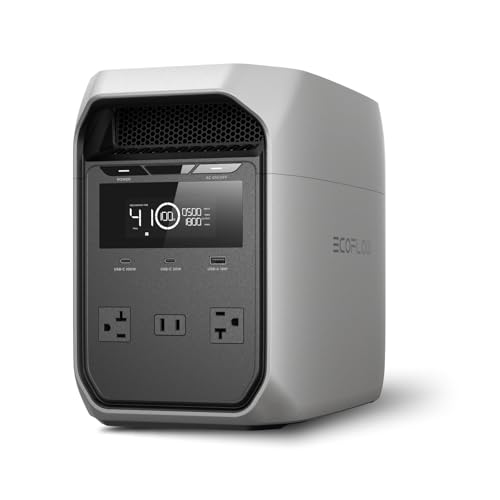
We research products from manufacturer specs and owner feedback; we don't test them ourselves. How we choose.
Sources
- Dometic — CFX3 Mobile Cooling Operating Manual (CFX3 25/35/45/55IM/75DZ/95DZ/100) — CFX3 55IM and 95DZ rated current at 12 V (8.9 A, 10.4 A) and rated annual energy use (82 and 111 kWh/year) used for the daily amp-hour figures; battery-protection cutoff voltages.
- ARB USA — Twin Motor Onboard 12V Air Compressor (CKMTA12) — CKMTA12 maximum current draw (68.6 A) and 100% duty-cycle rating.
- RIGID Industries — E-Series PRO 20" Spot/Flood Combo LED Light Bar — 214 W / 15.29 A current draw at 14 V.
- Victron Energy — Inverter VE.Direct 250VA–1600VA datasheet — Phoenix 12/800 no-load draw of 6.5 W and about 1 W in ECO mode.
- Lifeline Batteries (Concorde) — Technical Manual for Lifeline AGM batteries, Doc. 6-0101 Rev. F — Rate AGM at twice the load (50% average depth of discharge); cycle life vs depth of discharge; discharge curves at 1-hour to 120-hour rates and the GPL-31 discharge formula; capacity vs temperature; open-circuit voltage vs state of charge table.
- Battle Born Batteries — 100Ah 12V LiFePO4 battery (BB10012) manual — BB10012 usable depth of discharge, 3,000–5,000 cycle claim, 100 A continuous / 200 A 30-second limits, low-voltage disconnect (~10.6 V), and charging blocked below 32°F while discharge continues to −4°F.
- Battle Born Batteries — AGM vs. Lithium Batteries — LiFePO4 usable depth of discharge of 80–100% vs about 50% for AGM.