
Affiliate disclosure: As an Amazon Associate, we earn from qualifying purchases, at no extra cost to you. We research rather than test, and commissions never change our rankings. This site is reader-supported: those commissions pay for hosting, research and keeping every guide up to date, so if a guide helped you, buying through our links is an easy way to support it. How we rank · Full disclosure
TL;DR
- GMRS needs an FCC license: 18 or older, 10-year term, and your immediate family can use it too. FRS radios need no license.
- The FCC puts GMRS range at 1 to 25 miles, depending on station type, terrain and whether you use a repeater.
- Mobile radios can run up to 50 W on the main channels; FRS handhelds are capped at 2 W, and 0.5 W on channels 8–14.
- Repeaters listen on 467 MHz and retransmit on 462 MHz, and you need the right offset and tone programmed in advance.
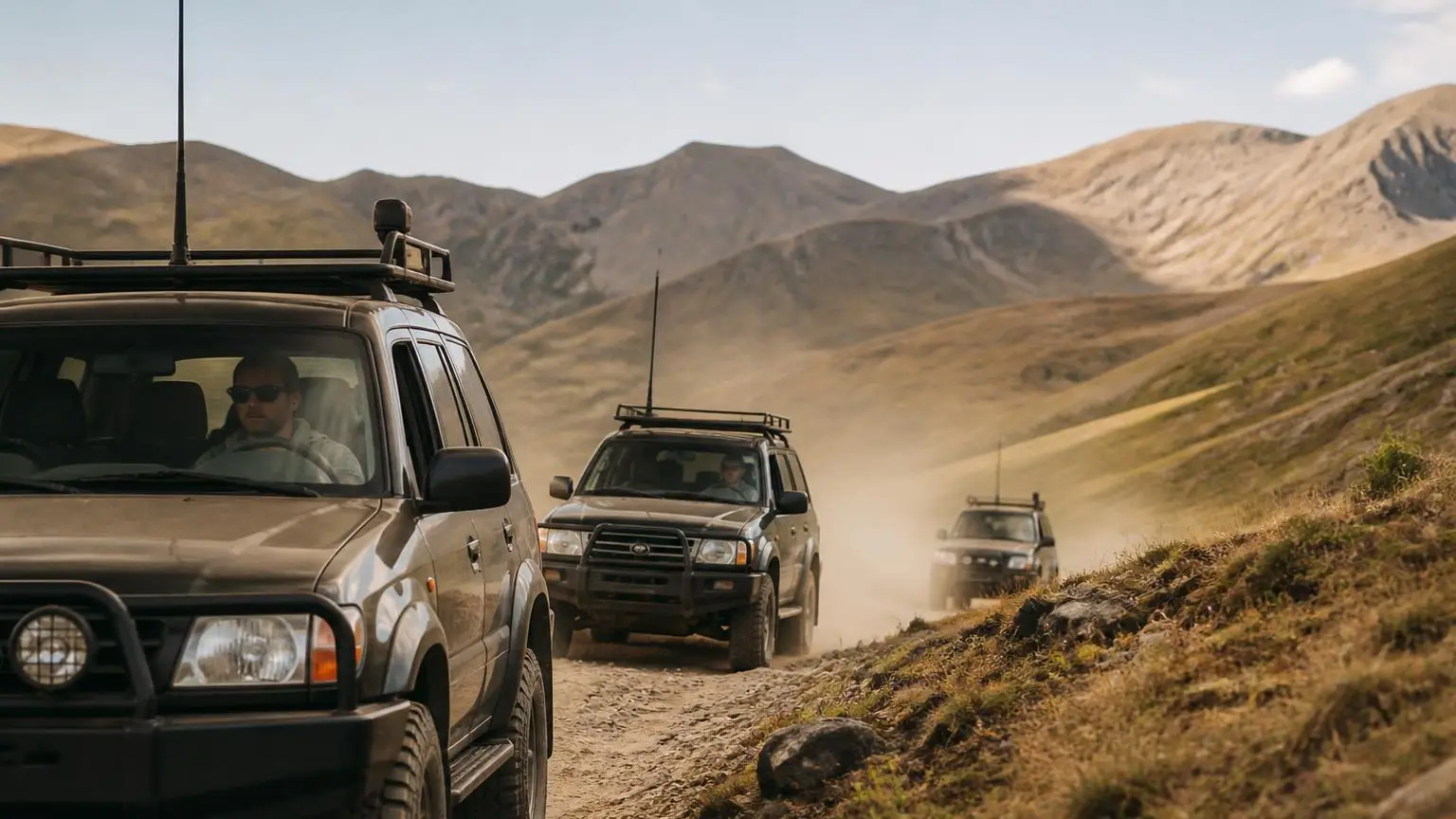
- For a trail group, the usual setup is a mobile radio with a roof antenna in each vehicle, plus a handheld for spotting.
At a Glance
| FRS | GMRS | Amateur (ham) | |
|---|---|---|---|
| License | None (licensed by rule) | One FCC license covers the licensee's immediate family | Individual license per operator, by exam |
| Power | 2 W; 0.5 W on channels 8–14 | Up to 50 W on main channels (mobile, base, repeater) | Depends on license class and band |
| Antenna | Must be non-removable | Mobile radios use external antennas | External antennas common |
| Repeaters | No | Yes | Yes |
| Typical trail role | Casual, short range | Group trail comms | Long range, for licensed operators |
The FCC License
The FCC's GMRS page puts it plainly: an FCC license is required to operate a GMRS system. The terms:
- you must be 18 or older and not a representative of a foreign government;
- licenses run for ten years and can be renewed from 90 days before expiration up to the expiration date;
- once you hold a license, any immediate family member, regardless of age, may operate stations in your system (47 CFR 95.1705);
- each station identifies with its FCC call sign at the end of a transmission or series of transmissions, and at least every 15 minutes during long ones (47 CFR 95.1751).
The license is issued by application through the FCC's Universal Licensing System. Amateur radio works differently: each operator earns an individual license by passing an exam given by volunteer examiners. See how to apply for a GMRS license for the steps.
FRS is the license-free option. The FCC says FRS is licensed by rule, open to anyone of any age, and uses 22 channels that are all shared with GMRS. FRS radios must be FCC-certified, can't be modified, and must have a non-removable antenna (47 CFR 95.587). Older “dual-service” FRS/GMRS radios count as FRS only if they stay within FRS channels and power. If a radio exceeds those limits or can transmit on the 467 MHz main channels, the FCC treats it as a GMRS device that needs a license.

Channels and Power Limits
GMRS has 30 channels in four groups (47 CFR 95.1763), and each group has its own power limit (47 CFR 95.1767):
| Channel group | Frequencies | GMRS power limit | FRS on the same frequencies |
|---|---|---|---|
| 462 MHz main (8) | 462.5500–462.7250 MHz | 50 W mobile, base, repeater; 15 W fixed | 2 W (FRS 15–22) |
| 462 MHz interstitial (7) | 462.5625–462.7125 MHz | 5 W ERP | 2 W (FRS 1–7) |
| 467 MHz interstitial (7) | 467.5625–467.7125 MHz | 0.5 W ERP, handhelds only | 0.5 W (FRS 8–14) |
| 467 MHz main (8) | 467.5500–467.7250 MHz | Repeater inputs; mobiles and handhelds only for repeater use or brief tests | Not allowed |
The 467 MHz interstitials are why an FRS radio on channels 8–14 has such short range. The FCC says their usual range is less than half a mile.
Realistic Range
The FCC says a GMRS user can expect a communications range of one to twenty-five miles, depending on station class, terrain and repeater use. The low end is handheld to handheld in hills or trees. The high end needs height: a repeater on a ridge, or mobiles with roof antennas and open ground between them. Terrain is the variable that matters most: a ridge or dense timber between two trucks can cut the link whatever the radios' power. Manufacturer claims of 20-plus miles describe ideal conditions, not a canyon trail.

Handheld vs Mobile Radio
A handheld is portable and battery-powered, for spotting a recovery or walking ahead to scout an obstacle. A mobile radio mounts in the vehicle, runs on the vehicle's electrical system and feeds an external antenna. FCC rules let mobile stations run up to 50 watts on the main channels. Many groups run a mobile in every vehicle and carry one handheld per vehicle for work outside it.
Antennas: Height and Placement
A roof-mounted antenna lifts the signal clear of the cab and the other vehicles, and owners consistently report that an antenna upgrade does more for trail range than a more powerful radio. FRS radios can't take this upgrade, because their antennas must be non-removable. See our GMRS antenna guide for mount types.

Repeaters
A GMRS repeater listens on one of the 467 MHz main channels and retransmits on the paired 462 MHz main channel, 5 MHz lower. Many repeaters only respond to radios sending a set CTCSS or DCS tone. To use one, you need its output frequency, the +5 MHz input offset and any tone programmed in before you leave. The FCC doesn't allow repeaters to be linked over the internet or other networks to extend coverage, citing 47 CFR 95.1733 and 95.1749.
Programming Before the Trip
Set up every radio in the group before leaving the trailhead:
- one agreed simplex channel for the group, plus a backup;
- any repeaters along the route, with offset and tone;
- matching tone settings on every radio, since a radio set to a tone the others don't send will stay silent.
Some radios can be programmed from the front panel; others need a cable and software.
GMRS vs FRS vs Ham Radio
FRS needs no license but is limited to low power and fixed antennas. GMRS needs a license but allows up to 50 watts on the main channels, external antennas and repeaters, which suits a trail group. Amateur radio gives the most frequencies and power, but every operator needs their own exam-based license. GMRS rules also bar some uses, including music or other entertainment, advertising, and false distress calls (47 CFR 95.1733).
Group Etiquette
GMRS channels aren't assigned to anyone. The FCC expects users to share them with a “listen before talk” etiquette. On a run:
- use one working channel for trail calls and keep chatter off it;
- keep transmissions short: vehicle, situation, what's needed;
- do a radio check at the trailhead and at major junctions, so a bumped channel knob gets caught early.
Weatherproofing
An IP rating under IEC 60529 gives two digits: dust protection from 0 to 6 (6 is dust-tight) and water protection from 0 to 9. For a handheld used outside the truck in rain, mud or a water crossing, check both digits on the spec sheet rather than trusting “waterproof” on the box.
How We Rank GMRS Radios
Radios on this hub are weighed on their FCC certification, power output and published specifications, alongside owner reviews of range and battery life. License and channel rules come from the FCC and 47 CFR Part 95. We don't buy or test this gear ourselves. See how we rank and our affiliate disclosure.
Sources
- FCC — General Mobile Radio Service (GMRS) — License required; age 18 and not a foreign-government representative; 10-year term and renewal window; family members of any age may operate; 1–25 mile range depending on station class, terrain and repeater use; listen-before-talk; no linking repeaters over networks; 30 channels.
- FCC — Family Radio Service (FRS) — FRS licensed by rule for any age; 22 channels all shared with GMRS; 2 W (0.5 W on channels 8–14); channels 8–14 usual range under half a mile; certified, unmodified radios; dual-service radio reclassification.
- FCC — Amateur Radio Service — Amateur operator license classes are earned by examination given by volunteer examiners.
- 47 CFR § 95.1705 — Individual licenses (LII) — Individual GMRS license requirement and operation by the licensee's immediate family members.
- 47 CFR § 95.1763 — GMRS channels (LII) — The four channel groups and their frequencies; 467 MHz main channels used by mobiles and handhelds only through repeaters or for brief tests.
- 47 CFR § 95.1767 — GMRS transmitting power limits (LII) — 50 W mobile, base and repeater and 15 W fixed on the main channels; 5 W on 462 MHz interstitials; 0.5 W handhelds on 467 MHz interstitials.
- 47 CFR § 95.587 — FRS additional requirements (LII) — FRS antennas must be a non-removable integral part of the transmitter.
- 47 CFR § 95.1733 — Prohibited GMRS uses (LII) — Prohibited uses including entertainment, advertising, false distress calls and messages carried by wireline control links.
- 47 CFR § 95.1751 — GMRS station identification (LII) — Call sign at the end of transmissions and at least every 15 minutes.
- FCC — Applying for a New License in ULS — GMRS licenses are applied for online through the Universal Licensing System.
- IEC — Ingress Protection (IP) ratings (IEC 60529) — IP code: first numeral solids 0–6 (6 = no ingress of dust), second numeral liquids 0–9.