

Affiliate disclosure: As an Amazon Associate, we earn from qualifying purchases, at no extra cost to you. We research rather than test, and commissions never change our rankings. This site is reader-supported: those commissions pay for hosting, research and keeping every guide up to date, so if a guide helped you, buying through our links is an easy way to support it. How we rank · Full disclosure
TL;DR
- A quarter wave on CB channel 19 (27.185 MHz) is about 108.5 inches, so most vehicle antennas are shortened with a loading coil. Firestik says taller and top-loaded designs perform better.
- Tune on the vehicle: aim for SWR under 2:1 on channels 1 and 40. At 2:1 about 11% of the power is reflected; at 3:1, 25%.
- The metal body is half the antenna system. Insulated mounts and fiberglass bodies need a ground strap or a no-ground-plane kit.
- A "1000 watt" rating is power handling only. The FCC caps CB at 4 W AM/FM and 12 W SSB peak, and bans amplifiers.
- The FCC sets no height limit for antennas on vehicles, so overhead clearance is the only practical limit.
On a CB station the antenna, coax, mount and vehicle body work as one system, and they decide most of the range difference between installations. The eight antennas below are ranked from aggregated owner reviews and each manufacturer's listed specifications, not first-hand testing.

Best for Owners wanting a widely used, trucker-standard mobile CB antenna.
- 5-inch shaft, mobile-mount design per the manufacturer's listing.
- Long-established design used broadly across the CB trucking community.
- Black finish for a low-visual-profile mount.

Best for Owners wanting antenna, mount and cable in one no-drill package.
- 28-inch antenna with a 3.5-inch heavy-duty magnetic mount per the manufacturer's listing.
- Includes 18-foot RG-58A/U coax cable and PL-259 connector.
- No drilling required for installation.
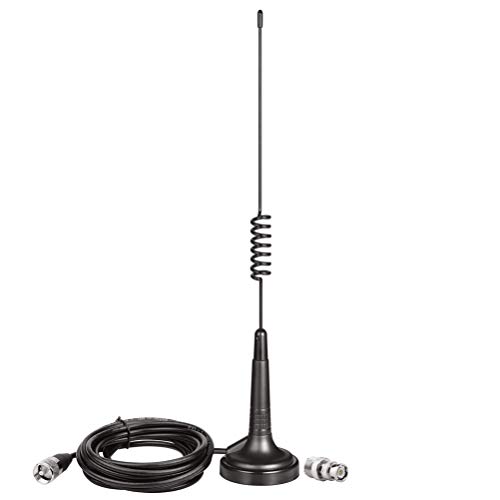
Best for Owners running radios from Cobra, Midland, Uniden or President who want one antenna compatible across brands.
- 27MHz tuning matching the CB band per the manufacturer's listing.
- PL259 and BNC connector options for broad radio-brand compatibility.
- Magnetic base mount.

Best for Owners wanting a shorter, more branch-tolerant fiberglass whip for trail use.
- 3-foot fiberglass construction, more flex-tolerant than a rigid metal whip.
- Compact length reduces overhead clearance concerns.
- Black finish.

Best for Owners wanting a heavy-duty spring-mounted whip rated well above CB's legal power ceiling.
- 1000-watt power rating per the manufacturer's listing, well above the FCC's 4-watt CB AM output limit.
- Heavy-duty stainless-steel spring base absorbs branch strikes and impacts.
- 3-foot fiberglass shaft.
Best for Tight-clearance trail rigs needing the shortest practical CB whip.
- 2-foot fiberglass shaft with heavy-duty stainless-steel spring.
- Shortest option on this list for garage or low-clearance parking.
- Fiberglass flex resists branch-strike damage.
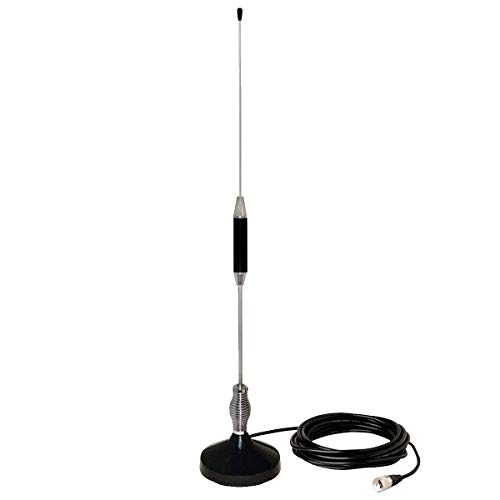
Best for Owners wanting a full kit rated for sustained highway speed per the manufacturer's testing.
- 28-inch antenna with heavy-duty magnetic mount and 10ft coaxial cable per the manufacturer's listing.
- Manufacturer states wind-tunnel testing to 100 km/h.
- Full kit includes cable, no separate purchase required.
Best for Owners without overhead clearance concerns wanting the longest whip in this lineup.
- 4-foot fiberglass shaft, the longest option on this list.
- 1000-watt power rating per the manufacturer's listing.
- Heavy-duty base construction.
How a CB Antenna Works: Wavelength and Loading
The FCC authorizes 40 CB channels between 26.965 and 27.405 MHz. A wavelength is the speed of light (299,792,458 m/s, per NIST) divided by frequency, so on channel 19 (27.185 MHz) one wavelength is about 11.03 meters and a quarter wave about 2.76 meters, or 108.5 inches. Across the band the quarter wave only runs from about 109.4 inches at channel 1 to 107.7 inches at channel 40, which is why one antenna can be tuned to cover all 40 channels.
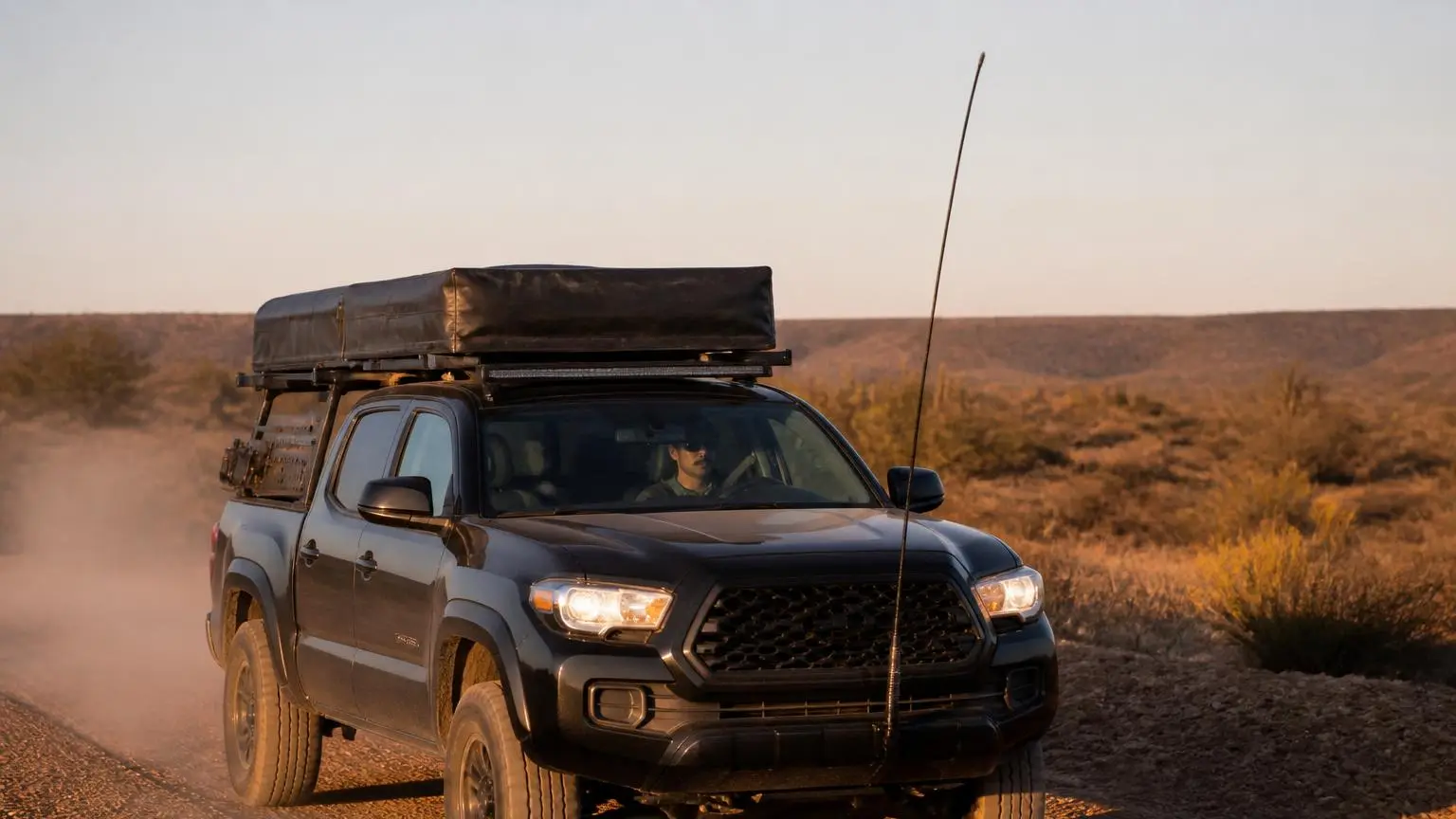
Few trucks can carry a nine-foot whip, so most mobile CB antennas are electrically lengthened. A loading coil at the base, center or top, or a continuous wire winding in a fiberglass shaft, makes a 2- to 5-foot antenna resonate like a quarter wave. Firestik, which makes CB antennas, says center-loaded antennas generally outperform base-loaded ones and top-loaded antennas outperform both. It also says that for any design, a taller antenna gives a wider bandwidth (lower SWR across more channels) and more power-handling capability. Firestik adds that "full-wave" claims for wire-wound antennas are misleading: wire length is not electrical length, and a mobile antenna still has to work as a quarter-wave or 5/8-wave radiator.
Ground Plane: The Other Half of the Antenna
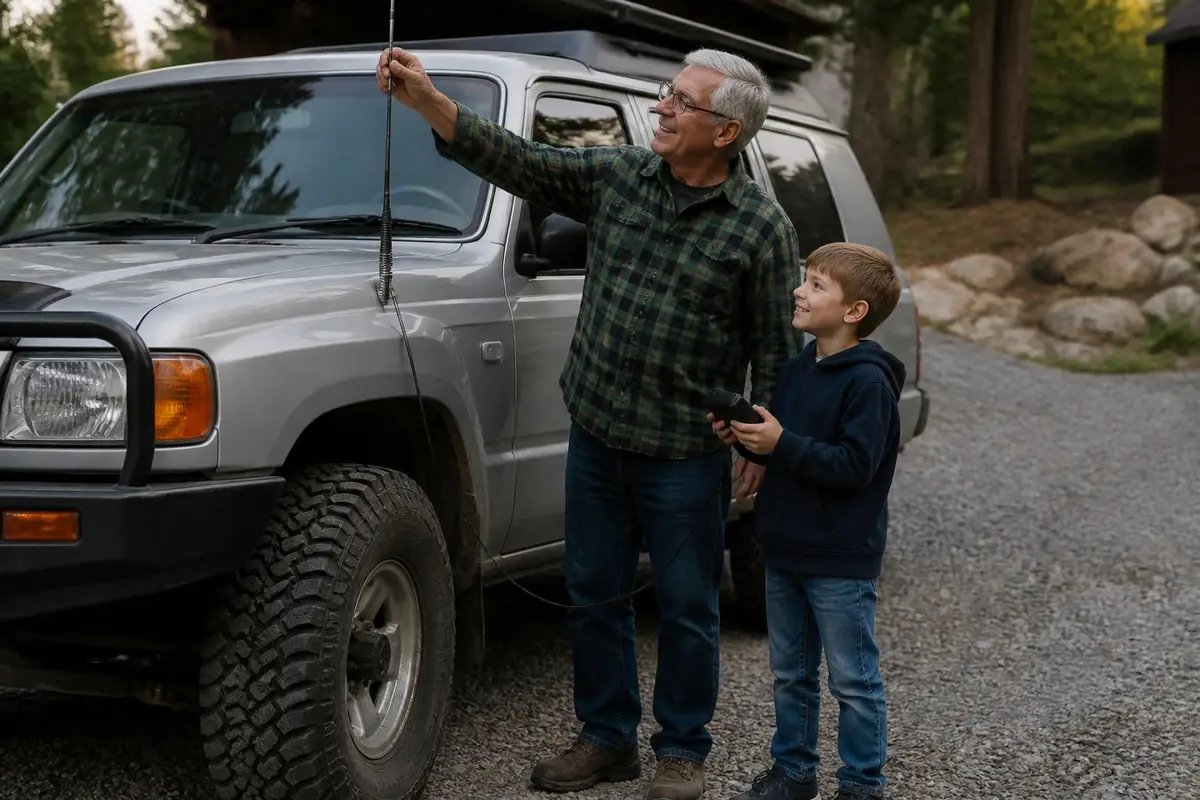
Every transmitting antenna needs a counterpoise, called a ground plane. On a vehicle the metal body and frame do that job, and Firestik describes the antenna as the radiating unit and the vehicle as the reflecting unit. That is why the same antenna reads differently on a bumper mount than on the roof. Firestik recommends at least 60% of the antenna's length above the roofline for best performance.
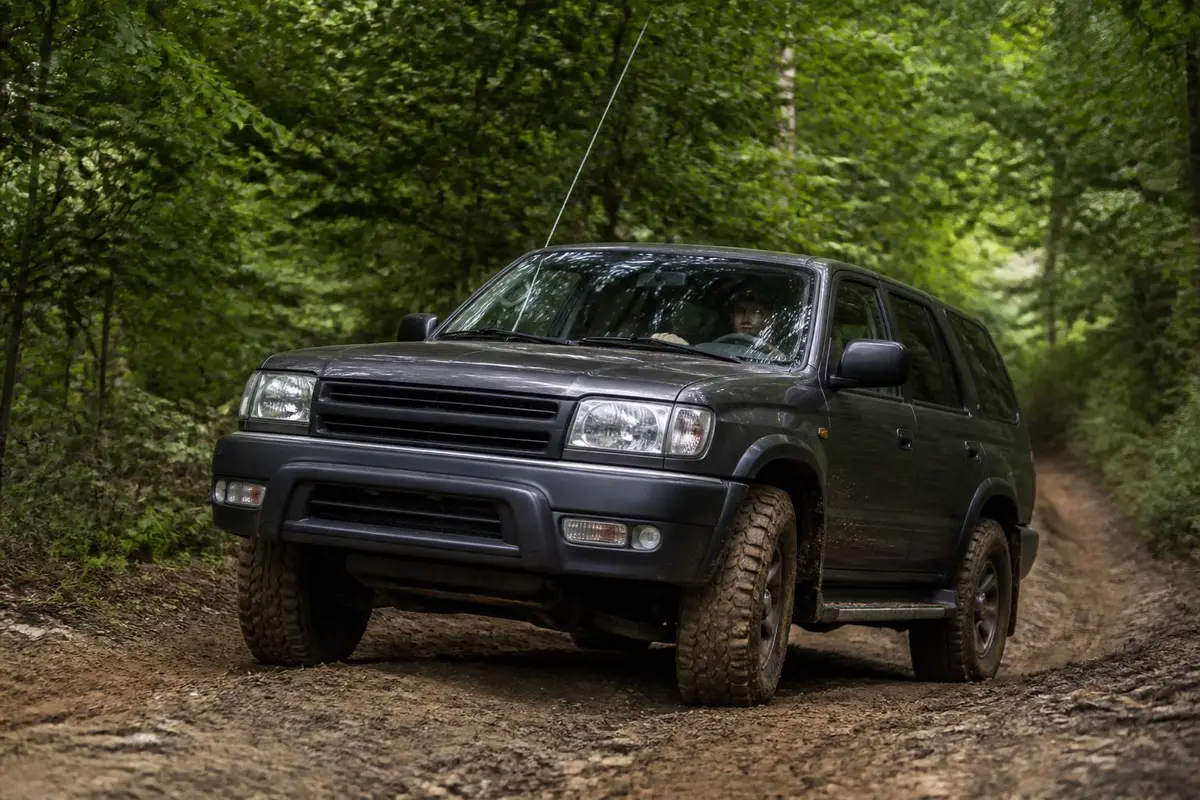
Ground-plane problems are common on 4x4s because doors, mirrors, spare tire carriers and luggage racks are often insulated from the body by rubber or nylon bushings, and fiberglass bodies give no ground plane at all. Firestik's fixes are a ground strap from the mount to the nearest chassis metal, adding a spring or quick-disconnect to raise the antenna, a co-phased pair, or a "no ground plane" kit that uses the coax shield as the counterpoise. Firestik notes that no-ground-plane antennas and cables are not interchangeable with standard kits.
SWR: What the Numbers Mean
Standing wave ratio (SWR) compares the maximum and minimum voltage along the coax, and it shows how well the antenna system matches the radio. It maps directly to how much power bounces back: the reflection coefficient is (SWR − 1) ÷ (SWR + 1), and the reflected share of power is that figure squared (Ellingson, Electromagnetics I).
| SWR reading | Reflection coefficient | Power reflected | What Firestik says |
|---|---|---|---|
| 1.0:1 | 0 | 0% | Perfect match |
| 1.5:1 | 0.20 | 4% | Well tuned |
| 2.0:1 | 0.33 | 11% | Target: stay below this on channels 1 and 40 |
| 3.0:1 | 0.50 | 25% | Operating above this can damage the radio |
Cobra's own control guide uses a looser threshold, calling for an SWR reading below 3. Firestik's advice is not to chase the lowest possible number: once SWR is under 2:1 at both ends of the band, further tricks gain little.
How to Tune a CB Antenna
Firestik's procedure puts an SWR meter in line between the radio and the coax, then reads SWR on channel 1, channel 19 and channel 40 in AM mode. It does this in an open area with the doors, hood and hatches closed, and with the antenna tip on if it will be used that way. If SWR is higher on channel 40 than on channel 1, the antenna is electrically long and needs shortening. If channel 1 reads higher, it is short and needs lengthening. When the readings match but stay above 2:1, more tuning won't help. Firestik points instead to the ground plane, the mount's ground or the coax, and it says a reading that pegs the meter on every channel almost always means a short.
Radio-mounted meters are fine for a rough check. Firestik says the meters built into CB radios are rarely accurate enough for fine tuning, and that many standalone meters it has compared read 0.3 to 0.7 off certified equipment.
Coax Cable and Connectors
A single-antenna installation uses 50-ohm coax such as RG-58/U, RG-58A/U or RG-8X, and a co-phased dual installation uses 72-ohm RG-59 harness cable, per Firestik. Its other coax rules: use a stranded center conductor with at least 90% shielding, avoid foam-insulated cable in vehicles, never splice coax like ordinary wire, and never coil the excess into a loop smaller than 12 inches across. Instead, fold it into a 12- to 18-inch oblong figure eight. When mismatches cause high SWR, Firestik says an 18-foot length of good coax often helps, but an antenna maker's own recommended length takes priority.
Magnetic Mount vs Permanent Mount
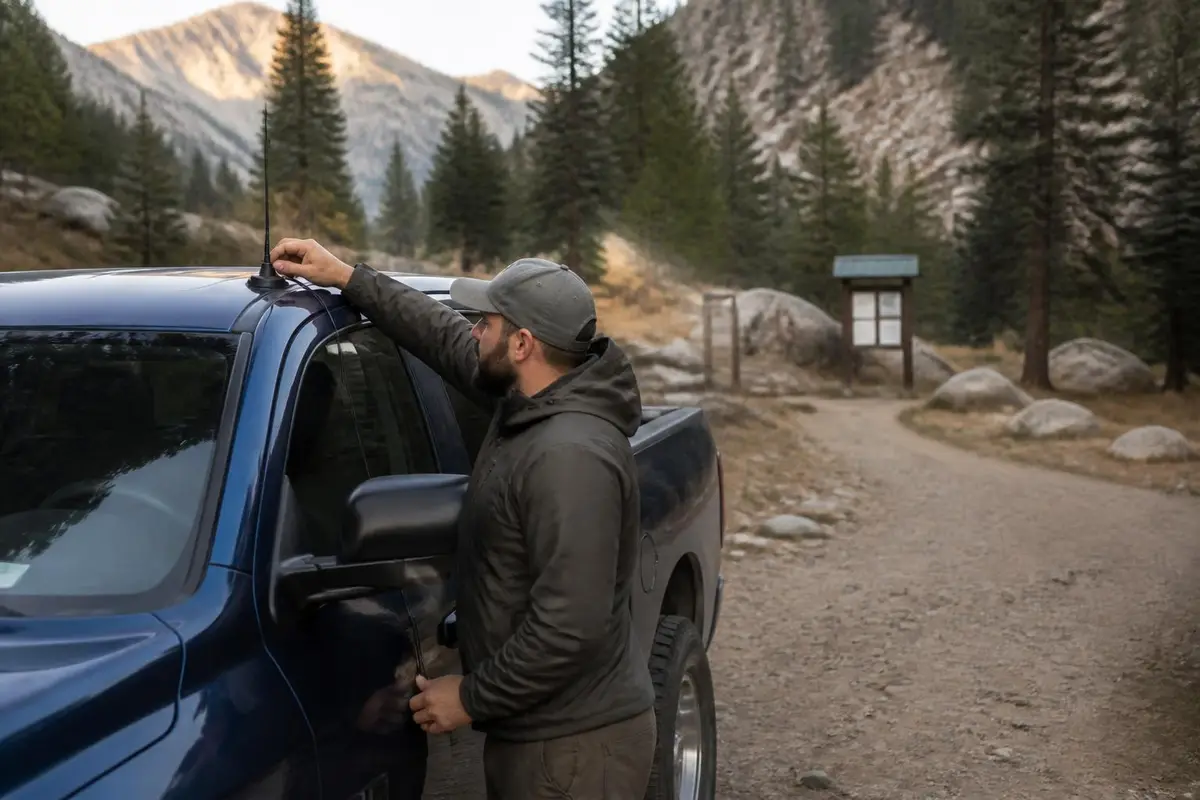
A magnetic mount, like the Nagoya CB-72 or LUITON kits here, needs no drilling. Firestik recommends magnets for temporary situations only. A magnet grounds through capacitance rather than a bolted connection, and a mount left in one place can trap moisture against the paint, causing rust or uneven fading. Firestik says to lift and clean a magnet periodically. A stud or bracket mount bolted to grounded metal gives a solid ground and stays put on washboard and rock. Firestik also recommends at least 24 inches between a CB antenna and other antennas, because nearby antennas change each other's radiation pattern.
Single vs Co-Phased Dual Antennas
A co-phased pair on the mirrors or bed rails is common on full-size trucks. Firestik says the pattern favors communication straight ahead and behind, which suits highway driving. It says co-phased pairs must be center- or top-loaded, and it has used spacing as small as 4 feet. It also says co-phasing can help vehicles with poor ground plane, though the mounts still need a chassis ground. For a single antenna mounted on one side, Firestik says the passenger side usually performs best, except when towing large trailers.
"1000 Watt" Ratings vs the Legal Limit
Several antennas on this list, including the Prostick fiberglass whips, list a 1,000-watt power-handling rating. That describes what the antenna can survive, not what a legal radio sends it. Under 47 CFR Part 95, §95.967 limits CB mean carrier power to 4 watts on AM and FM and peak envelope power to 12 watts on SSB, and §95.939 bars any external RF power amplifier. The FCC's CB guidance says the same: no raising a transmitter's power and no "linear" of any kind.
Antenna Height Rules
The FCC sets no height limit for antennas mounted on vehicles or for hand-held radios. Its limits in §95.941 apply to antennas on structures: no higher than 20 feet above the building or tree they're mounted on, or 60 feet above the ground, whichever is greater, with lower limits near airports. On a truck, the practical limit is clearance. Firestik suggests tilting long antennas forward so they stand near vertical at highway speed, and leaving mirror-mount bolts just loose enough that the mount can rotate when the antenna hits something overhead.
Pairing an Antenna With a Radio
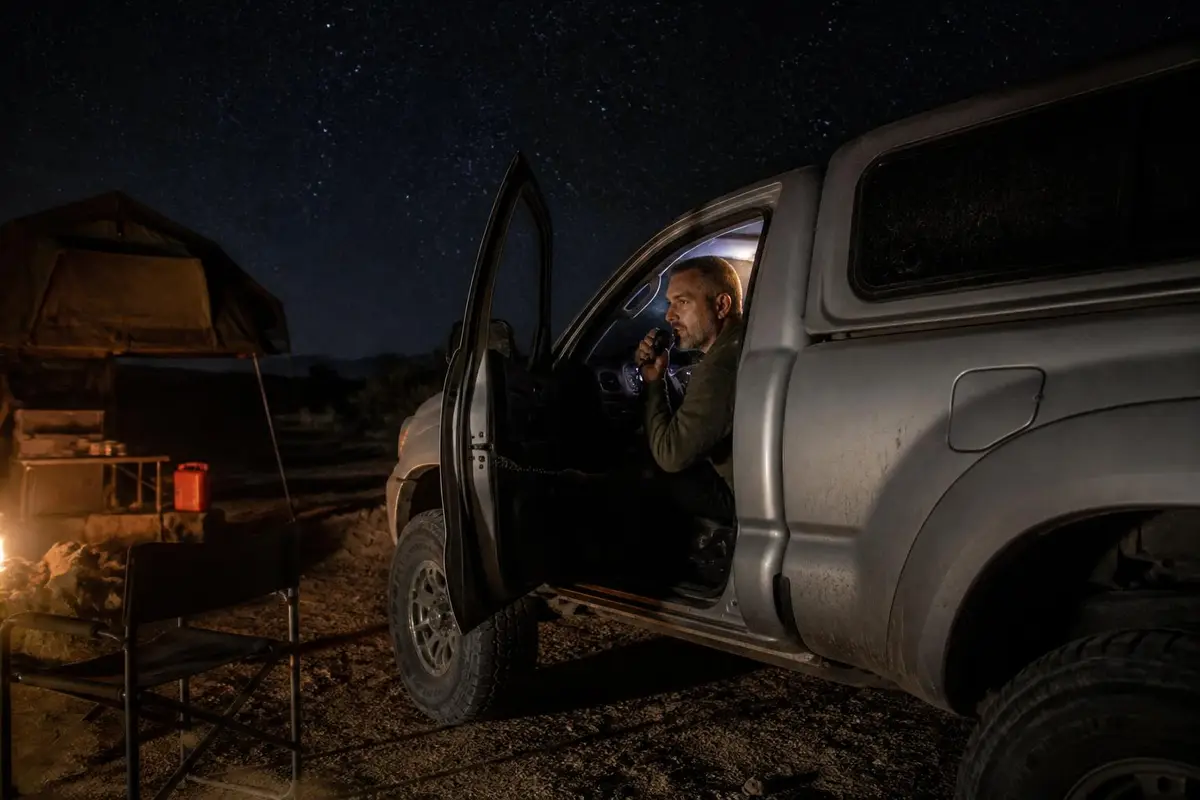
Mobile CB coax ends in a PL-259 connector (Firestik's tuning procedure uses PL-259 jumpers at the radio), and the Nagoya kit here includes one. For the radio side, see our best CB radios for trucks. Firestik's budget advice is to spend on the antenna: every legal CB transmits at the same 4 watts, so a good antenna on an inexpensive radio will usually outperform a poor antenna on an expensive one. Never transmit without an antenna or dummy load connected. These picks are weighed on published specifications and owner-reported reliability; we don't buy or test antennas ourselves (see how we rank).
Sources
- Firestik Antenna Co. — Measuring SWR and Things Every CB'er Should Know — Manufacturer guidance: tune on the vehicle; SWR below 2:1 target and above 3:1 can damage radios; physical quarter wave is 108 in; top/center/base loading and taller-is-better; ground plane and insulated mounts; 60% above roofline; 50-ohm RG-58/RG-8X and 72-ohm RG-59 for co-phase; 18-ft coax; coil no smaller than 12 in; magnetic mounts for temporary use; 24-in spacing; co-phase pattern and 4-ft spacing; built-in and standalone meter accuracy; power leads to battery; good antenna beats expensive radio.
- Firestik Antenna Co. — Setting the SWR of Your Antenna — SWR procedure on channels 1, 19 and 40; long vs short antenna readings; ground-plane deficiency causes 'short' readings; test with doors closed and tip on.
- NIST — Speed of light in vacuum (CODATA) — c = 299,792,458 m/s, used to compute CB wavelength and the ~108.5-inch quarter wave at 27.185 MHz.
- FCC — Citizens Band Radio Service (CBRS) — 40 CB channels from 26.965 to 27.405 MHz; no individual license required and who may operate; 5-minute transmission limit; no raising power or adding amplifiers; no height limit for vehicle antennas and the 20 ft / 60 ft structure limits; handles; priority for emergency traffic; no channel assigned for exclusive use.
- 47 CFR §95.963 — CBRS channel frequencies — Channel 1 at 26.965 MHz to channel 40 at 27.405 MHz; channel 23 (27.255 MHz) sits above channel 24 (27.235 MHz).
- Ellingson, Electromagnetics I (LibreTexts) — 3.14 Standing Wave Ratio — SWR = (1 + |Γ|) / (1 − |Γ|), rearranged for the reflection coefficient in the SWR table.
- Ellingson, Electromagnetics I (LibreTexts) — 3.20 Power Flow on Transmission Lines — Reflected power equals |Γ|² times incident power (4% at 1.5:1, 11% at 2:1, 25% at 3:1).
- Cobra Electronics — CB Control Settings — Channel 9 instant access; RF gain, squelch and ANL/NB explained; Cobra's guidance that SWR should read below 3.
- 47 CFR §95.967 — CBRS transmitter power limits — CB mean carrier power limited to 4 W on AM and FM; SSB peak envelope power limited to 12 W.
- 47 CFR §95.939 — External RF power amplifiers prohibited — Bans external RF power amplifiers on CB stations and lets the FCC presume a violation from possession plus evidence of over-power operation.
- 47 CFR §95.941 — CBRS antenna height limits — Structure-mounted CB antennas limited to 20 ft above the building or tree or 60 ft above ground, whichever is greater.