

Affiliate disclosure: As an Amazon Associate, we earn from qualifying purchases, at no extra cost to you. We research rather than test, and commissions never change our rankings. This site is reader-supported: those commissions pay for hosting, research and keeping every guide up to date, so if a guide helped you, buying through our links is an easy way to support it. How we rank · Full disclosure
TL;DR
- Weight: Battle Born's 100 Ah LiFePO4 BB10012 weighs 31 lb; Lifeline's 105 Ah GPL-31T AGM weighs 64 lb.
- Usable capacity: Battle Born says 80–100% is usable; Lifeline says to rate an AGM at twice the load (50%).
- Cycle life: Battle Born claims 3,000–5,000 cycles; Lifeline's chart shows about 1,000 AGM cycles at 50% depth.
- Charging: use a DC-DC charger. Victron says lithium's low impedance can overload an alternator connected directly.
- Cold: Battle Born's BMS blocks charging below freezing but keeps supplying power down to −4°F.
The numbers below come from two representative Group 31-size batteries, Battle Born's BB10012 (LiFePO4) and Lifeline's GPL-31T (AGM).

LiFePO4 vs AGM: Side by Side
| Battle Born BB10012 (LiFePO4) | Lifeline GPL-31T (AGM) | |
|---|---|---|
| Rated capacity | 100 Ah | 105 Ah (20-hour rate) |
| Weight | 31 lb | 64 lb |
| Size (L × W × H) | 12.76 × 6.86 × 8.95 in | 12.9 × 6.75 × 9.27 in |
| Recommended use per cycle | Up to 100% (maker says 80–100% usable) | About 50% (rate at twice the load) |
| Cycle life | 3,000–5,000 cycles (maker's claim) | About 1,000 at 50% depth; about 350 at 100% (maker's chart) |
| Absorption / float voltage | 14.2–14.6 V / 13.4–13.8 V, no temperature compensation | 14.3 V / 13.3 V at 77°F, adjusted for temperature |
| Charging temperature | BMS blocks charging below 32°F | Charges in the cold at a higher voltage |
| Current limit | 100 A continuous, 200 A for 30 s; 50 A max charge | No BMS limit; capacity falls at high current |

Weight: Half as Heavy, and Less Needed
The two batteries share nearly the same footprint, but the lithium one weighs 31 lb against 64 lb. The gap grows once you count usable capacity. Used to 80 percent, the BB10012 gives about 80 Ah; used to Lifeline's recommended 50 percent, the GPL-31T gives about 52 Ah. Getting 80 usable amp-hours from AGM takes about 160 Ah of rated capacity, roughly 98 lb of Lifeline batteries. Every pound counts against the truck's payload rating.
Depth of Discharge: The Number That Decides Usable Capacity
Depth of discharge is the share of the rating you use before recharging. Lifeline's technical manual says to rate an AGM battery at at least twice the load, which keeps the average depth at 50 percent and, in its words, dramatically extends battery life. Battle Born lists 100 percent usable depth of discharge for the BB10012, recommends a 10.5 V low-voltage disconnect, and says its BMS disconnects at about 10 V. This site's calculators plan on 80 percent to leave a reserve.
Cycle Life: Where Lithium Pulls Ahead
Lifeline's cycle-life chart for its AGM batteries, tested at 77°F to 80 percent of original capacity, shows about 5,000 cycles at 10 percent depth, about 1,000 at 50 percent and about 350 at 100 percent. Battle Born quotes 3,000 to 5,000 cycles for its LiFePO4 battery. Taken at face value, a lithium battery used to 80 percent every day would deliver several times more amp-hours over its life than an AGM used to 50 percent. That is the core case for lithium on a truck that camps often. For a battery that is rarely drawn down, the difference shrinks.
High Loads: Where AGM Loses Capacity
AGM ratings assume a slow, 20-hour discharge. Lifeline's discharge curves show an AGM giving about 60 percent of its rated capacity at the 1-hour rate and about 90 percent at the 8-hour rate, so an air compressor or an inverter shrinks what an AGM delivers. Lithium holds its capacity better but has a hard current limit: the BB10012's BMS allows 100 A continuously and 200 A for 30 seconds, and Battle Born says two in parallel give 200 A continuously. A 1,600 W inverter load at 12 V draws about 133 A before losses, which is more than one battery allows.
Charging: Voltages, Current and the Alternator
At room temperature the two chemistries want similar voltages: 14.2–14.6 V absorption for the BB10012 against 14.3 V for Lifeline's AGM. The differences are elsewhere. Lead-acid charging raises the voltage as the battery gets colder — Lifeline's table calls for 14.72 V at 50°F and 15.78 V at 0°F — while Battle Born says to disable temperature compensation, and its BMS disconnects the battery above 14.7 V. Current matters too. Battle Born lists a 50 A maximum charge current for the 100 Ah battery, and Victron says a lithium battery's low impedance can overload an alternator when the two are connected directly. A DC-DC charger set to the battery's profile, such as Victron's Orion-Tr Smart at 18 A or 30 A, solves both problems. See dual-battery isolators for why a simple relay can't.

Cold-Weather Charging Limits
Battle Born's manual says its BMS will not allow charging below 32°F (0°C) but continues to discharge down to −4°F (−20°C); its spec table lists 25°F as the lower charging limit, so check the manual for your exact model. In practice, a truck that sits in freezing weather may drive all day without refilling the battery. Heated models address this: Battle Born's warm the cells when the internal temperature reaches about 35°F, drawing about 28 W while heating. AGM keeps charging in the cold but delivers less: Lifeline's chart shows about 90 percent of room-temperature capacity at 32°F and about 68 percent at −4°F at slow discharge rates.
Mounting Location and Protection
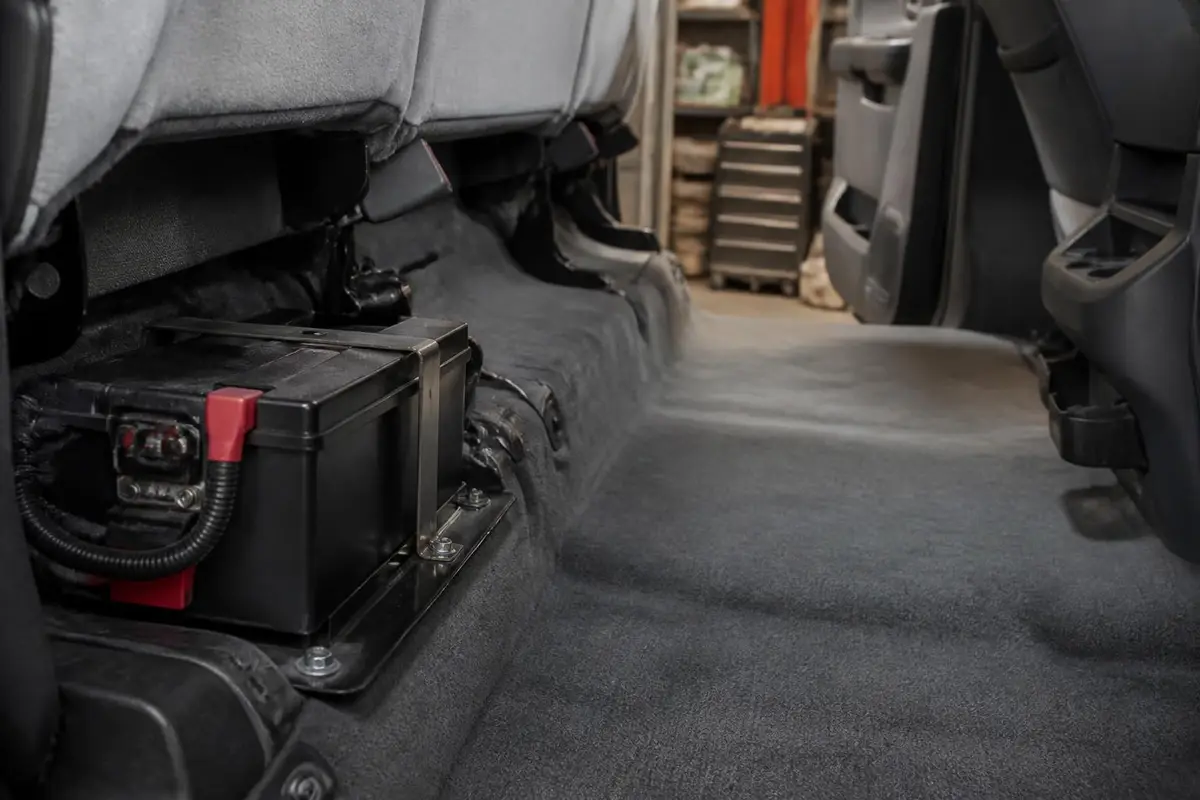
Battle Born says the BB10012 can be mounted in any orientation, rates its case IP65 (sealed and water-resistant, not submersible), and specifies a Type 3R enclosure when it is used outdoors. It lists UN 38.3 transport testing and ETL listings to UL 2054 and UL 62133-2. Whatever the chemistry, secure the battery against movement and fuse its positive cable close to the terminal. Victron's Wiring Unlimited guide adds that in a lithium installation at least one fuse must have an interrupt rating equal to or greater than the battery's maximum short-circuit current.
When AGM Still Makes Sense
AGM suits a second battery that is rarely drained deeply, a vehicle that is often charged below freezing, or a setup built around a simple voltage-sensitive relay rather than a DC-DC charger. Size it at twice your daily draw, per Lifeline's rule, and allow for the weight. The dual-battery and solar sizing calculator works out either chemistry for your load, and the dual-battery and portable power hub covers the rest of the system.
How We Research This
Figures on this page come from Battle Born's BB10012 manual and Lifeline's AGM technical manual and GPL-31T specifications, with charging guidance from Victron Energy, all listed in the sources below. We do not fit or field-test these batteries ourselves; see how we rank for the site's full method.
Recommended gear
Portable power for camp and the trail
Affiliate disclosure: As an Amazon Associate, we earn from qualifying purchases, at no extra cost to you. Purchases through these links help keep this site running and up to date. Learn more


We research products from manufacturer specs and owner feedback; we don't test them ourselves. How we choose.
Sources
- Battle Born Batteries — 100Ah 12V LiFePO4 battery (BB10012) manual — BB10012 capacity, weight, dimensions, 100% usable depth of discharge, 3,000–5,000 cycle claim, charge voltages and 50 A maximum charge current, no temperature compensation, 14.7 V high-voltage and ~10 V low-voltage BMS limits, 10.5 V recommended disconnect, 100 A/200 A discharge limits and parallel ratings, charging blocked below 32°F (25°F in the spec table) with discharge to −4°F, heated model behavior (~35°F, 28 W), mounting orientation, IP65, Type 3R enclosure outdoors, UN 38.3 and UL 2054/62133-2 listings.
- Battle Born Batteries — AGM vs. Lithium Batteries — LiFePO4 usable depth of discharge of 80–100%.
- Lifeline Batteries (Concorde) — Technical Manual for Lifeline AGM batteries, Doc. 6-0101 Rev. F — Rate AGM at twice the load; cycle life vs depth of discharge chart (77°F, to 80% capacity); discharge curves by rate; capacity vs temperature; temperature-compensated charge voltages (14.3 V at 77°F, 14.72 V at 50°F, 15.78 V at 0°F); hydrogen release and no sealed containers.
- Lifeline Batteries — GPL-31T AGM battery specifications — GPL-31T: 105 Ah, 64 lb, 12.9 × 6.75 × 9.27 in.
- Victron Energy — Orion-Tr Smart DC-DC Charger Isolated manual: Introduction — A lithium battery's low impedance can overload an alternator connected directly; controlled charging is indispensable with smart alternators.
- Victron Energy — Orion-Tr Smart DC-DC Charger Isolated manual: Engine shutdown detection — Smart alternators vary from about 12.5 V to 15 V.
- Victron Energy — Orion-Tr Smart DC-DC Charger Isolated manual: Specifications — Orion-Tr Smart 12 V models deliver 18 A or 30 A continuously.
- Victron Energy — Wiring Unlimited — At least one fuse in a lithium installation must have an interrupt rating equal to or greater than the battery's maximum short-circuit current.