

Affiliate disclosure: As an Amazon Associate, we earn from qualifying purchases, at no extra cost to you. We research rather than test, and commissions never change our rankings. This site is reader-supported: those commissions pay for hosting, research and keeping every guide up to date, so if a guide helped you, buying through our links is an easy way to support it. How we rank · Full disclosure
A camp shower comes down to how you heat the water and how much water you are willing to carry. Propane tankless heaters give hot water on demand; solar bags use only sunshine; rechargeable pump showers move water you heat on the stove. The picks below come from aggregated owner feedback and each listing's stated features, not showers we have used ourselves.

Best for Longer trips and cool weather where real hot water matters; needs a water pump or pressurized supply, confirm with the seller.
- Listed at 1.32 GPM.
- Overheat protection and low-pressure startup, per the listing.
- Folding handle.

Best for Owners who want a propane heater sold as a shower kit.
- Propane tankless heater.
- LCD display, per the listing.

Best for Overlanders who also want hot water for dishes at a camp sink.
- Portable water heater.
- Includes a sink, per the listing.
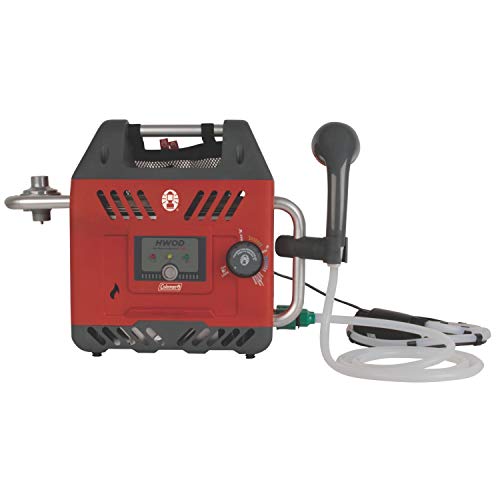
Best for Campers who prefer a widely supported camping brand for hot water on demand.
- Hot water on demand, per the listing.

Best for A compact kit for rinsing off and cleaning gear at camp; confirm contents with the seller.
- Portable shower and cleaning kit.

Best for Sunny-weather trips where you want no fuel, batteries or moving parts.
- 5 gal / 20 L bag.
- Removable hose and on-off shower head.

Best for Adding privacy to any of the showers above at a busy or open camp.
- Listed at 78 x 62 x 62 in.
- No-assembly frame, per the listing.
- Doubles as a camp restroom enclosure.
The Three Main Types
Propane tankless heaters. These heat water as it flows through a burner-heated coil, and the burner lights only when water is flowing. They need water pushed through them: Camplux says its basic AY132 has no built-in pump and needs a pressurized source or a separate pump, with a minimum start-up pressure of 3.0 psi. Camplux lists the AY132 at up to 34,000 BTU per hour and up to 1.32 gallons per minute, with ignition from two D-cell batteries, a flame-failure device, overheat shutoff and an anti-freeze drain plug, at 14 lb. The trade-offs are bulk, carrying propane and a strict open-air rule.
Pump showers. A rechargeable or 12V pump drops into a bucket or jug and pushes water through a hand-held head. You heat the water on your stove or use it cold. They are compact, and a jug of stove-heated water sets the shower's length.
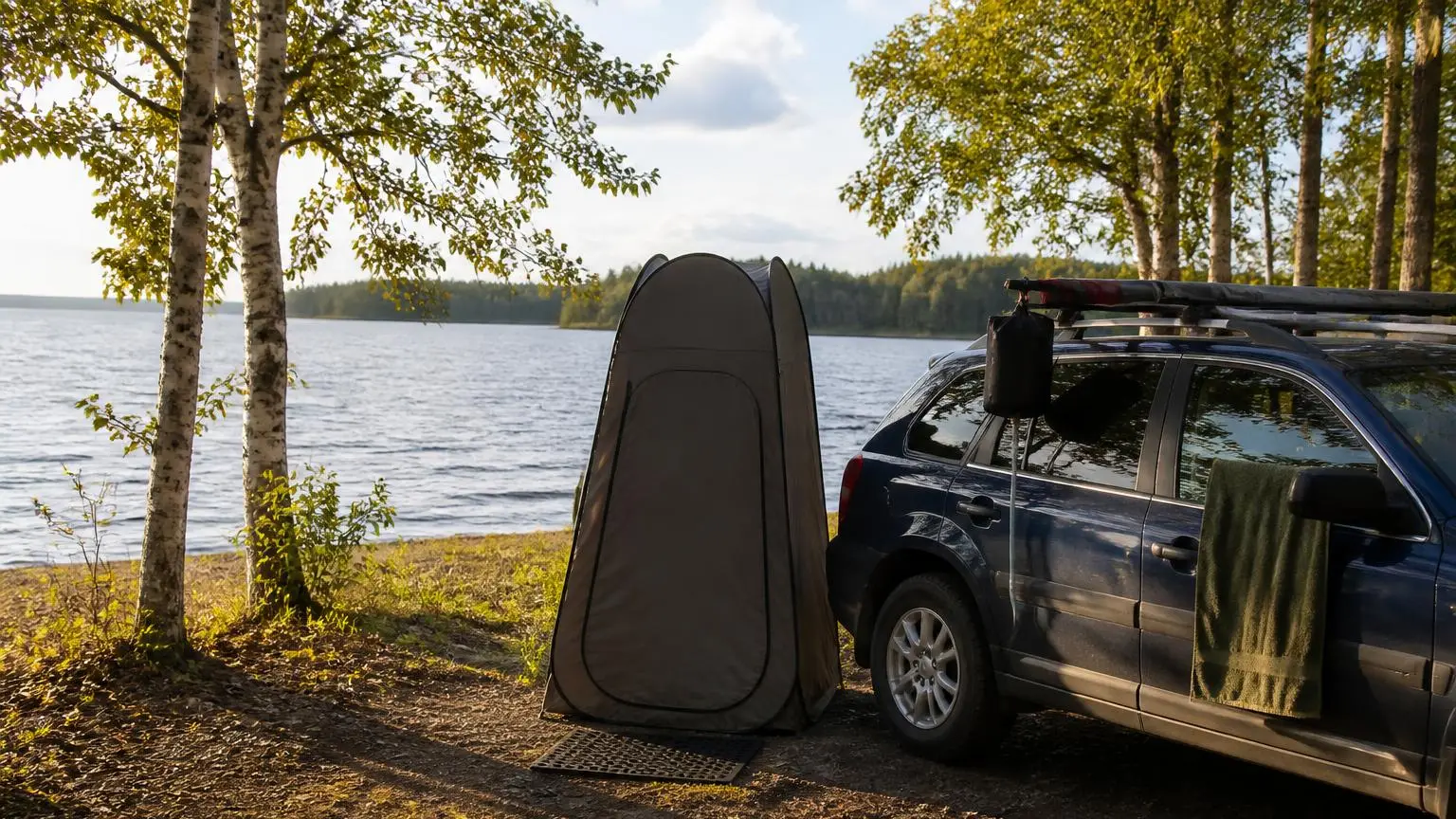
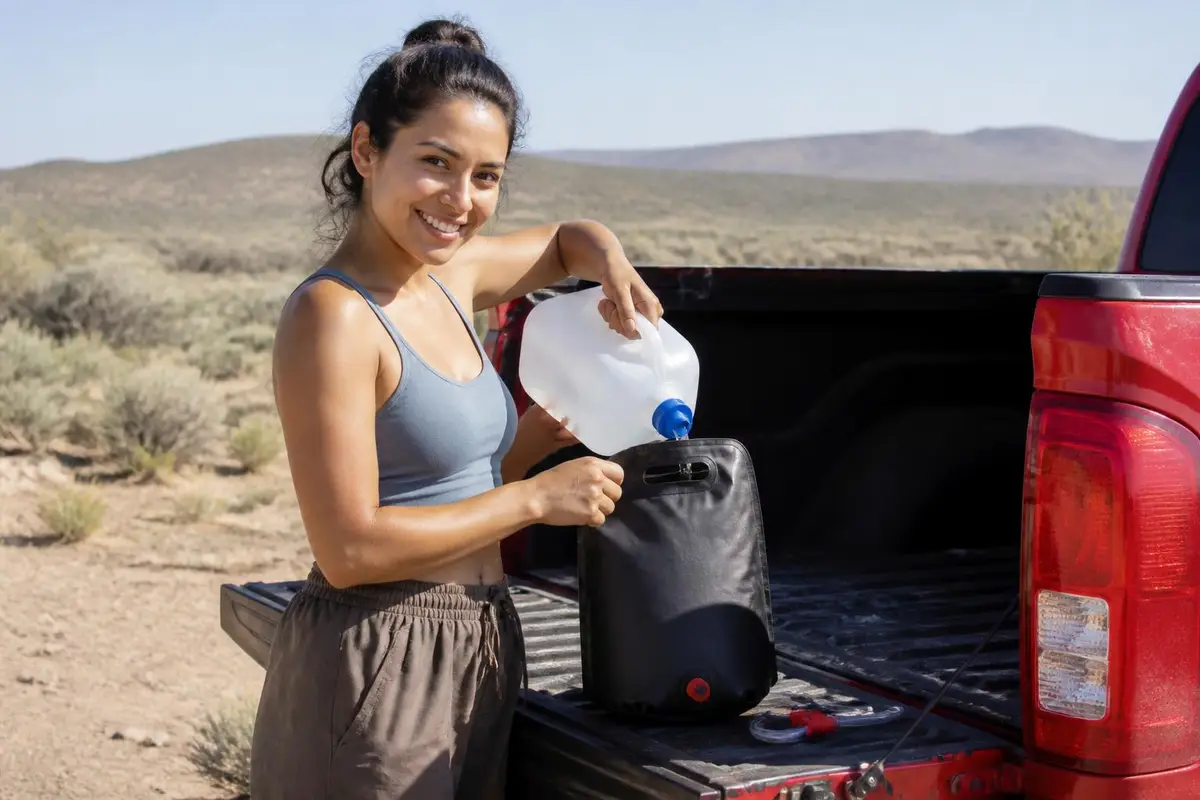
Solar shower bags. A dark bag, often around 5 gallons, warms in the sun and hangs overhead for a gravity shower. There is nothing to break or fuel, but heating depends entirely on sunshine and time. Five gallons of water weighs about 42 lb (USGS puts water at about 8.34 lb per gallon), so hang the bag from something that can carry it, and test the water before stepping under it on a hot day.
How Hot Can a Propane Heater Get the Water?
A heater's BTU rating sets how much it can raise the water temperature at a given flow. One Btu raises one pound of water by 1°F, per the U.S. Energy Information Administration, and a gallon of water weighs about 8.34 lb. So the maximum temperature rise is the heater's BTU per hour ÷ (gallons per minute × 8.34 × 60). For a 34,000 BTU/h heater:
| Flow rate | Theoretical maximum rise | With 50°F water in |
|---|---|---|
| 1.32 gal/min (full flow) | about 51°F | about 101°F |
| 1.0 gal/min | about 68°F | about 118°F |
| 0.75 gal/min | about 91°F | above 120°F — turn it down |
These figures ignore the heater's efficiency losses, so the real rise is lower, but the pattern holds: with cold source water, turning the flow down is what makes the shower hotter. The same math gives the fuel cost of a shower. A five-minute shower at 1.32 gallons per minute uses about 6.6 gallons; warming it from 60°F to 105°F takes about 6.6 × 8.34 × 45 ≈ 2,500 Btu. EIA puts propane at 91,452 Btu per gallon, so that shower burns roughly 0.03 gallons of propane before losses.
Water Temperature and Scalds
The CPSC recommends 120°F as the maximum setting for home water heaters and gives the burn thresholds: most adults suffer third-degree burns after two seconds in 150°F water, six seconds at 140°F and thirty seconds at 130°F, and even 120°F can cause them after five minutes. Children under five and older adults are most at risk. A camp heater at low flow on a warm day can exceed 120°F, as the table shows, so check the temperature by hand before anyone steps under it.
How to Choose
Start with trip length and climate. Warm-weather weekends suit a solar bag or a pump shower with stove-heated water; cold mornings and longer trips push most people toward propane. Next, budget the water: every shower draws from the same supply you drink and cook with, and Ready.gov's baseline of one gallon per person per day covers drinking and sanitation only. Size your water storage with showers added, or carry a separate jug for washing. Then consider fuel and power: a propane heater means managing another cylinder and spare D-cells, while a rechargeable pump is another device to charge from your power system.
Privacy Tents
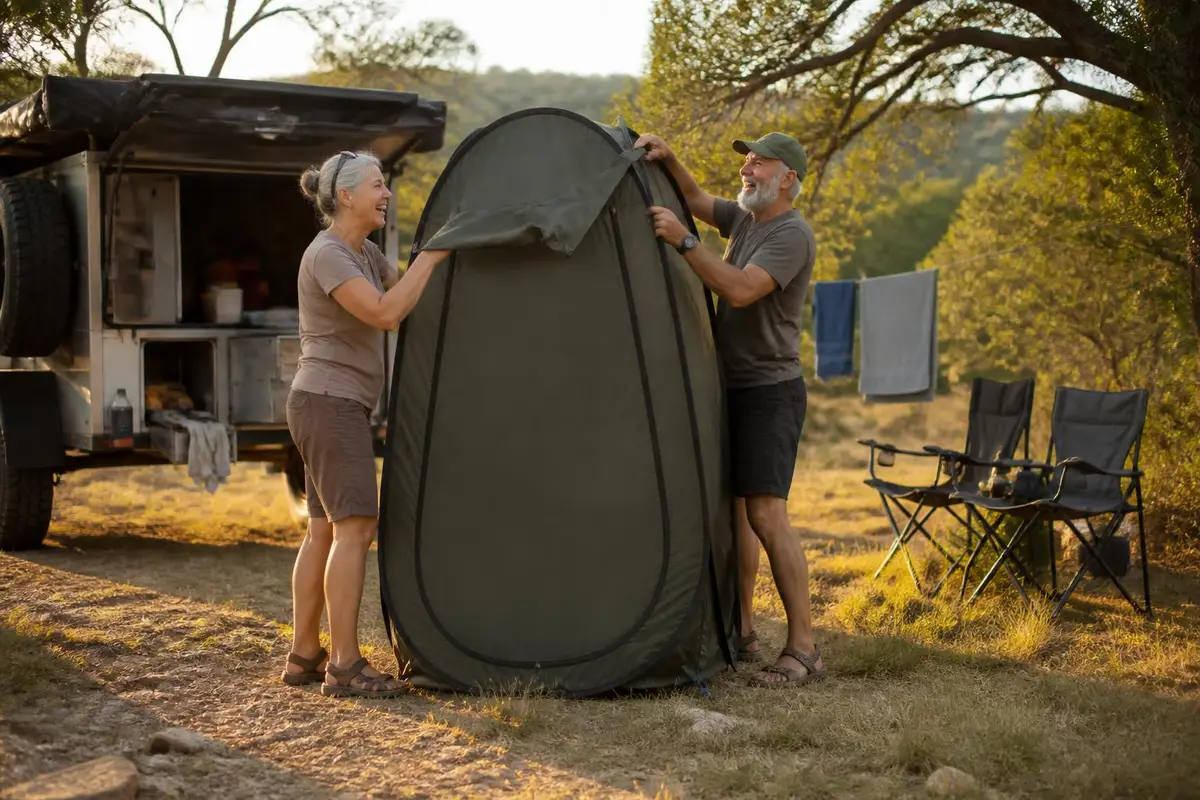
A pop-up privacy tent turns any shower into something you can use at a busy site or trailhead, and many double as a toilet enclosure. Look for a stable frame, a floor that drains and guy points, because tall, light shelters catch wind easily. Keep the propane heater outside the tent.
Showering Without Leaving a Trace
The National Park Service's Leave No Trace guidance is to carry water at least 200 feet away from streams or lakes and use only small amounts of biodegradable soap when washing. Set up on a durable surface such as rock or gravel, and scatter the used water. Some areas require you to collect gray water instead, so check the local rules.
What Owners Commonly Report
Propane heater owners most often report pressure or flow settings that need adjusting before the burner lights reliably, and wind blowing out the flame. With pump showers, battery life and flow rate come up most. With solar bags, the usual complaints are slow heating on cloudy days and leaking seams over time.
How We Rank Camp Showers
Every shower on this page is weighed against the features its listing and maker state, cross-referenced with owner reviews on reliability, heat and ease of setup. We do not buy or physically test camp showers ourselves; see how we rank for the full method and affiliate disclosure for how the site is funded. Confirm fuel type, fittings and what is included with the seller before buying.
Sources
- Camplux — AY132 Portable Propane Tankless Water Heater — Manufacturer specs: up to 34,000 BTU/h and 1.32 gal/min, 3.0 psi minimum start-up pressure, no built-in pump (needs a pressurized source), two D-cell ignition, flame-failure, overheat and anti-freeze protection, 14 lb; outdoor or properly ventilated use only.
- U.S. Energy Information Administration — British Thermal Units (Btu) — One Btu raises one pound of water by 1°F; propane contains 91,452 Btu per gallon — the basis of the temperature-rise and fuel-use math.
- U.S. Geological Survey — Water Density — Water weighs about 62.4 lb per cubic foot, about 8.34 lb per gallon.
- CPSC — Avoiding Tap Water Scalds (PDF) — 120°F recommended maximum; third-degree burn exposure times at 150°F, 140°F, 130°F and 120°F; children under five and older adults most at risk.
- CPSC — Portable Heaters & Camping Equipment (Carbon Monoxide) — Fuel-burning camping equipment in tents, campers and vehicles causes CO poisoning; higher risk at altitude; symptoms of CO poisoning.
- Ready.gov (FEMA) — Water — Planning figure of one gallon per person per day for drinking and sanitation.
- National Park Service — Leave No Trace Seven Principles — Wash 200 feet from streams or lakes with small amounts of biodegradable soap and scatter the strained water.