
Affiliate disclosure: As an Amazon Associate, we earn from qualifying purchases, at no extra cost to you. We research rather than test, and commissions never change our rankings. This site is reader-supported: those commissions pay for hosting, research and keeping every guide up to date, so if a guide helped you, buying through our links is an easy way to support it. How we rank · Full disclosure
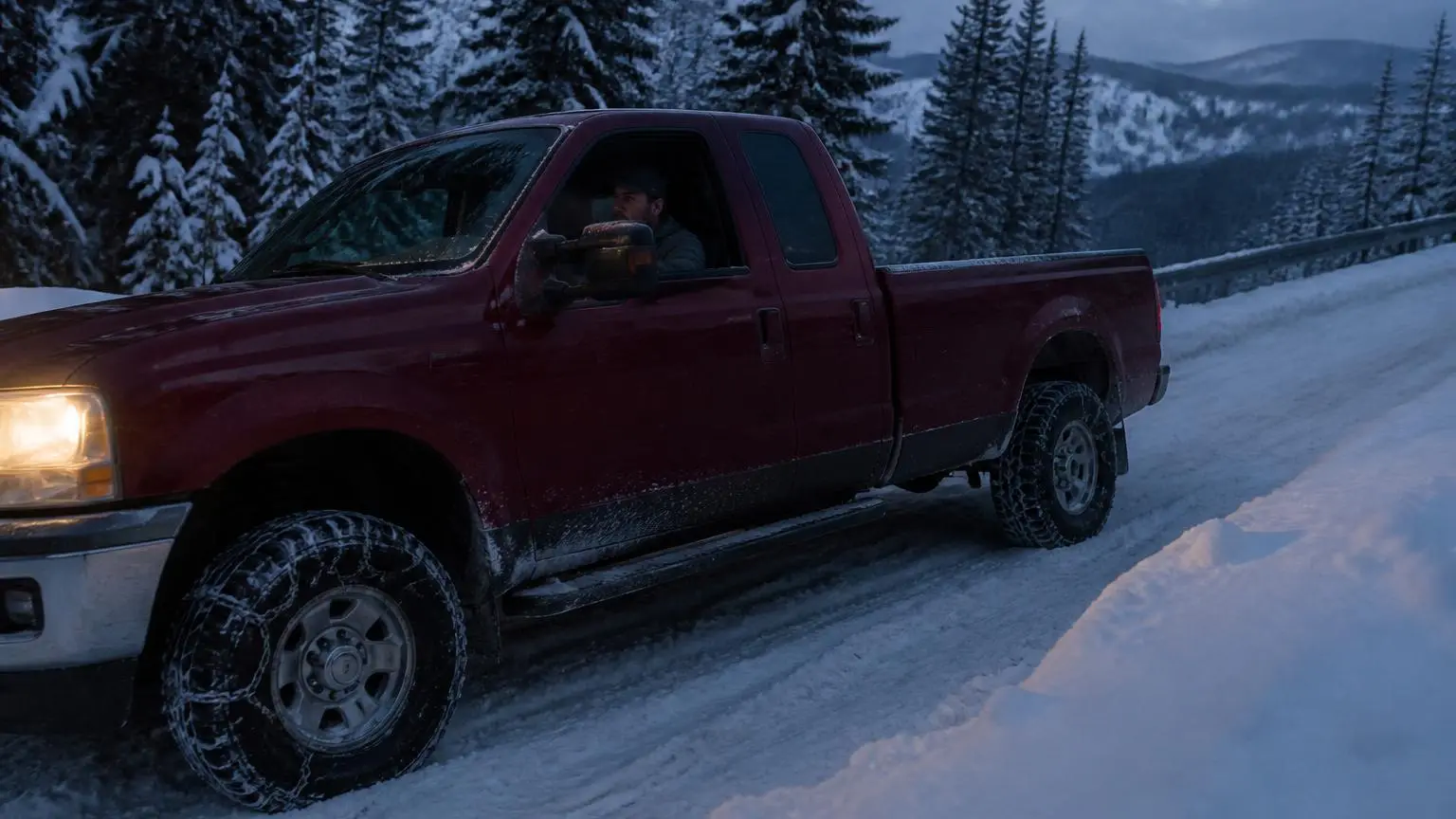
4WD sends power to all four wheels, which genuinely helps a truck accelerate on snow and ice. It does nothing for braking distance or cornering grip, both of which depend entirely on tire contact with the road — a 4WD truck stops and turns exactly as well as its tires allow (Consumer Reports). That's the real case for carrying chains: they add mechanical bite across braking and cornering that even a 3PMSF-rated all-terrain tire can't fully replace in deep snow or glare ice, and posted chain-control laws in several western states require them regardless of drivetrain.
At a Glance
| Situation | Chains needed? | Source |
|---|---|---|
| Caltrans R-1 in effect | Yes, unless 2WD/4WD with snow tires on 2+ drive wheels and under 6,000 lb | Caltrans |
| Caltrans R-2 in effect | Exempt only if 4WD/AWD with snow-tread tires on all four wheels — but still must carry a set | Caltrans |
| Caltrans R-3 in effect | Yes, every vehicle, no exceptions | Caltrans |
| Colorado Traction Law active | No, if tires are 3PMSF/M+S/all-weather rated with ≥3/16-in tread | CDOT |
| Colorado Chain Law active | Yes, every vehicle needs chains or an approved alternative device | CDOT |
What 4WD Actually Changes
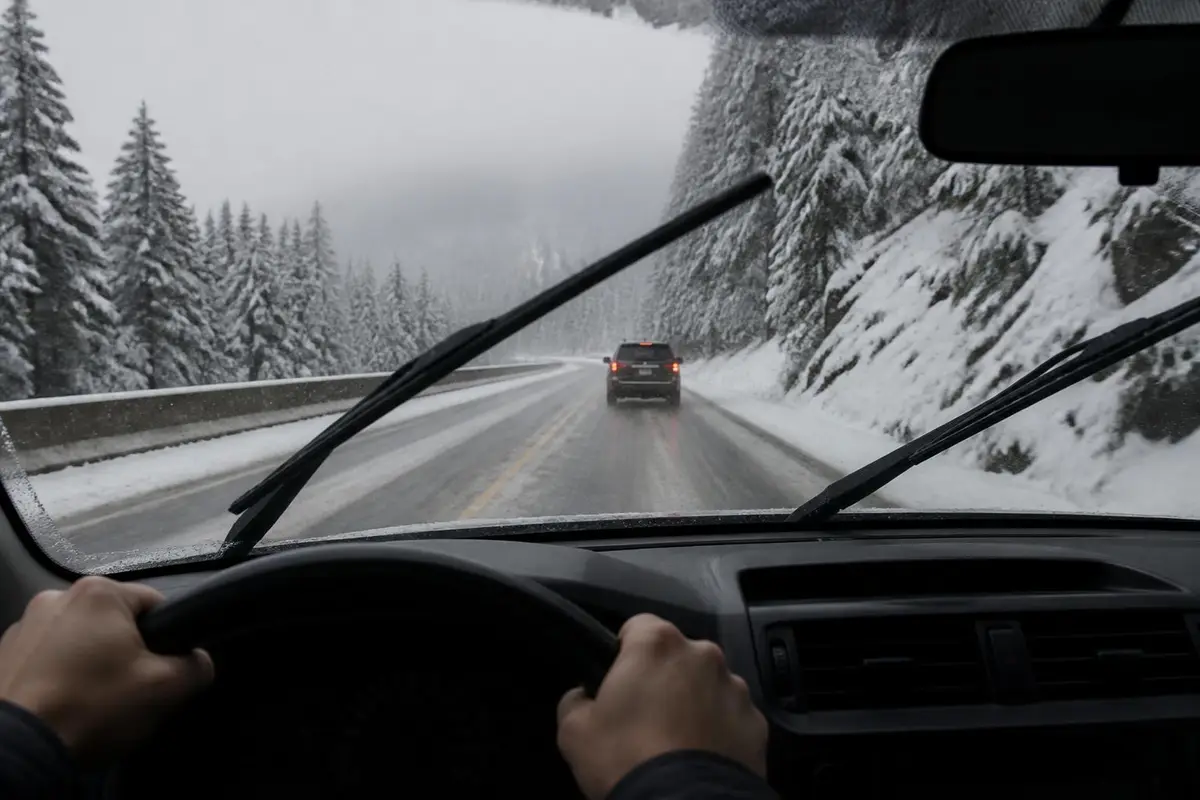
4WD distributes engine torque to all four wheels, which improves acceleration traction on snow and ice compared with a two-wheel-drive vehicle. It changes nothing about braking distance or cornering grip, since both depend entirely on how much the tire's contact patch can grip the surface — Consumer Reports' testing on this point is direct: driven-wheel layout doesn't help braking or cornering, tire grip does. A 4WD truck on worn all-season tires stops and turns exactly as poorly as a 2WD car on the same tires; only the tire (or a chain added to it) changes that.
Chain-Control Levels: R-1, R-2, R-3
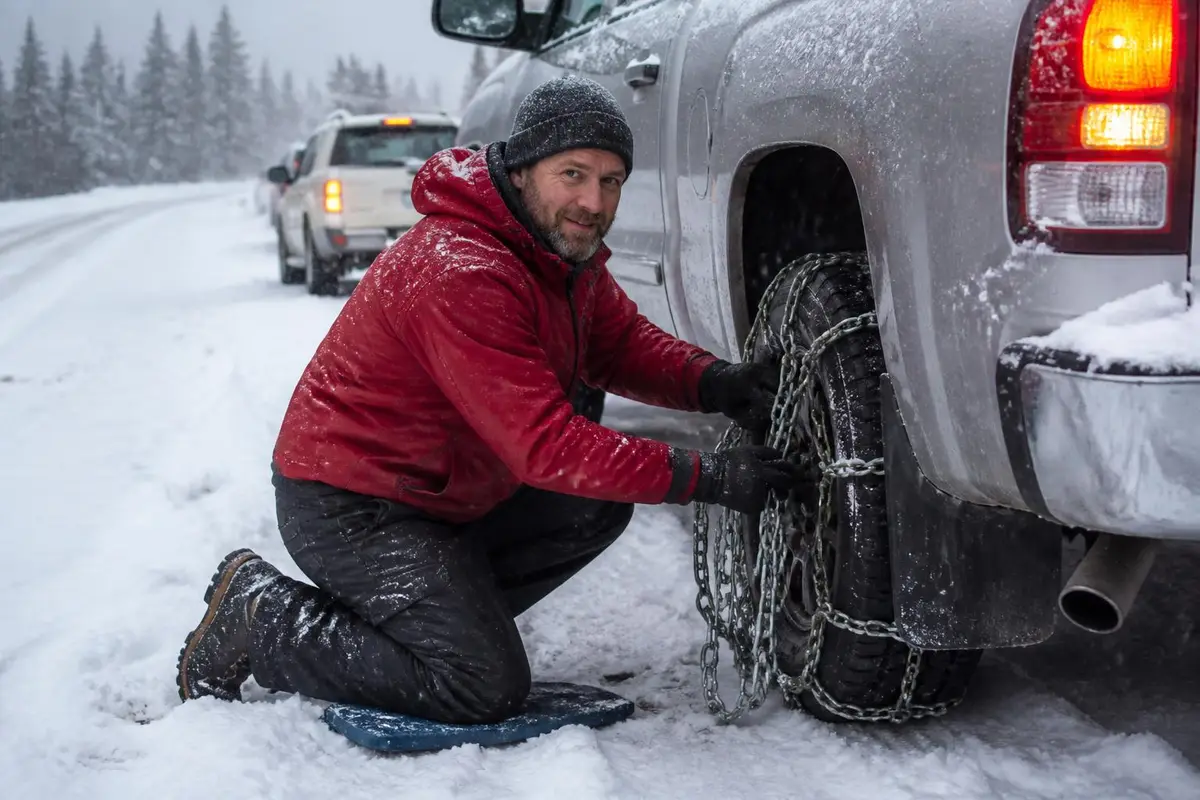
Caltrans posts three chain-control requirements on mountain routes during storms. R-1 requires chains on all vehicles except passenger cars and light trucks under 6,000 lb gross weight running snow tires on at least two drive wheels. R-2 requires chains or traction devices on every vehicle except 4WD or AWD vehicles with snow-tread tires on all four wheels — those vehicles are exempt from installing chains but must still carry a set in the chain-control area. R-3 requires chains on every vehicle, with no exceptions, and highways are typically closed outright before conditions reach R-3. The speed limit drops to 25–30 mph wherever chain controls are posted.
Colorado Runs Two Separate Laws
Colorado's Traction Law, active each year from September 1 through May 31 on the I-70 mountain corridor (and elsewhere when conditions warrant), is satisfied by any tire — winter, all-weather, or M+S-marked — with at least 3/16-inch tread depth on a 4WD or AWD vehicle; a vehicle that doesn't meet that needs chains or an approved alternative traction device on two or more drive tires instead. The separate, stricter Chain Law requires chains or an approved device on every vehicle, tire rating aside, once it's activated during a severe storm. A Traction Law violation carries a $50 fine plus a $17 surcharge; a Chain Law violation is $100 plus $33, rising sharply — plus vehicle recovery costs — if the vehicle blocks a travel lane.
Why a 3PMSF Tire Still Doesn't Replace Chains
The three-peak mountain snowflake (3PMSF) mark means a tire scored at least 110 on the industry's ASTM F1805 traction-index test against a reference tire rated 100 — roughly 10% better straight-line acceleration traction on packed snow (USTMA). That test measures acceleration only; it says nothing about braking or cornering, and nothing about ice. A chain's rigid links bite into packed snow and ice in a way no tread compound can, which is exactly why chain-control laws still apply on the worst days regardless of what's on the sidewall — see are all-terrain tires good in snow for the full rating breakdown.
Chain Fitment: SAE Class Sets the Limit
Chains are built to SAE clearance classes, not just a tire size range. Class S needs at least 1.46 in of tread-face clearance and 0.59 in of sidewall clearance; Class U needs 1.97 in and 0.91 in; Class W, the light-truck class, needs 2.5 in of tread-face and 1.5 in of sidewall clearance (Laclede Chain). A chain rated for a smaller class can be too tight for a truck's actual wheel-well clearance and rub the suspension or bodywork at full lock; check the vehicle's specified class, not just the tire's diameter, before buying.
Who Gets Real Value From Carrying a Set
An owner who regularly crosses posted chain-control zones — the I-70 corridor, Sierra passes on I-80, or similar mountain routes — needs a compliant set regardless of tire rating, since R-3 and Colorado's Chain Law apply to every vehicle. An owner who stays on plowed roads in a moderate climate, running a 3PMSF-rated tire, may reasonably decide chains stay in the garage most winters, but a low-cost set for an unexpected storm still avoids being turned back at a checkpoint that catches them off guard.
Practice Before the First Storm, Not During It
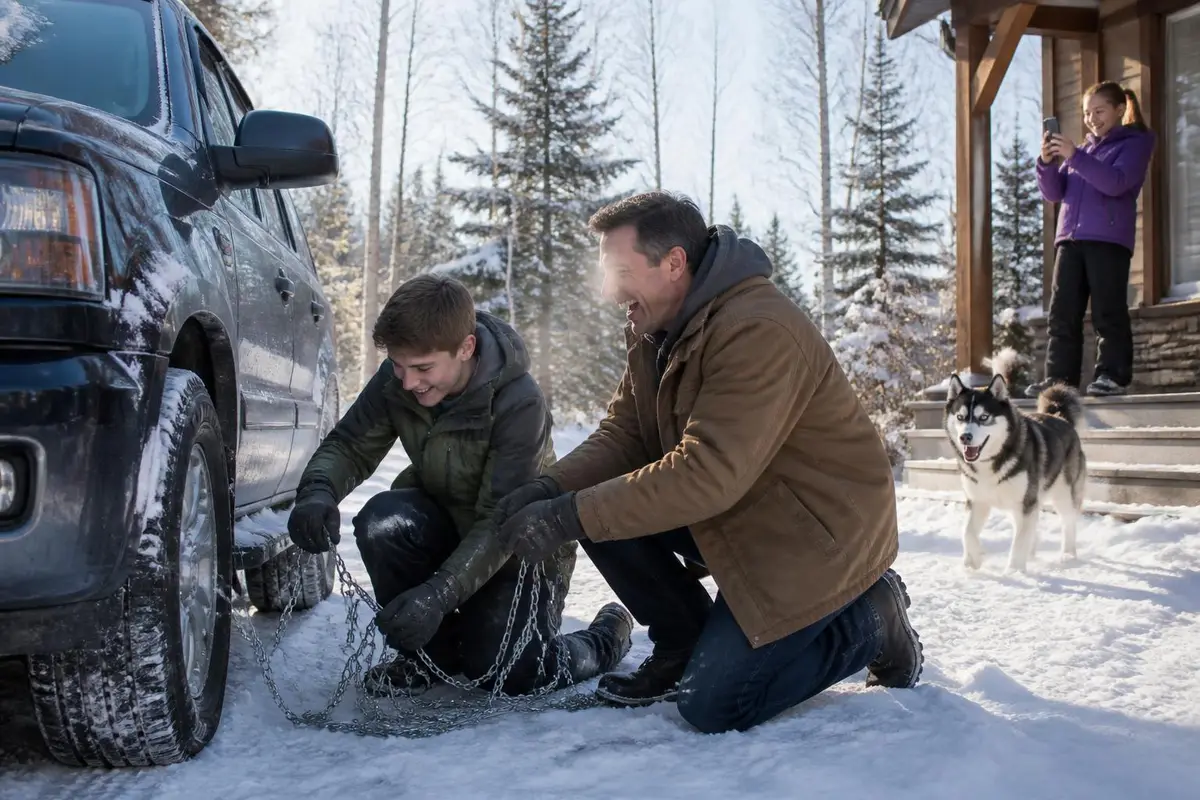
Confirming SAE class and tire-size fitment, then installing a set once at home in good conditions, removes the guesswork of a first attempt roadside in the dark and cold. Store chains somewhere reachable in the vehicle rather than under other cargo — a set that's correct for the truck but buried under gear at a checkpoint causes the same delay as not having one at all.
Recommended gear
Gear for snow and winter trips
Affiliate disclosure: As an Amazon Associate, we earn from qualifying purchases, at no extra cost to you. Purchases through these links help keep this site running and up to date. Learn more

Best for getting unstuck from sand, mud or snow without another vehicle.
- Nylon recovery boards that give spinning tires grip in sand, mud or snow.
- Double as a shovel to clear sand from in front of the tires.

Best for a kinetic rope with matching soft shackles.
- 7/8 in x 30 ft kinetic rope plus two 7/16 in soft shackles.
- Comes with a waterproof storage bag.

Best for a compact compressor for tires up to 33".
- Compact 12V compressor, 120 PSI, for tires up to 33 in.
- Small enough to keep in the vehicle full-time.

Best for plugging a tread puncture on the trail.
- Reamer-and-plugger kit for tread punctures.
- Lets you plug a tire on the trail instead of changing it.
We research products from manufacturer specs and owner feedback; we don't test them ourselves. How we choose.
Sources
- Consumer Reports — Do You Really Need AWD in the Snow? — Driven-wheel layout (2WD/4WD/AWD) doesn't help braking or cornering; tire grip does.
- Caltrans — Chain Controls / Chain Installation — R-1, R-2 and R-3 chain-control levels and their exemptions; 25-30 mph speed limit when chains are required; practicing chain installation before a storm.
- Colorado DOT — Passenger Vehicle Traction and Chain Laws — Traction Law tire and tread requirements (3/16-in, M+S/all-weather/3PMSF), active dates (Sept 1–May 31 on I-70), and the separate Chain Law; fines for each.
- USTMA — TISB 37: Tires for Use in Severe Snow Conditions — Industry definition of the three-peak mountain snowflake (3PMSF) severe-snow marking and the ASTM F1805 traction-index test.
- Laclede Chain — SAE Classifications — SAE chain clearance classes S, U and W and their tread-face/sidewall clearance minimums.