
Affiliate disclosure: As an Amazon Associate, we earn from qualifying purchases, at no extra cost to you. We research rather than test, and commissions never change our rankings. This site is reader-supported: those commissions pay for hosting, research and keeping every guide up to date, so if a guide helped you, buying through our links is an easy way to support it. How we rank · Full disclosure
TL;DR
- Engine braking is the drag you get when you lift off the throttle in gear; it grows with engine rpm, so lower gears and 4L make it stronger.
- At 3 mph in first gear, a Wrangler Rubicon's engine turns about 595 rpm in 4H but about 2,380 rpm in 4L (calculated from Stellantis specs).
- Ford: descend in the gear you would climb in, and never in neutral. Jeep: use low range and the lowest gear, and brake only to fine-tune.
- Pick the gear at the top; Georgia's CDL manual warns against downshifting once speed has built up.
- Riding the brakes on a long grade overheats them and can lead to brake fade.
How It Works
With the throttle closed, the engine is no longer driving the wheels. The wheels are driving the engine. Every revolution means compressing air in the cylinders, pumping air through a closed or nearly closed throttle and overcoming internal friction. All of that takes energy from the vehicle's motion.
The effect grows with engine rpm, and gearing sets the rpm. Georgia's commercial driver's manual puts it this way: the braking effect is greatest near the engine's governed rpm with the transmission in a lower gear. In a tall highway gear the engine turns slowly and you barely feel it. In first gear and low range it turns fast, and the drag is strong.
Worked Example: Why 4-Low Makes the Difference
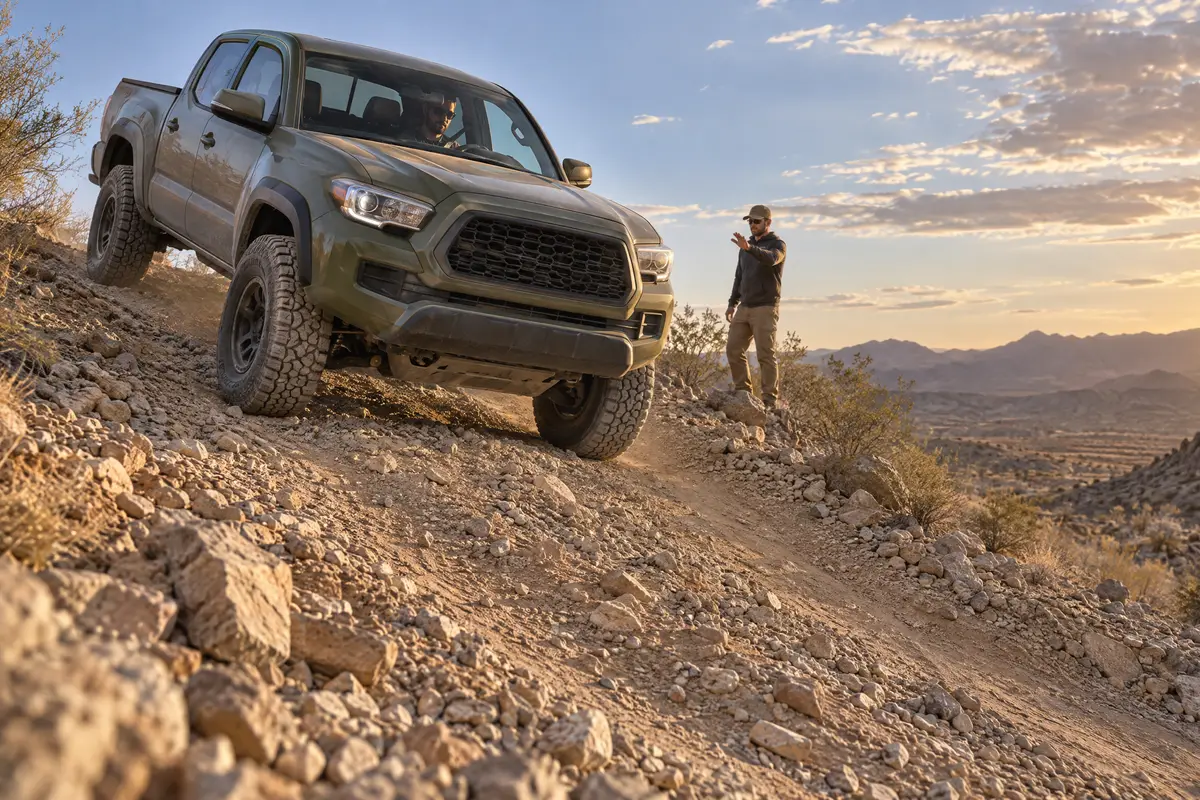
Take a Jeep Wrangler Rubicon with the 8-speed automatic (first gear 4.71:1), 4.10 axles, the 4.0:1 Rock-Trac low range and nominal LT285/70R17 tires (about 617 revolutions per mile), all from Stellantis's specifications. Here is what the engine is doing at 3 mph in first gear:
| Range | Overall ratio | Engine rpm at 3 mph |
|---|---|---|
| 4H (1:1) | 19.3:1 | about 595 rpm |
| 4L (4.0:1) | 77.2:1 | about 2,380 rpm |
In 4H, a 3 mph crawl barely turns the engine over, so there is little engine braking and the brakes have to do the work. In 4L, the engine turns four times faster at the same road speed and holds the vehicle back strongly. On a Wrangler with the 2.72:1 Command-Trac case, the multiplier is 2.72 instead of 4.
Why It Matters on Steep Descents
Friction brakes turn motion into heat. Used continuously on a long grade, they overheat. Georgia's CDL manual warns that brakes can fade or fail from excessive heat when a driver uses them too much instead of relying on engine braking. On a steep, loose off-road descent there's a second problem: a locked or heavily braked wheel loses steering control.
The advice is consistent across sources:
- Jeep: use the lowest gear with a manual, or low range and the lowest drive setting with an automatic. Let the gears and engine compression slow you down, and use the brakes only to fine-tune speed. Go straight down, never at an angle.
- Ford: descend in the same gear you would use to climb the hill, to avoid excessive brake application and brake overheating. Do not descend in neutral.
- Georgia CDL manual: select the low gear before starting down the grade, not after speed has built up.
Choosing the Gear Before You Start Down
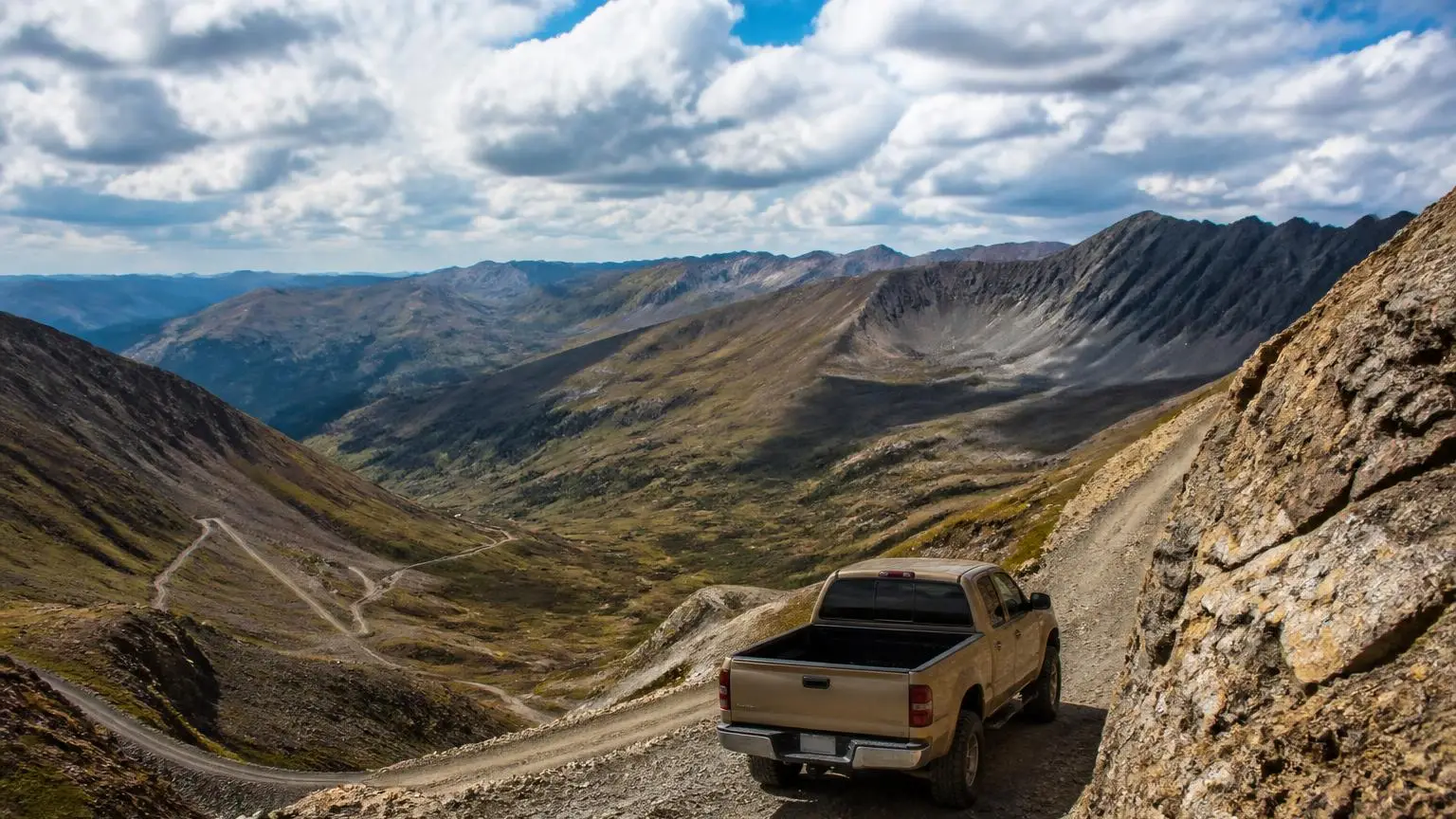
Pick the gear at the top, while the vehicle is stopped or slow. Shifting into 4L requires rolling at 2 to 3 mph in neutral (Jeep) or 3 mph or less (Ford), which you can't safely do halfway down a slope. The Georgia CDL manual makes the same point for trucks: don't try to downshift once speed has built up. As a starting point, use the gear you would climb the same slope in (Ford's rule). On a steep rock or dirt descent in a low-range 4x4, that usually means 4L and first gear.
If speed still creeps up, the CDL manual's technique for long grades is to brake firmly enough to drop about 5 mph below your safe speed, release (about three seconds of braking in its example), and repeat. Short, firm applications give the brakes time to cool between them. Constant light pressure doesn't.
Automatic Transmissions: Holding the Gear
Left in Drive, an automatic may upshift as the vehicle gains speed downhill, which reduces engine braking just when you need it. Use the manual-select mode to hold first or second, or low range if the vehicle has one. Many 4x4s also offer hill descent control. Jeep describes it as a system that uses the antilock brakes to hold a slow, steady speed without driver input. It works the brakes for you, and it's covered in hill descent control.
Common Mistakes
- Riding the brakes down a long grade in a tall gear. This is the brake-fade pattern the CDL manual warns about.
- Coasting in neutral, or with the clutch pressed. Ford says not to descend in neutral. Jeep warns that coasting with the clutch disengaged in low range can severely damage the clutch disc.
- Downshifting after speed has built up. Choose the gear at the top.
- Angling across a steep slope. Jeep says to go straight down and never get sideways.
See 4 high vs 4 low for how the two ranges work.
Recommended gear
A first recovery kit for any 4WD
Affiliate disclosure: As an Amazon Associate, we earn from qualifying purchases, at no extra cost to you. Purchases through these links help keep this site running and up to date. Learn more

Best for a complete strap, shackle and glove kit in one bag.
- Straps, shackles, gloves, damper and a recovery bag in one kit.
- Covers most vehicle-to-vehicle recoveries without buying parts separately.

Best for getting unstuck from sand, mud or snow without another vehicle.
- Nylon recovery boards that give spinning tires grip in sand, mud or snow.
- Double as a shovel to clear sand from in front of the tires.

Best for airing all four tires down to a set pressure at once.
- Automatic deflators preset between 6 and 30 PSI.
- Air all four tires down at once, then stop at the set pressure.

Best for airing back up before you hit pavement.
- Portable 12V compressor rated to 150 PSI.
- Sized for truck and SUV tires.
We research products from manufacturer specs and owner feedback; we don't test them ourselves. How we choose.
Sources
- Georgia Department of Driver Services — CDL Manual Section 2.16, Mountain Driving — Engine braking as the principal way to control speed on a downgrade; greatest near governed rpm in lower gears; select the gear before the grade; brake fade from overuse; the brake-release technique on long grades.
- Jeep — 4x4 FAQ & Glossary — Lowest gear or low range and lowest drive setting on descents; let the gears and engine compression slow you and use brakes to fine-tune; don't coast in low range with the clutch disengaged; go straight down; hill descent control uses ABS; 4L shift at 2–3 mph.
- Ford Owner's Manual — Using Four-Wheel Drive (2017 Expedition) — Ford: descend in the same gear you would climb in to avoid brake overheating, don't descend in neutral, 4L shift at 3 mph or less.
- Stellantis Media — 2026 Jeep Wrangler Specifications — 8-speed first gear 4.71, 4.10 axles, 4.0:1 and 2.72:1 low range, LT285/70R17 tire — inputs to the engine-rpm example.
- Cummins — Jacobs Compression Release Engine Brake — How a Jacobs compression-release engine brake opens the exhaust valves near top of the compression stroke; claim of 85% of braking needs.