
Affiliate disclosure: As an Amazon Associate, we earn from qualifying purchases, at no extra cost to you. We research rather than test, and commissions never change our rankings. This site is reader-supported: those commissions pay for hosting, research and keeping every guide up to date, so if a guide helped you, buying through our links is an easy way to support it. How we rank · Full disclosure
TL;DR
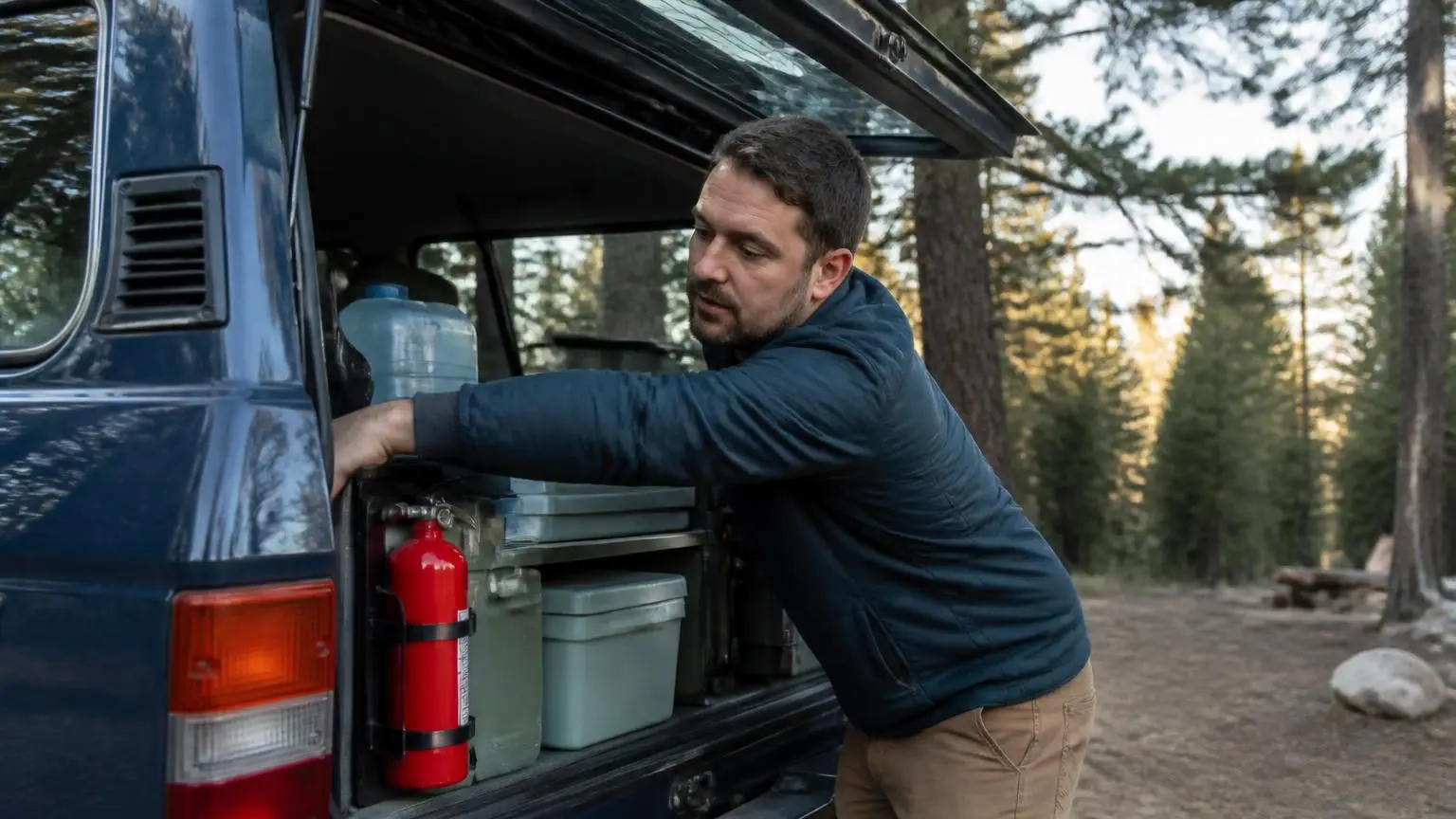
- Vehicle fires are mostly fuel and wiring fires: NFPA found 61% start in the engine, running gear or wheel area. Buy a B:C or A:B:C extinguisher.
- 5-B:C is the federal minimum for commercial trucks (49 CFR 393.95), and a sensible floor for any truck. 10-B:C covers about twice the spill area.
- ABC powder is acidic and corrodes metal if not cleaned up (Amerex). Clean agents such as Halotron leave no residue but cost more.
- Bolt it in a bracket within the driver's reach, away from seat-side airbags, and check the gauge regularly.
- Replace or recharge after any use. Kidde says a unit is good while the gauge is green and it is under 12 years old.

Best for Owners wanting a purpose-built vehicle extinguisher from an established brand.
- 10-B:C rating per listing.
- Marketed specifically for cars and trucks.

Best for Owners with limited mounting space wanting a smaller, still vehicle-rated unit.
- 5-B:C rating per listing.
- Smaller form factor than the Auto 10.

Best for Owners wanting one to keep at home and one in a second vehicle.
- 2-pack per listing.
- Mounting bracket included.

Best for Owners wanting to equip several vehicles or locations at a lower per-unit cost.
- 4-pack per listing.
- ABC rated per listing.
- 1.32 lb each.
Where Vehicle Fires Start
| NFPA finding (2018–2022 annual averages) | Figure |
|---|---|
| Highway vehicle fires per year | 195,927 |
| Civilian deaths per year in those fires | 579 |
| Fires that began in the engine, running gear or wheel area | 61% |
| Fires where mechanical failure was a factor | 30% |
| Fires where electrical failure was a factor | 12% |
NFPA also found that about three-quarters of the 2022 fires caused by mechanical or electrical failure involved model-year 2011 or older vehicles. Older trucks and trucks carrying added wiring for lights, compressors and fridges are the ones most worth equipping.
Class Ratings and What the Numbers Mean
Class A covers ordinary combustibles such as cloth, rubber and plastics; Class B covers flammable liquids such as fuel and oil; Class C covers energized electrical equipment. OSHA's extinguisher guidance explains the numbers: each unit in front of the A equals 1.25 gallons of water, and the number in front of the B is the square footage of a Class B fire a non-expert user should be able to extinguish. The C carries no number. Kidde lists its Auto 10 at 10-B:C and markets it for fires "from flammable liquids and electrical equipment", with a strap retention bracket.
| Rating | What it covers | Benchmark |
|---|---|---|
| 5-B:C | About 5 sq ft of flammable liquid fire, plus electrical | Minimum for a non-hazmat commercial truck (49 CFR 393.95) |
| Two units at 4-B:C | Same use, split between two locations | Allowed as an alternative to one 5-B:C unit |
| 10-B:C | About 10 sq ft of flammable liquid fire, plus electrical | Minimum for a placarded hazmat vehicle |
| A:B:C | Adds ordinary combustibles such as seats and cargo | Multipurpose dry chemical |
The federal rule applies to commercial motor vehicles, not personal trucks, but it also requires the unit to be securely mounted, readily accessible, filled, labeled with its UL rating and built so you can see it is charged. Those are sensible requirements for any vehicle.
Dry Chemical vs. Clean Agent
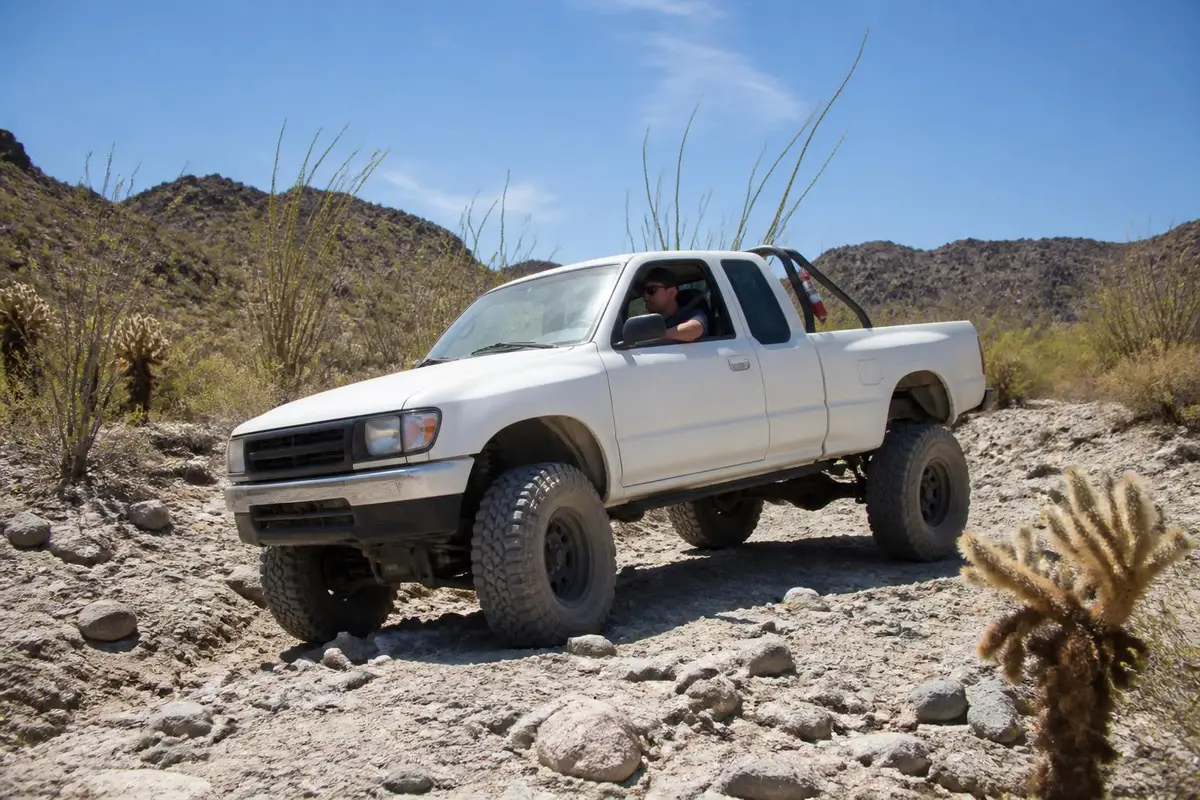
Multipurpose A:B:C powder is monoammonium phosphate. Amerex, an extinguisher manufacturer, describes it as acidic and says it will corrode untreated metal if it is not cleaned up quickly. Amerex also cites NFPA 10's rule that dry chemical should not be used to protect delicate electronic equipment, and says clean agents such as Halotron I are best suited to that hazard. According to Amerex, Halotron I discharges as a rapidly evaporating liquid that is nonconductive, non-corrosive and leaves no residue. The trade-off is that clean-agent units of the same rating are larger and less common.
Using It: PASS, and When Not To
The U.S. Fire Administration teaches PASS: Pull the pin, Aim low at the base of the fire, Squeeze the lever slowly and evenly, and Sweep side to side. USFA says to fight a fire only if it is small and contained, someone has called 911, you are safe from the smoke and you have a clear escape route. Otherwise, leave and call 911.
Mounting and Regular Checks
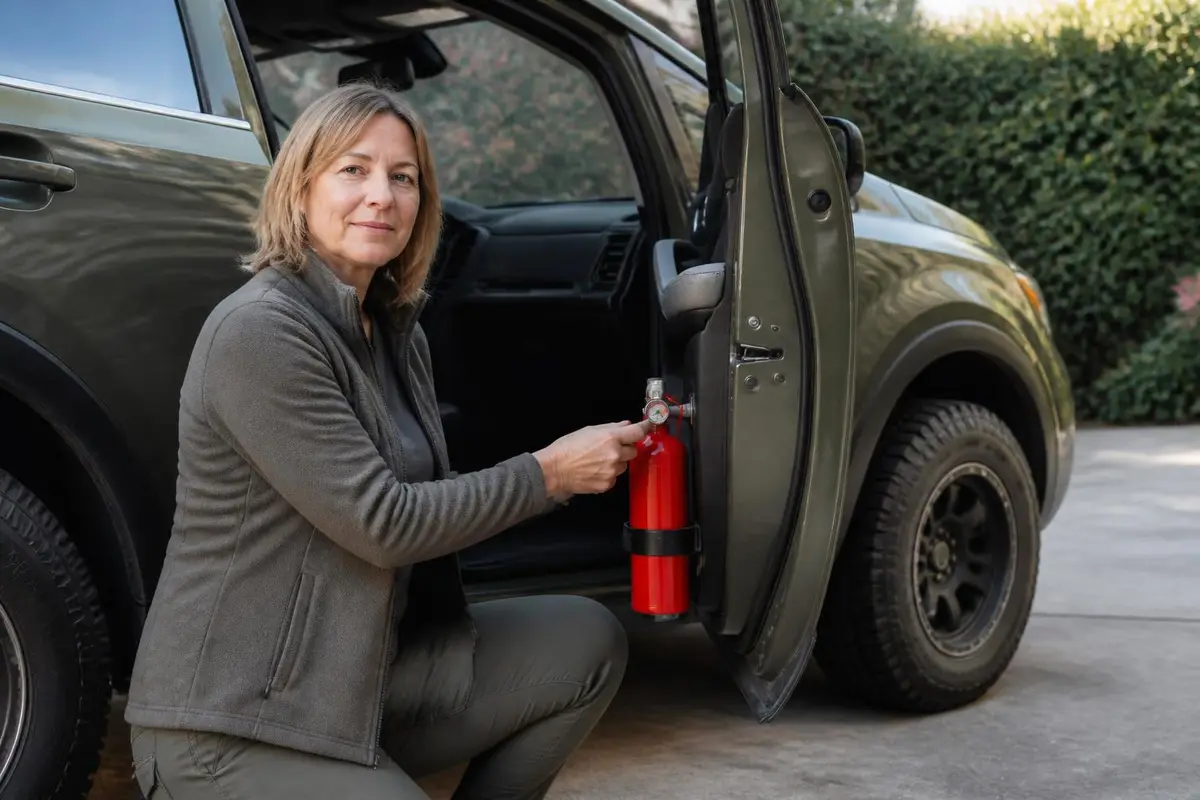
Use the metal or strap bracket and bolt it to a solid surface: a seat base, the floor or a roll bar. Don't mount it on the side of a front seatback. Ford's owner guides warn against mounting equipment on or near the side airbag area of the seats. At each check, go through USFA's list: nothing blocks access, the gauge shows full pressure, and there are no dents, rust or buildup of dirt and oil.
Replace or Recharge?
USFA says to recharge or replace an extinguisher once its pressure drops, and any use at all counts, even a short test burst. Kidde says a unit is still good if the gauge needle is in the green and the manufacture date is less than 12 years ago; rechargeable models go to a service center. The vehicle picks above are sold as complete units, so check each listing and the included instructions to see whether the model you pick can be recharged. See our vehicle emergency kit checklist for how an extinguisher fits a roadside kit. Cape Hatteras National Seashore, for example, recommends carrying one for beach driving.
Sources
- NFPA Research — Vehicle Fires (McGree, November 2024) — 195,927 highway vehicle fires and 579 civilian deaths per year (2018–2022); 61% began in the engine, running gear or wheel area; mechanical failure a factor in 30% and electrical failure in 12%; about three-quarters of 2022 failure fires involved model-year 2011 or older vehicles.
- OSHA — Portable Fire Extinguishers: Extinguisher Basics — Fire classes A, B, C, D and K; the numeral before A equals 1.25 gallons of water per unit and the numeral before B is the square footage of Class B fire a non-expert can extinguish.
- 49 CFR § 393.95 — Emergency equipment on power units (Cornell LII) — Commercial trucks need a 5-B:C extinguisher (or two 4-B:C), 10-B:C for placarded hazmat; securely mounted, readily accessible, filled, UL-rating labeled and visibly charged.
- Kidde — Auto 10 Fire Extinguisher (M10G) — Auto 10 rated 10-B:C, designed for vehicle fires from flammable liquids and electrical equipment, with a strap retention bracket.
- Kidde — How to Tell When You Need to Refill Your Fire Extinguisher — Extinguisher is still good if the gauge needle is in the green and the manufacture date is less than 12 years ago; rechargeable units go to a service center.
- U.S. Fire Administration — Choosing and Using Fire Extinguishers — PASS technique; fight a fire only if it is small and contained with a clear escape route, otherwise leave and call 911; regular checks of access, pressure and condition; recharge or replace when pressure drops.
- Amerex — Common Myth #17: ABC Dry Chemical (Tech Tip PDF) — Monoammonium phosphate (ABC) is acidic and corrodes untreated metal if not cleaned up; NFPA 10 says dry chemical is not for delicate electronics; clean agents such as Halotron I suit that hazard.
- Amerex — Halotron Clean Agent Extinguishers — Halotron I discharges as a rapidly evaporating liquid that is nonconductive, non-corrosive and leaves no residue.
- Ford — 2022 Expedition Supplemental Owner's Guide: How Do the Side Airbags Work — Accessory seat covers not released by Ford could prevent airbag deployment; do not place objects or mount equipment on or near the seatback side airbag area.
- NPS — Cape Hatteras National Seashore: Off-Road Vehicle FAQ — ORV permit requires a low-pressure tire gauge, shovel, jack and jack support board; recommends a full-size spare, first-aid kit, fire extinguisher, flashlight, trash bag and tow strap; under 20 psi recommended on sand and reinflate on pavement.