

Affiliate disclosure: As an Amazon Associate, we earn from qualifying purchases, at no extra cost to you. We research rather than test, and commissions never change our rankings. This site is reader-supported: those commissions pay for hosting, research and keeping every guide up to date, so if a guide helped you, buying through our links is an easy way to support it. How we rank · Full disclosure
TL;DR
- Most onboard kits use a 12-volt electric pump like the portables. VIAIR's onboard 450C and portable 450P share the same 1.80 CFM rating.
- Fill time depends on real CFM. A 35-inch tire from 15 to 35 PSI takes about 1.5 minutes at ARB's 4.68 CFM (29 PSI) and about 5 minutes at 1.5 CFM.
- Onboard kits are usually rated for 100% duty; small portables for about 20–30 minutes at 30 PSI.
- A 2.5-gallon tank at 145 PSI holds only about 2.5 cubic feet of usable air for a 35 PSI tire. It helps air tools more than tire fills.
- An onboard install means fused wiring, a relay and pressure switch, and plumbing. A portable needs none and works on any vehicle.
At a Glance
| Portable 12V compressor | Onboard air system | |
|---|---|---|
| Setup each time | Unpack, clamp to the battery or plug into a socket, run the hose | Connect the hose to a fitting and open the valve |
| Install | None | Mounting, fused wiring and a relay, plus plumbing if there's a tank |
| Typical duty cycle | From about 20–30 minutes at 30 PSI to 100% on larger units | Often 100% (VIAIR 450C, ARB CKMTA12) |
| Use on other vehicles | Yes, from any battery | Only within reach of its hose |
| Air tools | Limited by flow and duty cycle | Better with a tank that stores air at 110–145 PSI |
Most Onboard Systems Use a 12-Volt Pump Too
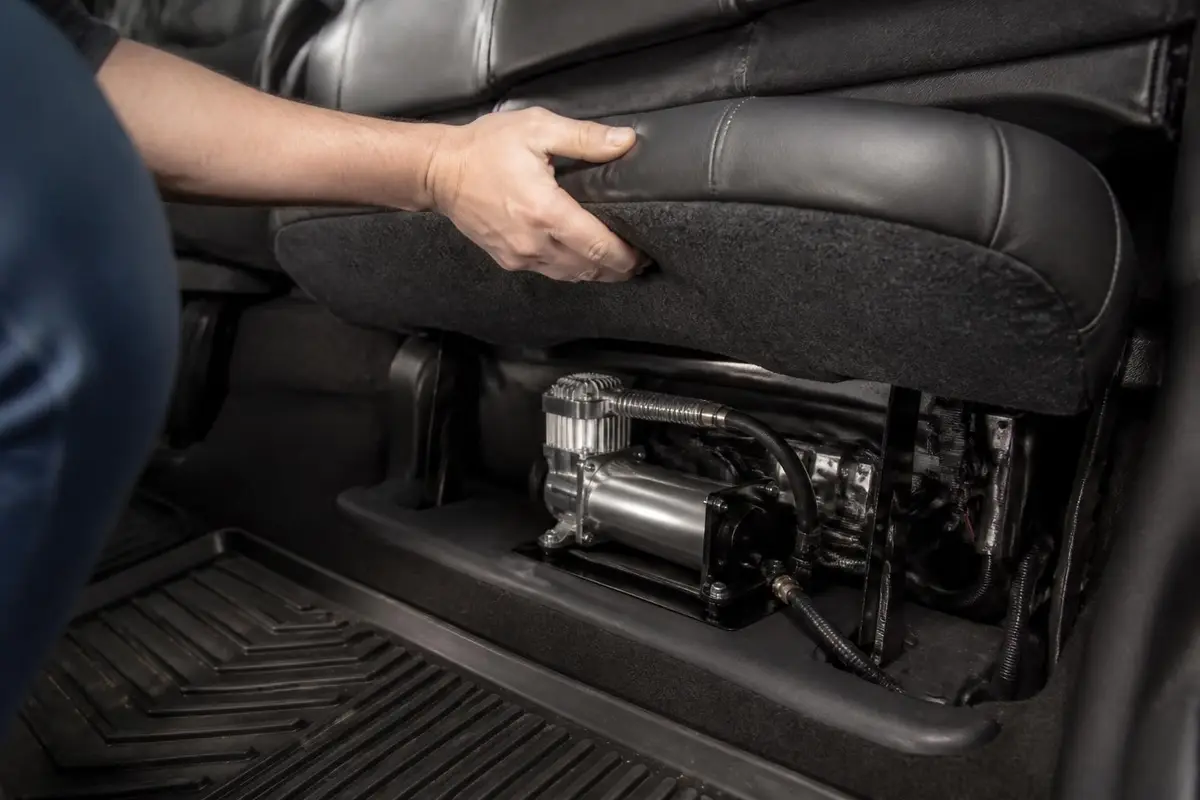
An onboard system is mostly defined by how it's installed, not by a different kind of pump. VIAIR's Constant Duty onboard kit is built around its 450C compressor, rated 1.80 CFM at 0 PSI with a 100% duty cycle at 100 PSI. VIAIR's chart gives exactly those figures for its portable 450P. ARB's CKMTA12 is also a 12-volt electric unit, with twin motors rated 6.16 CFM at 0 PSI and 4.68 CFM at 29 PSI, drawing up to 68.6 A. Engine-driven onboard air is a separate, smaller category. Off Road Only's York kits, for example, mount a York compressor with an electromagnetic clutch to the engine of specific Jeep Wrangler models.
Fill Time Depends on the Pump, Not the Mounting
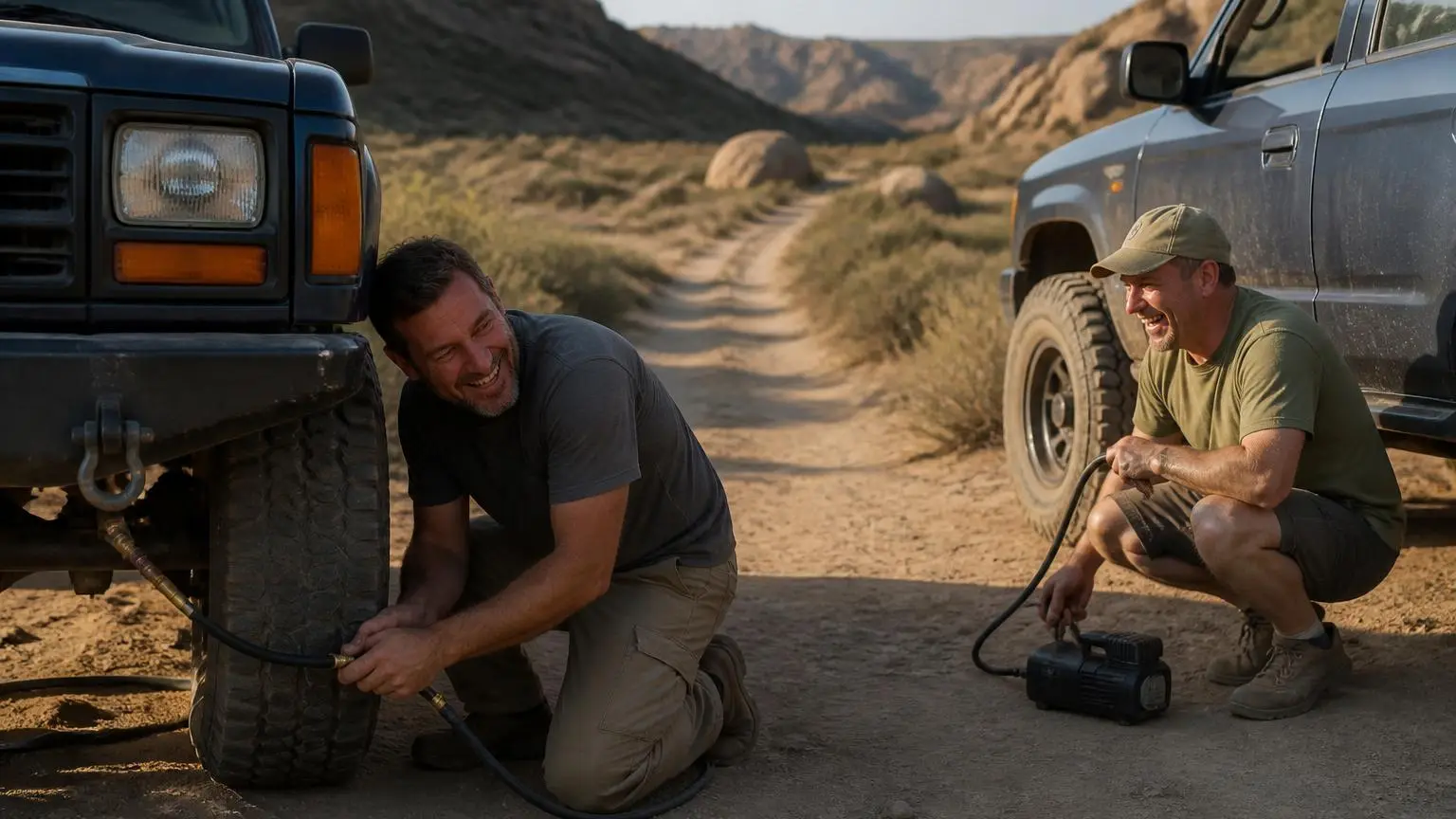
Raising a 35x12.50R17 from 15 to 35 PSI takes at most about 7.2 cubic feet of free air (see the fill-time table on the air compressors and tire deflators hub). At ARB's 4.68 CFM rating that's about 1.5 minutes per tire, or 6 minutes for four. A pump that really delivers 1.5 CFM needs about 5 minutes per tire and about 19 for four, whether it's bolted in or sitting on the ground.
Duty cycle is where onboard kits usually pull ahead, because they're built for continuous use. VIAIR's portable 88P is rated for 25 minutes at 30 PSI, and its 400P for 33% at 100 PSI, about 20 minutes per hour. The 450C in VIAIR's onboard kit and ARB's CKMTA12 are both rated 100%.
What a Tank Adds, and What It Doesn't
VIAIR's onboard kit pairs the compressor with a 2.5-gallon tank and a pressure switch that turns the pump on at 110 PSI and off at 145 PSI. A 175 PSI safety valve protects the tank. A tank gives short bursts of high-flow air for air tools and for seating a bead, but it holds little air for filling tires. NIST defines a gallon as 231 cubic inches, so 2.5 gallons is about 0.33 cubic feet. Draining it from 145 PSI down to a 35 PSI tire releases about (145 − 35) ÷ 14.7 × 0.33 ≈ 2.5 cubic feet of free air. That's about a third of what one 35-inch tire needs from 15 PSI, so the pump still does most of the work on a full air-up.
What an Onboard Install Involves
VIAIR's Constant Duty kit shows what's typically involved. It includes 20 feet of 12-gauge wire with an inline fuse holder, a relay and pressure switch, a dash gauge with an on/off switch, a drain cock for the tank, air line and compression fittings, and a 35-foot coil hose with a tire chuck. VIAIR specifies thread sealant rather than tape and gives fitting torques of 10–11 ft-lb for 1/8-inch and 16–18 ft-lb for 1/4- and 3/8-inch fittings. It also says to mount the pressure switch in a weatherproof spot. VIAIR's FAQ says to run the engine while the compressor works, since its ratings assume 13.8 volts.
Portability
A clamp-powered portable runs from any vehicle's battery, so one unit can serve a second vehicle or another truck on the trail. The tradeoff is setup each time: unpack it, connect power, run the hose, and stow it again. An onboard system skips that setup but works only within reach of its hose. VIAIR's kit hose is 35 feet.
Who Should Choose Each
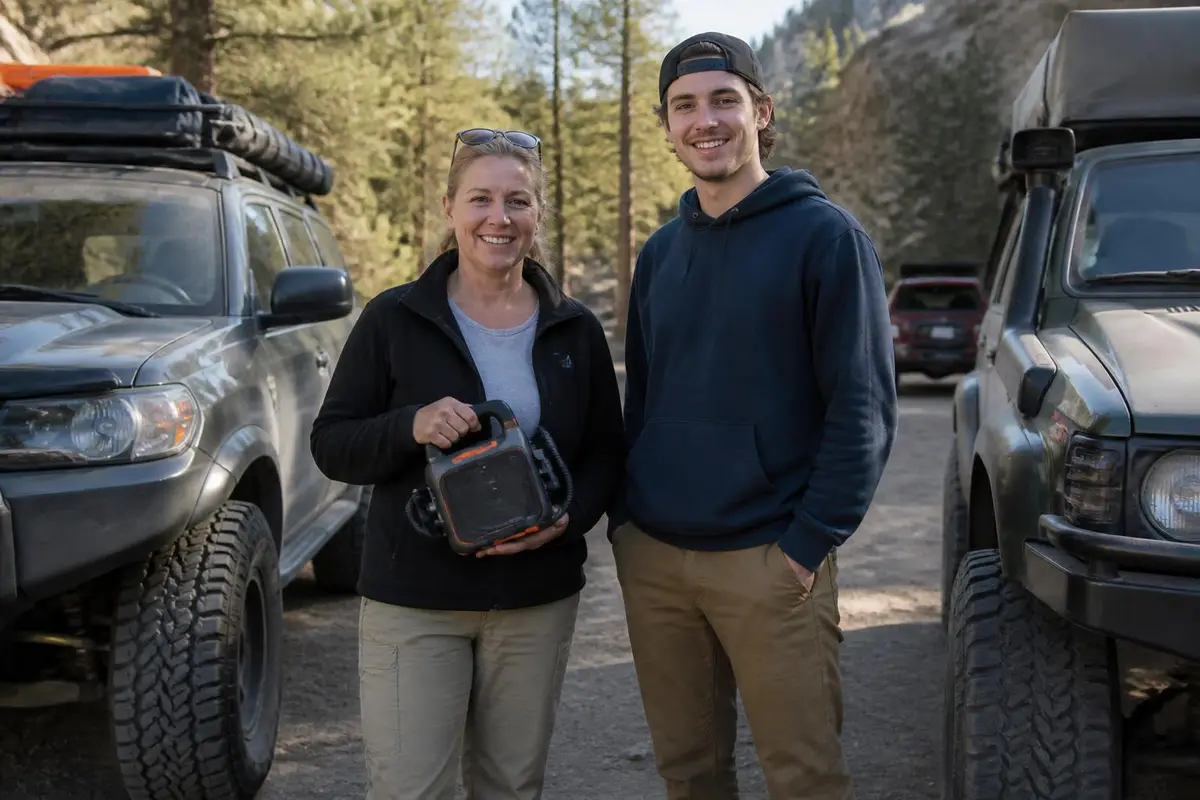
If you air down on most trips, run tires of 35 inches or larger, or want air for tools, a 100%-duty onboard system saves the setup each time and the waits for cool-down. If you air down now and then, want one unit to share between vehicles, or don't want permanent wiring, a portable with a CFM rating and duty cycle matched to your tire size does the same job more slowly. Either way, size it with the fill-time math on the hub. This comparison uses manufacturer specifications; we don't buy, install or test this gear ourselves (how we rank).
Recommended gear
Gear for airing down and back up
Affiliate disclosure: As an Amazon Associate, we earn from qualifying purchases, at no extra cost to you. Purchases through these links help keep this site running and up to date. Learn more

Best for airing all four tires down to a set pressure at once.
- Automatic deflators preset between 6 and 30 PSI.
- Air all four tires down at once, then stop at the set pressure.

Best for budget-friendly airing down before sand or rock.
- Adjustable 4-pack of deflators, 10–30 PSI.
- Screw on, set the pressure, and they stop automatically.

Best for airing back up before you hit pavement.
- Portable 12V compressor rated to 150 PSI.
- Sized for truck and SUV tires.

Best for fast inflation of larger off-road tires.
- Heavy-duty 12V off-road compressor.
- Built for inflating larger off-road tires quickly.
We research products from manufacturer specs and owner feedback; we don't test them ourselves. How we choose.
Sources
- VIAIR — Constant Duty Onboard Air System (10007) — Kit contents (450C compressor, 2.5-gallon tank, 110/145 PSI pressure switch with relay, 175 PSI safety valve, 20 ft of 12-gauge wire with inline fuse, dash gauge and switch, 35 ft hose); 1.80 CFM at 0 PSI, 100% duty at 100 PSI, 23 A; thread-sealant and fitting-torque instructions.
- VIAIR — Compressor Comparison Chart — 450P and 450C both 1.80 CFM at 0 PSI and 100% duty; portable duty cycles from 20 to 30 minutes at 30 PSI; 400P at 33% at 100 PSI.
- VIAIR — 88P Portable Compressor Specifications — 25-minute duty cycle at 30 PSI; battery-clamp connection.
- VIAIR — FAQ — Run the engine while the compressor works; ratings assume 13.8 volts.
- ARB USA — Twin Motor Onboard Air Compressor (CKMTA12) Specifications — 12-volt twin-motor onboard compressor: 6.16 CFM at 0 PSI, 4.68 CFM at 29 PSI, 100% duty cycle, 68.6 A maximum draw.
- Off Road Only — York Compressor Kit for Jeep Wrangler JK — Example of engine-driven onboard air: a York compressor with an electromagnetic clutch mounted to the 2012–18 JK 3.6L engine.
- NIST Handbook 44 (2026), Appendix C — General Tables of Units of Measurement — 1 U.S. gallon = 231 cubic inches, used to convert tank volume.
- NOAA National Data Buoy Center — What Is Air Pressure? — Sea-level air pressure of 14.7 PSI, used in the fill-time and tank math.
- 49 CFR 571.110 (FMVSS 110) — Tire Selection and Rims (Cornell LII) — The vehicle placard lists the manufacturer's recommended cold inflation pressure.