

Affiliate disclosure: As an Amazon Associate, we earn from qualifying purchases, at no extra cost to you. We research rather than test, and commissions never change our rankings. This site is reader-supported: those commissions pay for hosting, research and keeping every guide up to date, so if a guide helped you, buying through our links is an easy way to support it. How we rank · Full disclosure
An automatic tire deflator is built around one specific convenience: set it once, and it stops itself at the target pressure without a driver watching a gauge at each tire. This review is based on the product's listed configuration and how a mechanical preset deflator differs from a manual air-down valve — not a first-hand trailhead test.

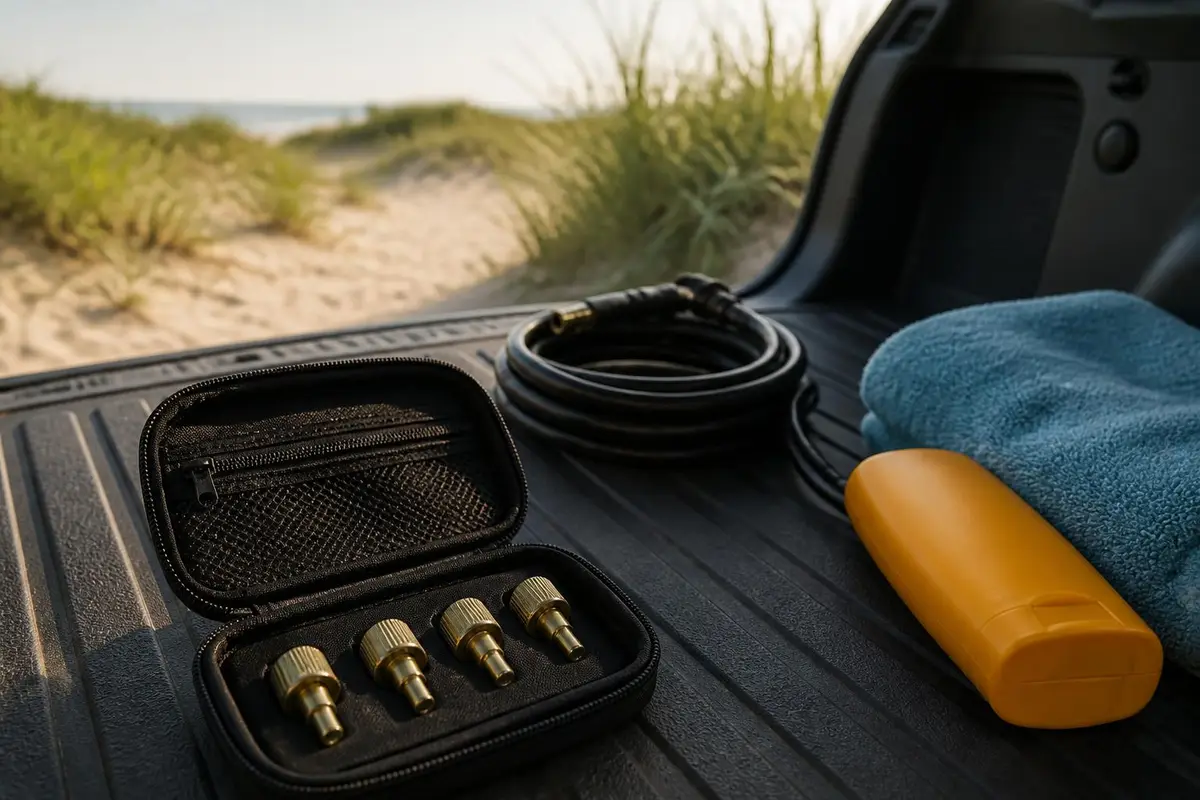
Staun's deflators screw onto each valve stem and are preset to a target PSI before the run — once set, they bleed air automatically and stop on their own at that pressure, without a driver watching a gauge on each tire.
Why You Should Get This
The whole appeal is walking away rather than crouching at each tire with a gauge: set all four to the same target PSI once, screw them on, and they self-stop without further attention.
Benefits
- Preset to a target PSI once, then left on all four valve stems to deflate automatically and stop on their own.
- No gauge-watching required at each tire during the air-down process itself.
- A listed 6-30 PSI range on the standard model covers the pressures most off-road tires air down to.
Pros and Cons
- Genuinely hands-off once set — walk to each tire, screw one on, move to the next, and they finish themselves.
- Removes the risk of misreading a gauge or stopping deflation at slightly the wrong pressure by hand.
- A Heavy Duty (HD) variant is sold with a higher 15-55 PSI range for larger, higher-pressure tires.
- A dedicated preset tool costs more than a simple air-down valve stem cap or a gauge used manually.
- Four units need to be carried, kept together and not lost, unlike a single gauge tool used one tire at a time.
- Presetting all four to a new target pressure for a different trail or load takes its own setup step before each trip.
Confirm with the seller for your exact year/trim and valve-stem compatibility before ordering.

How a Preset Mechanical Deflator Actually Works
Before a trip, an adjustment collar on the tool is turned to the target PSI — commonly somewhere in the 15-25 PSI range for moderate off-road use, adjusted up or down for terrain and load. Screwed onto the valve stem, the tool releases air until the tire's actual pressure drops to that set point, then a mechanical valve closes and stops further release on its own, without a driver needing to read a gauge during the process itself.
Standard, Light and Heavy-Duty Ranges
Staun sells this deflator in three pressure ranges, per the manufacturer: Standard Duty (SD) at 6-30 PSI, the version reviewed here and the one that covers most off-road air-down targets on light trucks and SUVs; Light Duty (LD) at 1-10 PSI for very low pressures such as sand-only setups on lighter rigs; and Heavy Duty (HD) at 15-55 PSI for larger, higher-pressure tires where the standard range wouldn't reach the needed set point.

The Actual Value: Hands-Off, Not Faster Air-Out
A preset deflator doesn't necessarily release air faster than a fully open manual valve — the value is entirely in not needing to crouch at each tire watching a gauge to catch the exact stopping point. For a group that airs down often, at the same handful of target pressures each time, that hands-off convenience is the entire case for paying more than a basic valve-stem tool.

A Gauge Still Belongs in the Kit
A preset deflator doesn't display a live pressure reading, so a standalone gauge remains necessary both to confirm the deflator is calibrated correctly before a run and to spot-check actual pressure afterward — a preset tool and a gauge are complementary, not a straight substitute for one another.
Maintenance: The Cap, Spring and Piston
Staun's own FAQ describes the deflator's internal mechanism in terms of a cap, spring and piston, sealed with O-rings, and covers maintaining those O-rings as the routine upkeep item — dirt or grit on the O-ring is the most likely cause of a deflator that won't hold its preset or won't seal fully once screwed onto the valve stem. Keeping the threads and O-ring clean before storage, the same habit that matters for any adjustable deflator, is what keeps a preset calibration accurate trip to trip.
How We Research This Review
This review is drawn from the product's listed configuration, Staun's own published FAQ on how the mechanism works and its maintenance, and the general mechanical principle behind a self-stopping, preset air-down valve. We do not buy or physically test this gear ourselves — see how we rank for the full method and affiliate disclosure for how the site is funded.
Reported failures & warranty
No widespread failures documented in the sources we checked; see the maker's warranty terms.
Research log
- 2026-09-26:Specs and claims for Staun automatic tire deflator researched from Staun — FAQ and the other sources cited below.
Sources
- Staun — FAQ — How the preset cap/spring/piston mechanism works and seals at the set point; O-ring maintenance as the routine upkeep item; deflators work fast enough that the first tire is nearly finished by the time the fourth is applied.
- Staun — Standard Duty Tyre Deflators (6-30 PSI) — Standard Duty (SD) model pressure range, 6-30 PSI.
- 4x4TruckLEDs — Staun Tire Deflator, Heavy Duty (15-55 PSI) — Heavy Duty (HD) model pressure range, 15-55 PSI, for larger and higher-pressure tires.
- 4x4TruckLEDs — Staun Tire Deflator, Light Duty (0-10 PSI) — Light Duty (LD) model pressure range, roughly 1-10 PSI, for very low pressures such as sand-only setups.
- BFGoodrich — 4x4 Driving Guide: Off-Road Tire Selection — Air-down target pressure depends on terrain, load and tire type, the context for choosing a preset deflator's target PSI.