

Affiliate disclosure: As an Amazon Associate, we earn from qualifying purchases, at no extra cost to you. We research rather than test, and commissions never change our rankings. This site is reader-supported: those commissions pay for hosting, research and keeping every guide up to date, so if a guide helped you, buying through our links is an easy way to support it. How we rank · Full disclosure
TL;DR
- Safety depends on fitment and installation. Use a vehicle-specific, hub-centric spacer, one per wheel.
- Each lug nut needs thread engagement at least equal to the stud diameter, 12 mm on M12 studs (McGard).
- Torque with a torque wrench, never an impact gun, and re-check after about 50 miles (Spidertrax).
- Each inch of spacer adds about one inch-pound of bending moment on the bearing per pound of corner load.
- Spidertrax itself calls a correctly backspaced wheel the ideal fix. Under FTC guidance, a spacer doesn't void a warranty unless it's shown to cause the damage.
A wheel spacer bolts between the hub and the wheel and moves the wheel outward, usually to clear a larger tire, fit wheels with too much backspacing, or widen the track.
At a Glance
| Check | What good looks like | Source of the number |
|---|---|---|
| Centering | Hub-centric: the spacer's bore fits the hub, and the wheel centers on the spacer | Spacer maker's fitment |
| Thread engagement | At least one stud diameter of thread in each nut (12 mm on M12 studs) | McGard |
| Spacer count | One spacer per wheel | Spidertrax instructions |
| Torque | Torque wrench, no impact gun; for example 85 ft-lb (spacer) and 75–85 ft-lb (wheel) on Spidertrax's Toyota kit | Spidertrax instructions |
| Re-check | After about 50 miles, per Spidertrax; McGard says 25 miles for its locks | Manufacturer instructions |
Types of Spacer
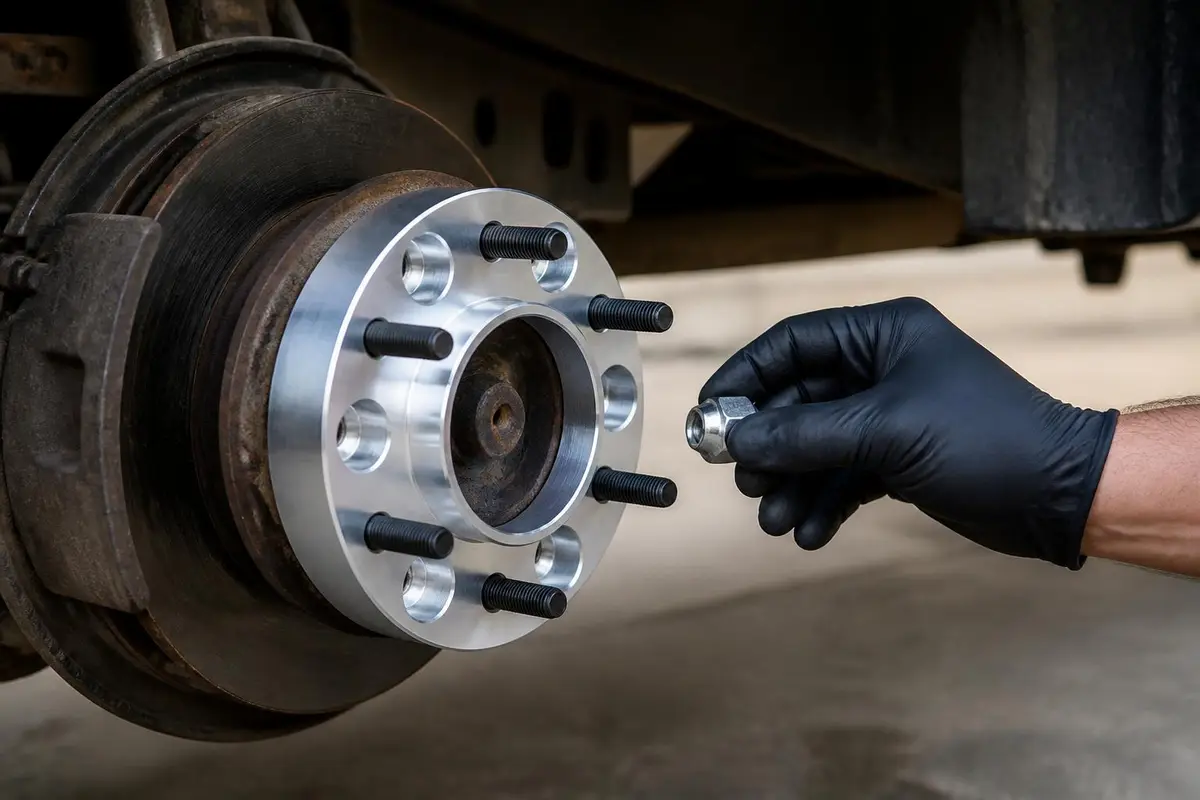
A slip-on spacer is a thin plate that slides over the factory studs. The wheel's lug nuts then thread onto whatever stud length is left. A bolt-on spacer (sometimes called an adapter when it also changes the bolt pattern) is fastened to the hub with its own nuts and carries its own studs for the wheel. Spidertrax's Toyota kit, for example, includes two spacers, twelve pre-installed grade 10.9 M12×1.5 studs, twelve lug nuts and thread locker. Spidertrax machines its spacers from 6061-T6 aluminum to fit specific vehicles. It sells them in fixed thicknesses, such as 1-1/4 inches for the Jeep TJ, because it sets the thickness per vehicle.
Hub-Centric Fit
A factory wheel is centered by the hub's pilot, the raised ring in the middle, with the lug nuts clamping it in place. A hub-centric spacer keeps that arrangement: its bore fits the hub pilot, and it has its own pilot for the wheel. Spidertrax attributes most spacer problems to "universal" spacers made to fit many vehicles, which don't account for each vehicle's fit. It names spacer thickness, the strength of the factory mounting (stud size and count, hub-centric options) and scrub radius as the three things it designs around.

Thread Engagement
McGard, which makes lug nuts and wheel locks, sets the rule that minimum thread engagement must equal the stud's diameter: 12 mm of thread on an M12 stud, which at 1.5 mm pitch is 8 full turns of the nut. A slip-on spacer uses up stud length equal to its thickness, so check engagement before driving. With a bolt-on spacer, check that the factory studs don't stick out past the spacer's wheel-mounting face; Spidertrax's instructions call for this, since protruding studs stop the wheel from sitting flat. Use one spacer per wheel; Spidertrax says not to stack them.
Leverage on the Bearing, Track Width and Scrub Radius
Moving the tire outward moves the point where the road pushes up on it farther from the wheel bearing. The added bending moment is the corner load times the distance moved. On a corner carrying 1,500 lb, a 1-1/4-inch spacer adds 1,500 × 1.25 = 1,875 in-lb, or about 156 ft-lb, before any cornering or impact forces. A spacer of the same thickness on each side widens the track by twice its thickness, 2.5 inches for a pair of 1-1/4-inch spacers. It also changes the scrub radius, the distance at the ground between the tire's center and the steering axis, which affects steering feel and kickback. That's why Spidertrax treats scrub radius as a design limit. It also says that, from an engineering standpoint, a wheel with the right backspacing is the ideal solution, with spacers winning on cost and availability.
Installation and Torque
Spidertrax's Toyota kit shows the general procedure:
- Remove the wheel and any rotor or drum retainer clips.
- Apply the supplied thread locker to the factory studs.
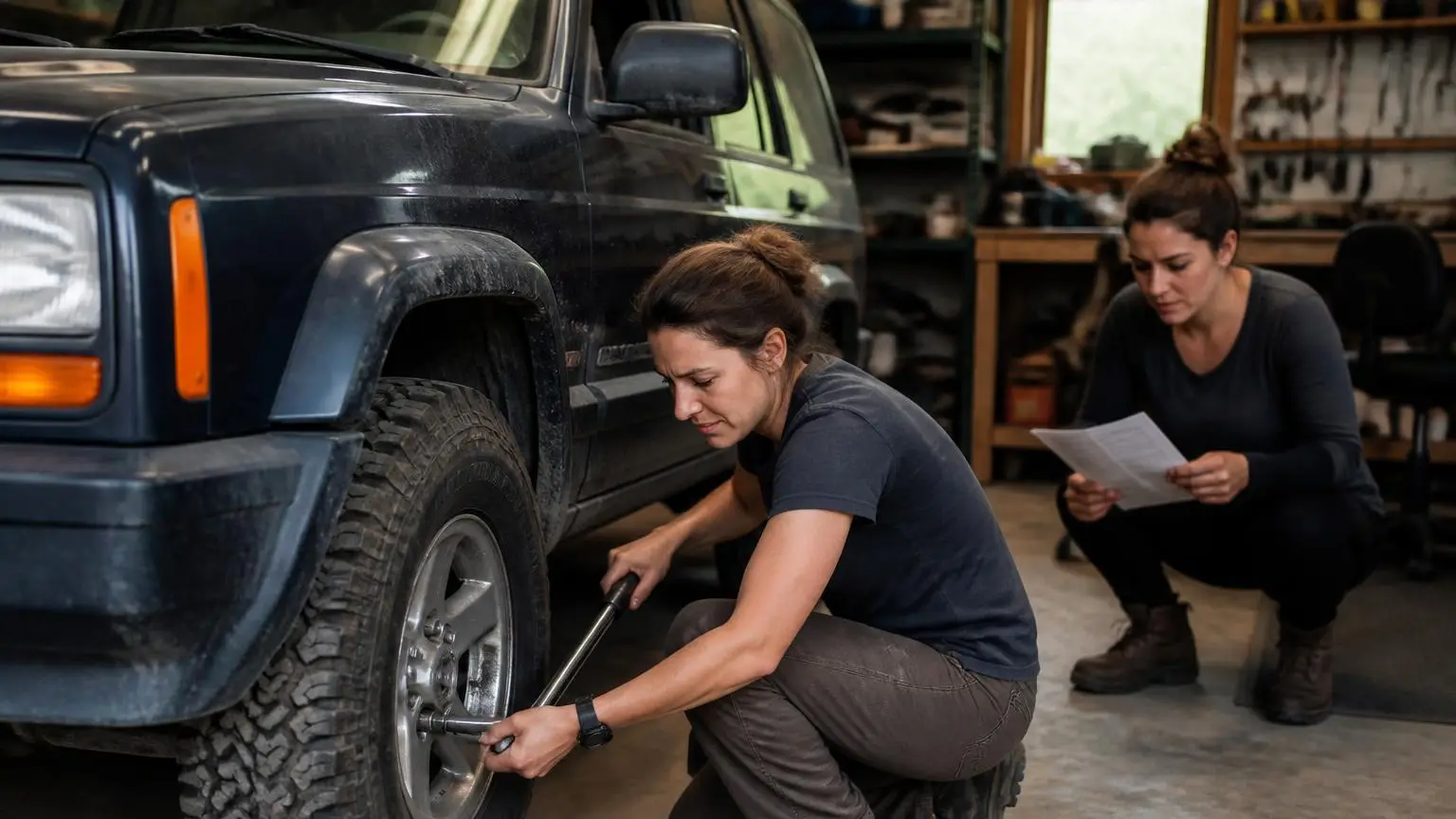
- Have a helper hold the brakes and torque the spacer nuts to 85 ft-lb with a torque wrench, not an impact gun. Spidertrax warns that impact guns are dangerous here.
- Mount the wheel and tighten its nuts in a criss-cross pattern to 75–85 ft-lb.
- After 50 miles, take the wheel off and check the spacer nuts at 75 ft-lb. If any nut moves, reinstall from the thread-locker step.
Other spacers have their own torque figures; use the ones in your kit's instructions and the vehicle's wheel torque spec. McGard's own guidance also says to use a torque wrench, avoid impact guns, and re-torque after driving.
When a Different Wheel Is the Better Fix
If the goal is tire clearance, a wheel with less backspacing moves the tire out without adding a separate part, and Spidertrax itself calls that the ideal solution. Spacers make sense for keeping factory wheels, for bolt-pattern adapters, or where the right wheel isn't made. If you do use spacers, choose a vehicle-specific, hub-centric design, and see best wheel spacers for trucks. This page uses manufacturer instructions and FTC guidance; we don't install or test spacers ourselves (how we rank).
Recommended gear
Gear for airing down and back up
Affiliate disclosure: As an Amazon Associate, we earn from qualifying purchases, at no extra cost to you. Purchases through these links help keep this site running and up to date. Learn more

Best for airing all four tires down to a set pressure at once.
- Automatic deflators preset between 6 and 30 PSI.
- Air all four tires down at once, then stop at the set pressure.

Best for budget-friendly airing down before sand or rock.
- Adjustable 4-pack of deflators, 10–30 PSI.
- Screw on, set the pressure, and they stop automatically.

Best for airing back up before you hit pavement.
- Portable 12V compressor rated to 150 PSI.
- Sized for truck and SUV tires.

Best for fast inflation of larger off-road tires.
- Heavy-duty 12V off-road compressor.
- Built for inflating larger off-road tires quickly.
We research products from manufacturer specs and owner feedback; we don't test them ourselves. How we choose.
Sources
- Spidertrax — Toyota Wheel Spacer Kit Instructions — Kit contents (grade 10.9 M12×1.5 studs, lug nuts, thread locker); thread locker on factory studs; 85 ft-lb spacer nuts with a torque wrench, no impact gun; one spacer per wheel; factory studs must not protrude past the spacer face; wheel nuts 75–85 ft-lb criss-cross; re-check at 75 ft-lb after 50 miles; off-road use only.
- Spidertrax — "Spaced Out" (J Rations interview with Spidertrax) — 6061-T6 aluminum, vehicle-specific thicknesses (1-1/4 in for the Jeep TJ); design factors of stud size and count, hub-centric options and scrub radius; universal spacers pose the most risk; a correctly backspaced wheel is the ideal solution; no DOT rule on spacers, local inspection decides; impact guns are dangerous.
- McGard — Installation/Removal — Minimum thread engagement must equal the stud's thread diameter; use a torque wrench; avoid impact guns; re-torque after 25 miles.
- Federal Trade Commission — Auto Warranties and Auto Service Contracts — A warranty stays in effect with aftermarket parts; the manufacturer or dealer must prove the aftermarket part caused the damage before denying coverage.