

Affiliate disclosure: As an Amazon Associate, we earn from qualifying purchases, at no extra cost to you. We research rather than test, and commissions never change our rankings. This site is reader-supported: those commissions pay for hosting, research and keeping every guide up to date, so if a guide helped you, buying through our links is an easy way to support it. How we rank · Full disclosure
TL;DR
- A body lift puts spacers between body and frame: the body and wheel wells rise, the frame, axles and differentials don't.
- A suspension lift raises the frame and body off the axles, improving clearance under the chassis and approach and departure angles.
- Neither raises a solid axle; bigger tires do, by half the diameter increase (31 to 33 inches adds about 1 inch).
- The two stack, but states can cap the result — California limits the body floor to 5 inches above the frame.
- Neither changes GVWR, tow or payload ratings.
What a Body Lift Does
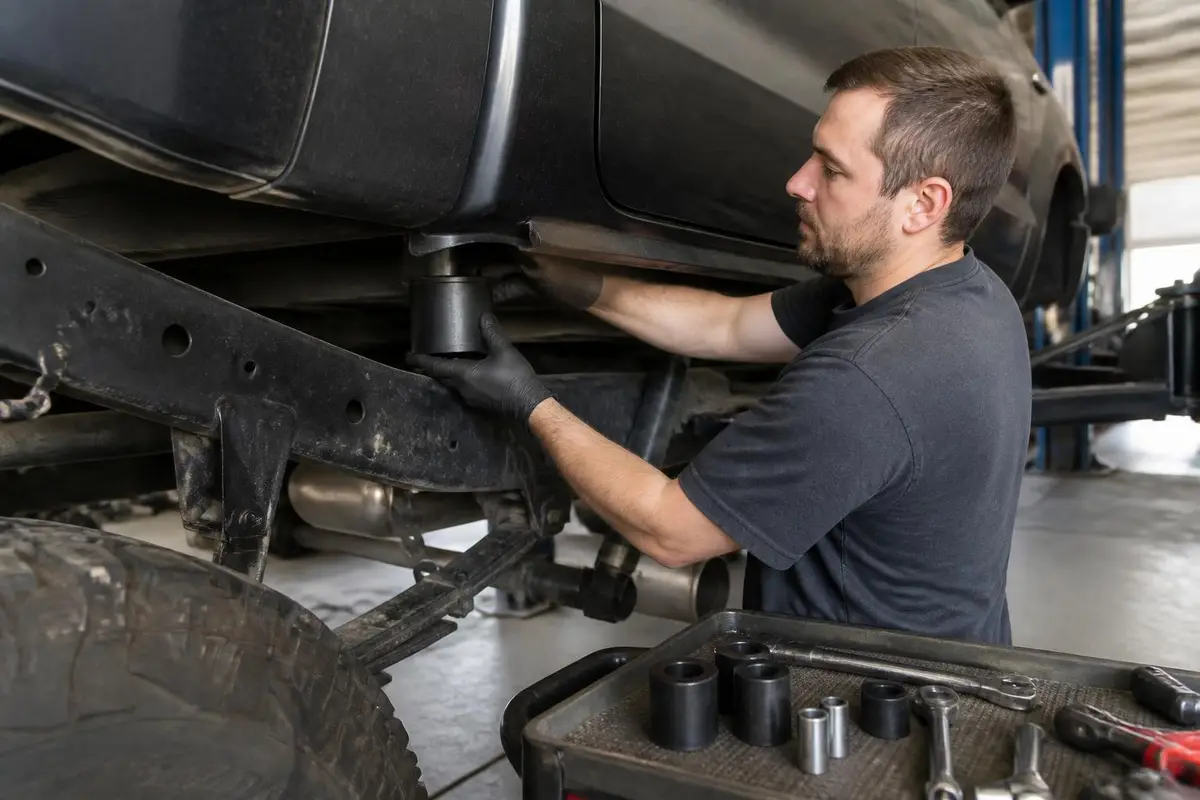
A body lift installs spacers — often called pucks — between the body and the frame at each body mount, with longer bolts to match. Rough Country's 1.25-inch kit for the 2018–2026 Jeep Wrangler JL shows what's involved: pucks made of fiberglass-reinforced nylon that nest with the factory body mounts, keeping the factory mounts' noise and vibration damping, plus rear bumper brackets so the factory rear bumper sits flush with the raised body. The company notes those brackets work only with the standard factory bumper.
Because the frame doesn't move, anything bolted to the frame stays at its old height while everything bolted to the body goes up. That is why body lifts come with bumper brackets, and why the gap between body and frame grows by the spacer height.
What a Suspension Lift Does
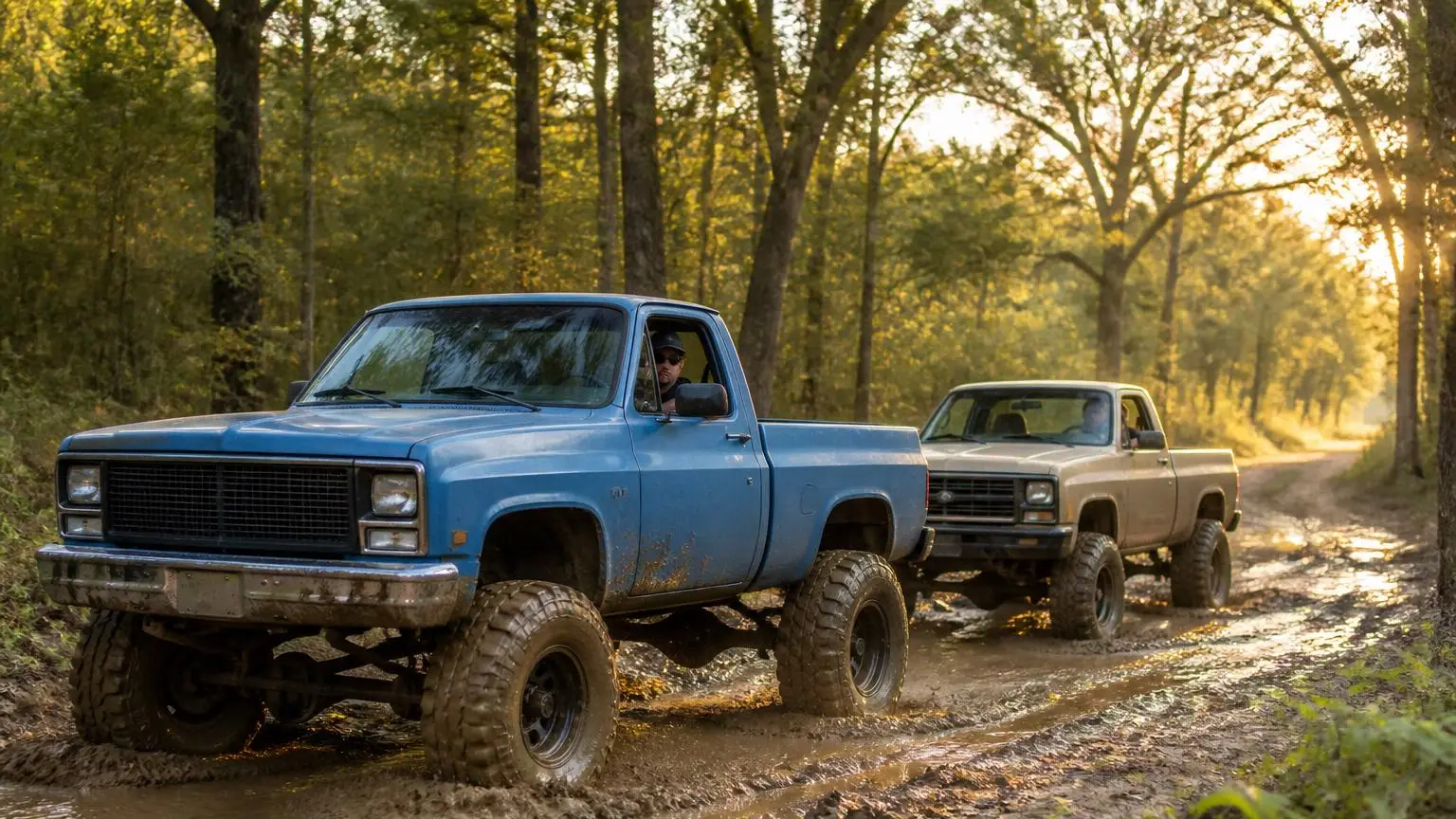
A suspension lift raises the frame, and the body on it, by changing springs, struts, spacers, shocks or control arms; Rough Country says taller kits add knuckles, crossmembers, brackets, differential drops or blocks to keep suspension and steering geometry in range. The frame, rocker panels, skid plates and bumpers all rise, which improves approach, departure and breakover angles and clears larger tires. What doesn't rise is a solid axle: its height is set by the tire radius. On independent-front-suspension trucks the front differential hangs from the frame, so it rises with the lift unless the kit lowers it again; Rough Country's 3.5-inch knuckle lift for GM heavy-duty trucks includes differential drop spacers to improve driveline angles and reduce CV bind.
Where Each One Adds Clearance
| Part of the truck | Body lift | Suspension lift | Bigger tires |
|---|---|---|---|
| Solid axle housing and differential | No change | No change | Rises by half the diameter increase |
| Frame-mounted IFS front differential | No change | Rises, less any differential drop | Rises by half the diameter increase |
| Frame rails and frame-mounted skid plates | No change | Rises | Rises by half the diameter increase |
| Rocker panels and body-mounted parts | Rises by the spacer height | Rises | Rises by half the diameter increase |
| Room for bigger tires in the wheel well | More | More | — |
The tire math is simple: the axle center sits one tire radius off the ground, so going from a 31-inch to a 33-inch tire raises the axle, and everything on it, by about 1 inch. Rough Country makes the same point, noting that larger tires raise the axles farther from the ground while suspension height adds clearance around the body and chassis. It markets its JL body lift as adding ground clearance; that is true of the body panels, not of the axles or differentials.

Downsides of Each
A body lift leaves a visible gap between body and frame, moves the body away from frame-mounted parts such as bumpers so brackets must be relocated, and stretches anything that crosses from body to frame, such as wiring, hoses and linkages. A suspension lift changes suspension geometry, steering angles and alignment settings, Rough Country says, so it needs an alignment afterward, and taller lifts increase driveshaft and CV operating angles. Both raise the vehicle's center of mass; NHTSA's rollover ratings are built on how top-heavy a vehicle is, from its center-of-gravity height and track width.
Combining Both
Because a body lift works at the body mounts and a suspension lift works between frame and axle, the heights stack. A build aiming for a large tire sometimes pairs a modest suspension lift with a body lift instead of a single very tall suspension lift. Some states regulate the result: California Vehicle Code § 24008.5 limits the lowest part of the body floor to 5 inches above the top of the frame and caps frame height at 27 inches for vehicles up to 4,500 lb GVWR, 30 inches for 4,501–7,500 lb and 31 inches for 7,501–10,000 lb. Check your own state's code.
What Neither Lift Changes
Neither lift changes the ratings on the door label. Federal standards define GVWR as the manufacturer's value for the loaded weight of the vehicle, Rough Country notes that suspension height does not raise the tow or payload rating, and California's frame-height law explicitly uses the manufacturer's GVWR whether or not the vehicle is modified.
Which One You Need
If the goal is clearing rocks and ruts under the frame, better approach and departure angles, and room for bigger tires, a suspension lift does that; the bigger tires then add clearance under the axles. If the goal is only more room in the wheel wells for a slightly larger tire, a body lift gets there without changing suspension geometry. See how to lift a truck for the suspension-lift methods and the suspension and lift kits hub for leveling kits, driveline angles and alignment. This explainer uses makers' published kit contents and instructions and state and federal rules; we don't install lifts ourselves — see how we rank.
Sources
- Rough Country — 1.25" Body Lift Kit, Jeep Wrangler JL (RC614) — Fiberglass-reinforced nylon pucks that nest with factory body mounts; rear bumper brackets for a flush factory bumper, standard bumper only; marketed as adding ground clearance.
- Rough Country — Lift Kit vs. Leveling Kit — Suspension lift parts by height; larger tires raise the axles farther from the ground while suspension height adds body and chassis clearance; lifts don't raise tow or payload ratings.
- Rough Country — 3.5" Knuckle Lift, Silverado/Sierra 2500HD/3500HD (2011–2019) — Differential drop spacers to improve driveline angles and reduce CV bind.
- Rough Country — How to Prep for a Lift Kit Install — Lifts change geometry, steering angles and alignment and increase operating angles; alignment after installation.
- National Academies (TRB Special Report 265) — Rollover Information from NHTSA — NHTSA rollover ratings measure center-of-gravity height and track width.
- California Legislative Information — Vehicle Code § 24008.5 — Body floor no more than 5 in. above the top of the frame; frame-height caps by GVWR; GVWR is the manufacturer's rating whether or not the vehicle is modified.
- eCFR — 49 CFR § 571.3 (FMVSS definitions) — GVWR is the manufacturer's value for the vehicle's loaded weight.