
Affiliate disclosure: As an Amazon Associate, we earn from qualifying purchases, at no extra cost to you. We research rather than test, and commissions never change our rankings. This site is reader-supported: those commissions pay for hosting, research and keeping every guide up to date, so if a guide helped you, buying through our links is an easy way to support it. How we rank · Full disclosure
Enter a lift height, stock tire diameter and fender trimming level below for a rough maximum tire diameter. It is a starting point for research, not a guaranteed fit for any specific truck.
How This Is Estimated
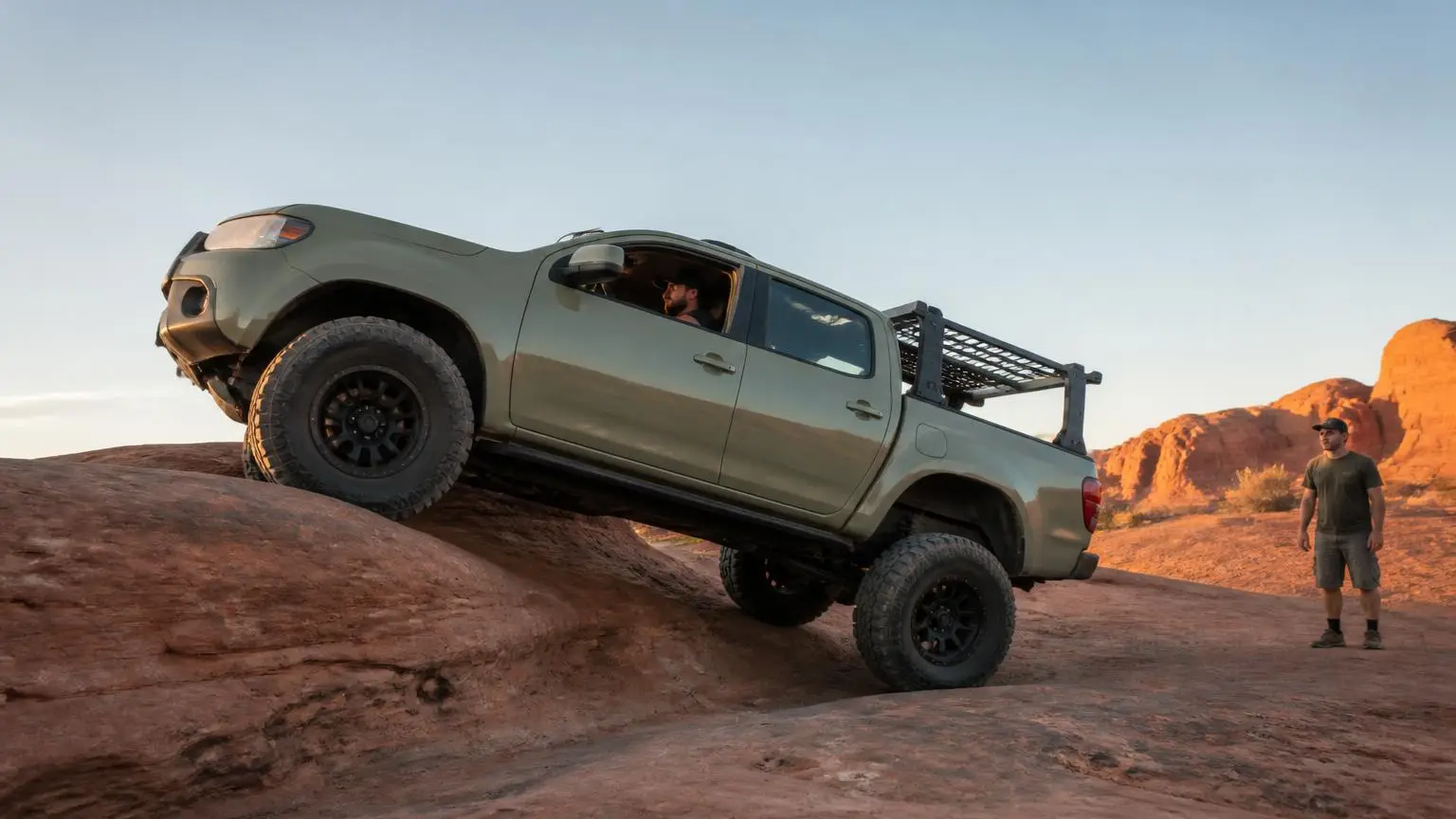
Max diameter = stock diameter + (lift height × 0.9) + trimming bonus (0 for none, 1 inch for mild, 2 inches for major).
This is the site's own conservative planning assumption, not a published standard. The geometry and factory examples below show why it undershoots in some cases and overshoots in others.
General information only. Real clearance depends on bump-stop position, wheel backspacing, fender shape and steering lock, which vary by model and trim. Confirm against the lift or fender maker's stated tire size for your truck before buying tires.
TL;DR
- A tire's diameter is the rim size plus two sidewall heights. An LT315/70R17 works out to 34.4 inches (Mickey Thompson's formula).
- A bigger tire grows half its extra diameter upward from the axle and half forward and back. Lift only adds room upward, not front-to-back.
- What rubs at full compression is set by the bump stops and fenders, not ride height. TeraFlex specifies bump-stop extensions by tire size and fender type.
- Jeep fits 35-inch tires to the Wrangler with a 1.5-inch lift where 33s are standard, and pairs them with a 4.56 axle ratio.
- Going from 31 to 33 inches makes the speedometer read about 6.5% low: 60 mph indicated is about 63.9 mph actual.
Step 1: Work Out the Real Tire Diameter
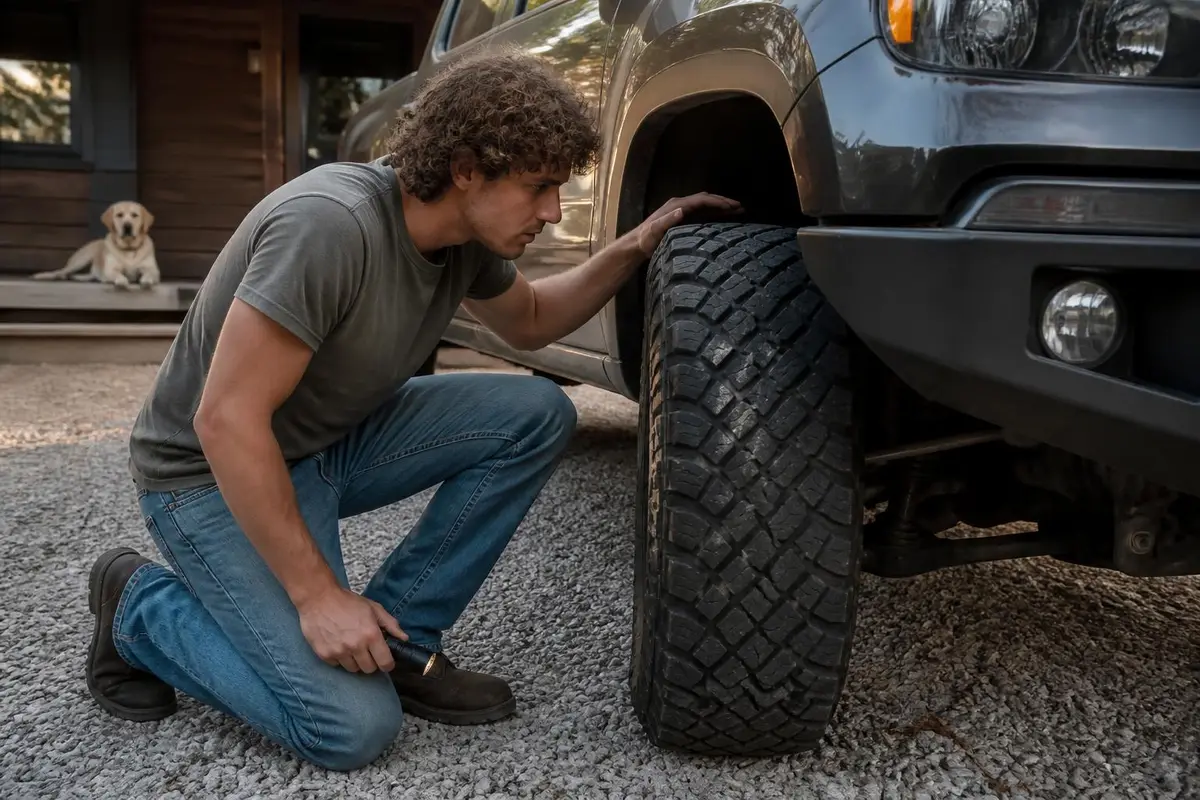
Tire sizes are nominal. For a metric size, Mickey Thompson's formula divides section width by 25.4 to get inches, multiplies by the aspect ratio to get sidewall height, then doubles that and adds the rim diameter. Worked examples:
| Tire size | Sidewall height | Calculated diameter | Usually called |
|---|---|---|---|
| 265/70R17 | 7.30 in | 31.6 in | 32-inch |
| LT285/70R17 | 7.85 in | 32.7 in | 33-inch |
| LT315/70R17 | 8.68 in | 34.4 in | 35-inch |
Mickey Thompson notes that rim width, air pressure and sidewall construction all change a mounted tire's real size, and it says to treat conversion charts as a guide only. Use the calculated diameter, not the marketing size, as the calculator's stock and target figures, and check the tire maker's published overall diameter for the exact model.
Step 2: Where the Extra Diameter Goes
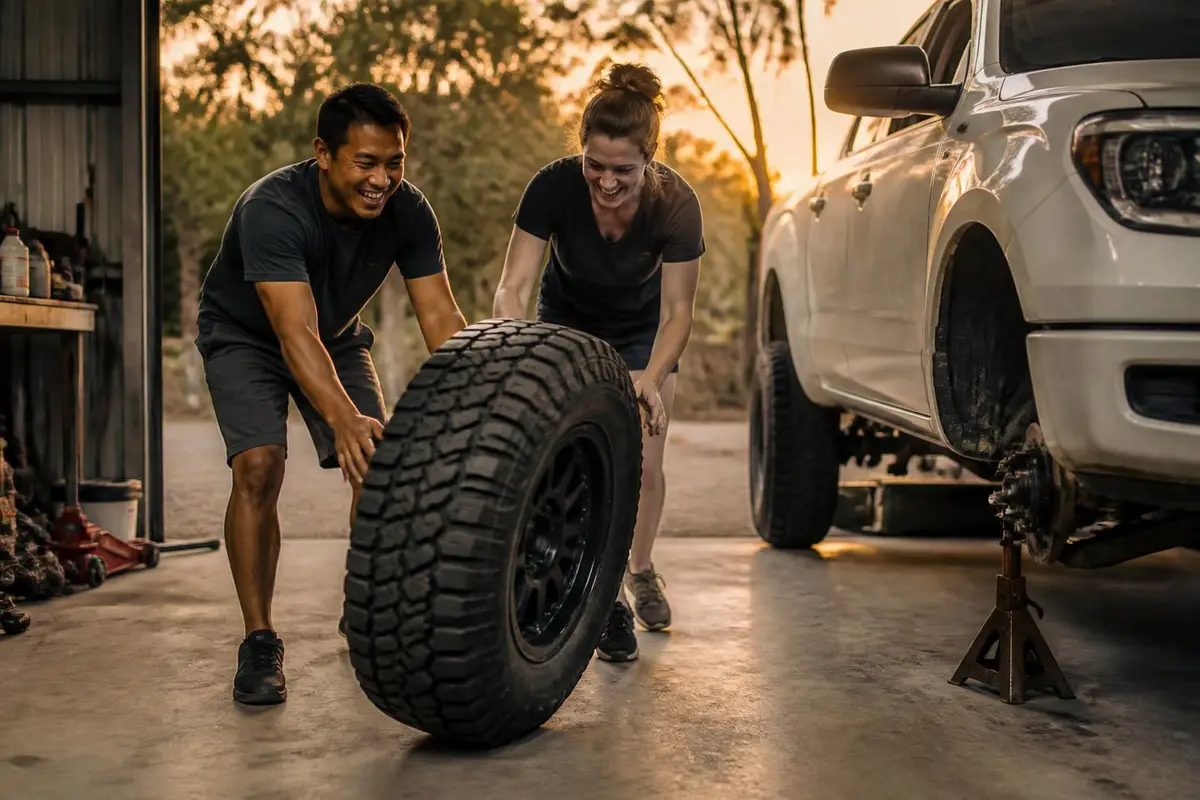
When a tire's diameter grows by some amount, its radius grows by half that amount. Measured from the axle, the top of the tread moves up by half the increase, and the front and rear of the tread each move out by half. Going from 31 to 33 inches, for example, raises the top of the tire 1 inch closer to the fender and pushes the front edge 1 inch closer to the bumper and fender liner.
A suspension lift raises the body relative to the axle, so at ride height each inch of lift gives back an inch of space above the tire. It does not add room at the front and back of the wheel opening, where the tire meets the bumper, the fender liner and the body mounts at full steering lock. That is why a pure height rule can't settle fitment, and why the calculator's 0.9 factor stays below the 2-inch-per-inch-of-lift figure that vertical geometry alone would allow.
Step 3: Full Compression Is Set by the Bump Stops
At full suspension compression, the axle rises until it hits the bump stops. If a lift raises ride height without moving the bump stops, the tire still travels up to the same spot in the wheel well as before, so the lift adds no clearance at full stuff. Lift makers deal with this by extending the bump stops. TeraFlex's instructions for the JL Wrangler show how the answer depends on the fenders as well as the tire:
| JL Wrangler fenders | Tire size | Bump-stop extension (front / rear) |
|---|---|---|
| Sport/Sahara | 35 in | 3 in / 2.5 in |
| Sport/Sahara | 37 in | 3.5 in / 4 in |
| Rubicon (higher-cut) | 37 in | 2.5 in / 3 in |
| Aftermarket high fenders | 39 in and up | Varies |
TeraFlex adds that the requirements vary with the wheel and tire combination, the shocks' collapsed length and the fenders, and that the installer must check clearances. A bump stop extended to protect a bigger tire also reduces upward suspension travel, which is the tradeoff behind every big-tire build.
A Factory Example: Jeep's 35-Inch Package
Jeep's own Xtreme Recon package shows what a manufacturer considers necessary for two more inches of tire. Stellantis lists 33-inch tires as standard on the 2023 Wrangler Rubicon. The package steps up to LT315/70R17 (35-inch) BFGoodrich KO2 tires on 17×8-inch beadlock-capable wheels, and adds a 1.5-inch factory suspension lift with its own shock tuning. It also includes a 4.56:1 axle ratio and, on the 2024 two-door version, swing-gate reinforcement. By calculated diameter that is about 1.7 inches more tire on 1.5 inches of lift, with Rubicon fenders. The calculator's formula would estimate 1.35 inches for the same lift and no trimming. For a factory-developed combination, it is conservative.
Wheel Backspacing and Offset
Mickey Thompson defines backspacing as the distance from the back of the wheel's mounting pad to the wheel's back lip, and offset as the distance from the mounting surface to the wheel's centerline, in millimeters. For positive offset, backspacing = (wheel width + 1) ÷ 2 + offset × 0.03937. For negative offset, subtract the second term instead. For an 8-inch-wide wheel:
| Offset | Backspacing | Tire position |
|---|---|---|
| +18 mm (on a 9-in wheel) | 5.7 in | Tucked in, toward the suspension |
| 0 mm | 4.5 in | Centered on the mounting face |
| −12 mm | 4.0 in | Pushed out, toward the fender lip |
Less backspacing (more negative offset) moves the tire outward, away from control arms, leaf springs and frame rails but toward the fender edge. More backspacing does the opposite. Mickey Thompson notes that negative offset widens the track. A wider tire on the same wheel grows both inward and outward, so it can rub on the inside even when the diameter clears.
Where Tires Rub: Compression vs Steering Lock
These are two separate checks. Full-compression rubbing happens at the top and rear of the wheel opening when the axle meets the bump stops. Full-lock rubbing happens at the front and rear corners of the opening and on the inner suspension and frame as the tire swings. The worst case is both at once, with one front wheel stuffed while the steering is at full lock, which is common on uneven trails. Since lift doesn't add room front-to-back, a build can clear at ride height and still rub at lock. The usual fixes are trimming the fender or liner, higher-cut fenders, adjusted steering stops or different backspacing.
Side Effects of Bigger Tires: Speedometer and Gearing
A larger tire covers more ground per revolution. Revolutions per mile equal 63,360 inches divided by the tire's circumference (π × diameter). Worked through:
| Change | Revs per mile | Speedometer at 60 mph shown | Effect of a 4.10 axle ratio |
|---|---|---|---|
| 31 → 33 in | 651 → 611 | ≈ 63.9 mph actual | Acts like ≈ 3.85 |
| 33 → 35 in | 611 → 576 | ≈ 63.6 mph actual | Acts like ≈ 3.87 |
Unless the speedometer is recalibrated, it reads low by the ratio of the two diameters, and the odometer undercounts by the same share. The taller tire also lowers the effective axle ratio in proportion to its size, which cuts acceleration and crawl control. That is why Jeep pairs its 35-inch package with a numerically higher 4.56:1 ratio.
Leveling Kits, Suspension Lifts and Body Lifts
A leveling kit raises only the front to remove factory rake, so it adds room over the front tires and none over the rears. A suspension lift raises the body relative to the axles at both ends. As shown above, full-compression clearance still depends on where the bump stops end up. A body lift raises the body on spacers above the frame, which adds room between the tire and the body and fenders, but not between the tire and frame-mounted parts. Enter only the lift that actually raises the fenders over the tire you're checking. For a leveling kit, that means the front figure only. See suspension and lift kits for how lift types compare.
Confirming Fitment for a Specific Truck
The most reliable number is the one a lift, fender or bump-stop maker publishes for your exact model, with its required extensions and trimming, like the TeraFlex table above. After that, mount one tire and cycle the suspension through full compression at full lock on each side before buying a set. Our brand hubs for Ford, Toyota and Jeep cover model-specific fitment.
Sources
- Mickey Thompson — Metric Conversion Charts — Overall diameter = 2 × section height + rim diameter; rim width, pressure and construction change real size, so charts are a guide only.
- Mickey Thompson — Backspacing and Offset (Tech Bulletin #7) — Definitions of backspacing and offset, the conversion formula, and negative offset moving wheels outward and widening the track.
- TeraFlex — JL 2" Bump Stop Strike Pad Extension Kit — Bump-stop extension requirements for 35-, 37- and 39-inch tires by fender type on the JL Wrangler; requirements vary and the installer must check clearances.
- Stellantis — New Jeep Wrangler Xtreme Recon Package — LT315/70R17 (35-inch) tires, 17×8 beadlock-capable wheels, 1.5-inch factory lift with tuned shocks and 4.56:1 axle ratio.
- Stellantis — 35-inch tires on the 2024 two-door Wrangler — 2024 two-door 35-inch package: 1.5-inch lift, 4.56:1 ratio and swing-gate reinforcement.
- Stellantis — 2023 Jeep Wrangler fact sheet — 33-inch tires standard on the 2023 Wrangler Rubicon.