

Affiliate disclosure: As an Amazon Associate, we earn from qualifying purchases, at no extra cost to you. We research rather than test, and commissions never change our rankings. This site is reader-supported: those commissions pay for hosting, research and keeping every guide up to date, so if a guide helped you, buying through our links is an easy way to support it. How we rank · Full disclosure
TL;DR
- Proportional controllers match trailer braking to how hard the truck slows. Dexter calls time-based controllers “not the best choice for optimum braking.”
- Count your trailer’s brakes: each magnet draws 2.5–3.0 A, so a tandem with 12-inch brakes pulls about 12 A. The CURT Echo covers 2–4 brakes, the Spectrum up to 8.
- The plug-in CURT Echo takes power from the 7-way +12 V pin; CURT says that fuse should be rated for 30 A.
- The Hopkins Impulse is time-based, not proportional. The CURT, REDARC and Tekonsha picks are proportional.
- Set the gain with hard stops from 20 mph, just short of wheel lockup, per Dexter.
A brake controller powers a trailer’s electric or electric-over-hydraulic brakes from the tow vehicle. The picks below differ mainly in how they mount and how they sense braking: the CURT Echo plugs into the 7-way socket and is set up from a phone, the CURT Spectrum and REDARC Tow-Pro Elite are wired in behind the dash, and the Hopkins Impulse is a time-based unit rather than a proportional one. They are ranked from published manufacturer specifications and aggregated owner reviews, not first-hand testing.
At a Glance
| Controller | Sensing | Mounting | Trailer brakes supported (maker’s figure) |
|---|---|---|---|
| CURT Echo (51180) | Proportional (3-axis accelerometer) | Plugs into the 7-way socket; phone app | 1–2 axles, 2–4 brakes |
| CURT Spectrum (51170) | Proportional (3-axis accelerometer) | Dash knob plus hidden module | 1–4 axles, 2–8 brakes |
| REDARC Tow-Pro Elite | Proportional, or user-controlled mode | Dash knob plus module mounted any way up | Electric and electric/hydraulic; 12 V or 24 V |
| Tekonsha Prodigy iD (90920) | Proportional | Configured from a phone | 1–4 axles |
| Hopkins Impulse (47235T) | Time-based | Mounts at any angle | Up to 6 brakes |
Proportional vs Time-Based: What the Sensor Does
Dexter, which builds trailer axles and brakes, explains the difference. A proportional (inertial) controller uses an accelerometer to sense how quickly the tow vehicle is slowing and sends a matching voltage to the trailer brakes. An electronic timing controller ramps up output over a set time whatever the truck is doing, and Dexter calls these inexpensive but “not the best choice for optimum braking.” Dexter’s target is about 2 volts when the brake pedal is first pressed, rising gradually to 12 volts as pedal pressure increases. A controller that jumps straight to high voltage keeps the brakes fully on even in gentle stops, giving harsh braking and possible wheel lockup. Hopkins lists the Impulse as time-based with braking force adjustable from 5% to 99%. The CURT, REDARC and Tekonsha units here are proportional. Tekonsha’s Prodigy P3 (90195), covered in our Prodigy P3 review, is another proportional unit: Tekonsha lists it for 1–4 axles, with a button to switch between electric and electric-over-hydraulic brakes and three boost levels. See what is a proportional brake controller.

The Rankings

Best for Owners who tow with more than one vehicle or trailer and want the controller to move between them.
- 7-way plug-in, controls up to 2 axles/4 trailer brakes.
- OneControl Auto smartphone app, roughly 50 ft Bluetooth range.
- Continues braking on last-programmed settings if Bluetooth drops.
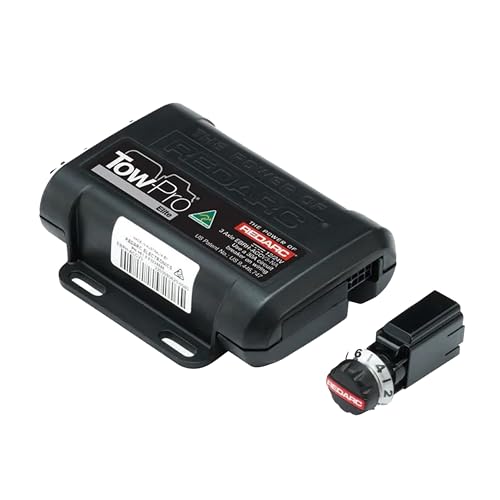
Best for Owners who tow both on-road and off-road and want a proportional plus user-controlled mode in one unit.
- 12V/24V compatible; electric and electric/hydraulic trailer brakes.
- Three-axis accelerometer, mounts in any orientation.
- One-time calibration, universal fit for 1-3 axle trailers.

Best for Owners already invested in Tekonsha hardware who want app-based setup on a confirmed-genuine listing.
- Smart-phone-configured setup, 1-4 axle compatibility.
- Compatible with Ford, GM, Chevy, Dodge, RAM, Toyota, Jeep (verify per vehicle).
- Same sensing family as the Prodigy P3 — see fitment note below.

Best for Owners who prefer a traditional physical dash-mounted controller over an app-paired unit.
- Proportional operation with a physical dash-mount knob.
- No smartphone pairing required.
- Standard 7-way connector installation.
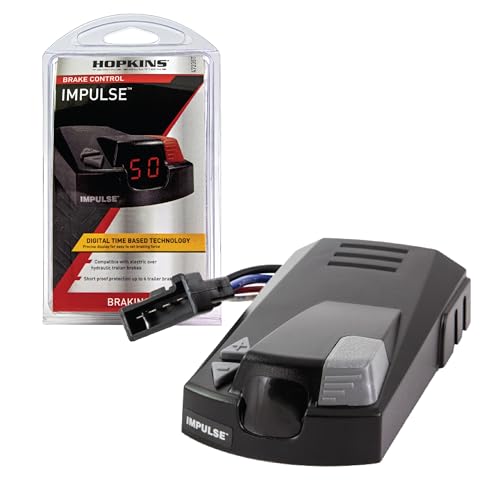
Best for Owners towing a multi-axle trailer with more brake magnets than a standard 4-brake controller supports.
- Rated for up to 6 trailer brakes.
- Time-based (not proportional) actuation, braking force adjustable 5–99% per Hopkins.
- Standard 7-way connector wiring.

Match the Controller to Your Trailer’s Brake Count
A controller’s rating counts trailer brakes (one magnet per wheel), not truck size. Dexter lists each magnet at 2.5 amps for 7-inch brakes and 3.0 amps for 10- to 12-1/4-inch brakes. That puts two brakes at about 6 amps, four at 12 amps and six at 18 amps. A single-axle trailer has two brakes, a tandem four, a triple-axle six. CURT rates the Echo for 2–4 brakes, so it won’t cover a triple-axle trailer; the Spectrum is rated for up to 8 brakes and the Hopkins Impulse for up to 6. Dexter also sizes the trailer’s brake wiring by brake count and hitch-to-axle distance:
| Brakes | Hitch-to-axle distance | Minimum copper wire (Dexter) |
|---|---|---|
| 2 | Any | 12 AWG |
| 4 | Under 30 ft | 12 AWG |
| 4 | 30–50 ft | 10 AWG |
| 6 | Under 30 ft | 10 AWG |
| 6 | 30–50 ft | 8 AWG |
Plug-In vs Wired: What the Echo Needs
A dash-mounted controller like the Spectrum is wired to the vehicle, usually through a vehicle-specific harness, and feeds the brake output wire of the 7-way socket. The Echo works differently: CURT’s Echo installation sheet says it plugs in between the vehicle’s and trailer’s 7-way connectors and takes power from the socket’s +12 V pin, which it shares with the trailer. It says that circuit’s fuse should be rated for 30 amps, and that an existing factory or aftermarket controller won’t work while the Echo is installed. CURT quotes an unobstructed Bluetooth range of up to 50 feet, and says the Echo keeps braking on its last-programmed settings if the phone connection drops.
Setting the Gain
Dexter’s synchronization procedure: on a dry, paved road clear of traffic, make several hard stops from 20 mph. If the trailer wheels lock, turn the gain down. If they don’t, turn it up slightly, to just short of lockup. Then adjust so the trailer brakes come on just slightly ahead of the truck’s brakes, with no feel of the trailer jerking or pushing. Dexter adds that not every trailer brake can lock a wheel, and that load, brake type and tire size all change the result.
When a Trailer Needs Brakes
Trailer brake requirements are set by each state. RVIA’s 2017 summary of state codes shows thresholds including 1,500 lbs for trailer coaches and camp trailers in California (Vehicle Code §26303), 3,000 lbs in Colorado and Georgia, over 3,000 lbs in Florida and Washington, and over 4,500 lbs in Texas. Ford recommends separate trailer brakes on any trailer over 1,500 lbs loaded, because the tow vehicle’s brakes are rated for its own GVWR, not the combination. See the towing and payload hub for the full state table.
How We Rank Brake Controllers
Each controller is weighed against its manufacturer specifications (sensing method, brake count, mounting and connector) and cross-referenced with owner reports. We don’t buy, install or tow with this hardware ourselves. See how we rank and our affiliate disclosure.
Sources
- Dexter — Light Duty Axle Operation, Maintenance & Service Manual — Proportional (inertial) vs electronic timing controllers; target output of about 2 volts rising to 12 volts; 2.5 or 3.0 amps per brake magnet; minimum hookup wire gauge by brake count and hitch-to-axle distance; gain synchronization procedure; breakaway checks at every use.
- CURT Manufacturing — Echo Mobile Trailer Brake Controller (51180) — Echo supports 1–2 axles and 2–4 brakes, uses a 3-axis accelerometer, stores vehicle and trailer profiles, and keeps braking on its last settings if Bluetooth drops.
- CURT Manufacturing — Echo installation sheet (51180) — Echo plugs between 7-way connectors, draws power from the +12 V pin shared with the trailer, needs that fuse rated for 30 amps, disables an existing controller, may need tow/haul mode, and has up to 50 ft of unobstructed Bluetooth range.
- CURT Manufacturing — Spectrum Proportional Trailer Brake Controller (51170) — Spectrum is proportional with a 3-axis accelerometer, supports 1–4 axles and 2–8 brakes, and uses a dash knob with a hidden module and vehicle-specific harness.
- REDARC Electronics — Tow-Pro Elite Electric Trailer Brake Controller — Tow-Pro Elite runs on 12 V or 24 V, operates electric and electric/hydraulic brakes, and offers proportional and user-controlled modes with a 3-axis accelerometer that mounts in any orientation.
- Tekonsha — 90195 Prodigy P3 Proportional Brake Controller — Prodigy P3 is a proportional controller for 1–4 axle trailers with electric or electric-over-hydraulic selection and three boost levels.
- Tekonsha — 90920 Prodigy iD Smart Phone Configured Brake Controller — Prodigy iD is a smartphone-configured controller for 1–4 axle trailers.
- Hopkins Towing Solutions — 47235T Impulse Brake Control — Impulse is time-based, controls up to 6 trailer brakes and adjusts braking force from 5% to 99%.
- RVIA — Trailer Brake Requirements: State Equipment and Road Use Law Summaries (08/2017) — State trailer brake thresholds, e.g. 3,000 lbs in Colorado and Georgia, over 3,000 lbs in Florida and Washington, over 4,500 lbs in Texas (as of August 2017).
- California Vehicle Code §26303 — Trailer coach and camp trailer brakes — California requires brakes on trailer coaches and camp trailers of 1,500 lbs or more gross weight.
- California Vehicle Code §26304 — Automatic brake application on breakaway — California requires trailer brakes to apply automatically on breakaway and hold for at least 15 minutes.
- Ford — 2026 RV & Trailer Towing Guide — Ford recommends separate trailer brakes above 1,500 lbs loaded because the tow vehicle’s brakes are rated at GVWR, not GCWR.