

Affiliate disclosure: As an Amazon Associate, we earn from qualifying purchases, at no extra cost to you. We research rather than test, and commissions never change our rankings. This site is reader-supported: those commissions pay for hosting, research and keeping every guide up to date, so if a guide helped you, buying through our links is an easy way to support it. How we rank · Full disclosure
TL;DR
- Aim for 10–15% of the loaded trailer on the hitch (Sherline calls 12% ideal). Ford uses 10% for conventional trailers and 15% for 5th-wheels.
- Choose a gauge that puts your reading mid-scale: Sherline gauges are about 2% accurate there and about 3% at the ends.
- Measure with the coupler at hitch height, the trailer level and weight-distribution bars loose.
- Weigh Safe builds the gauge into the ball mount (2-in shank: 1,500 lbs tongue). A standalone Sherline works with any hitch and 5th-wheel pins.
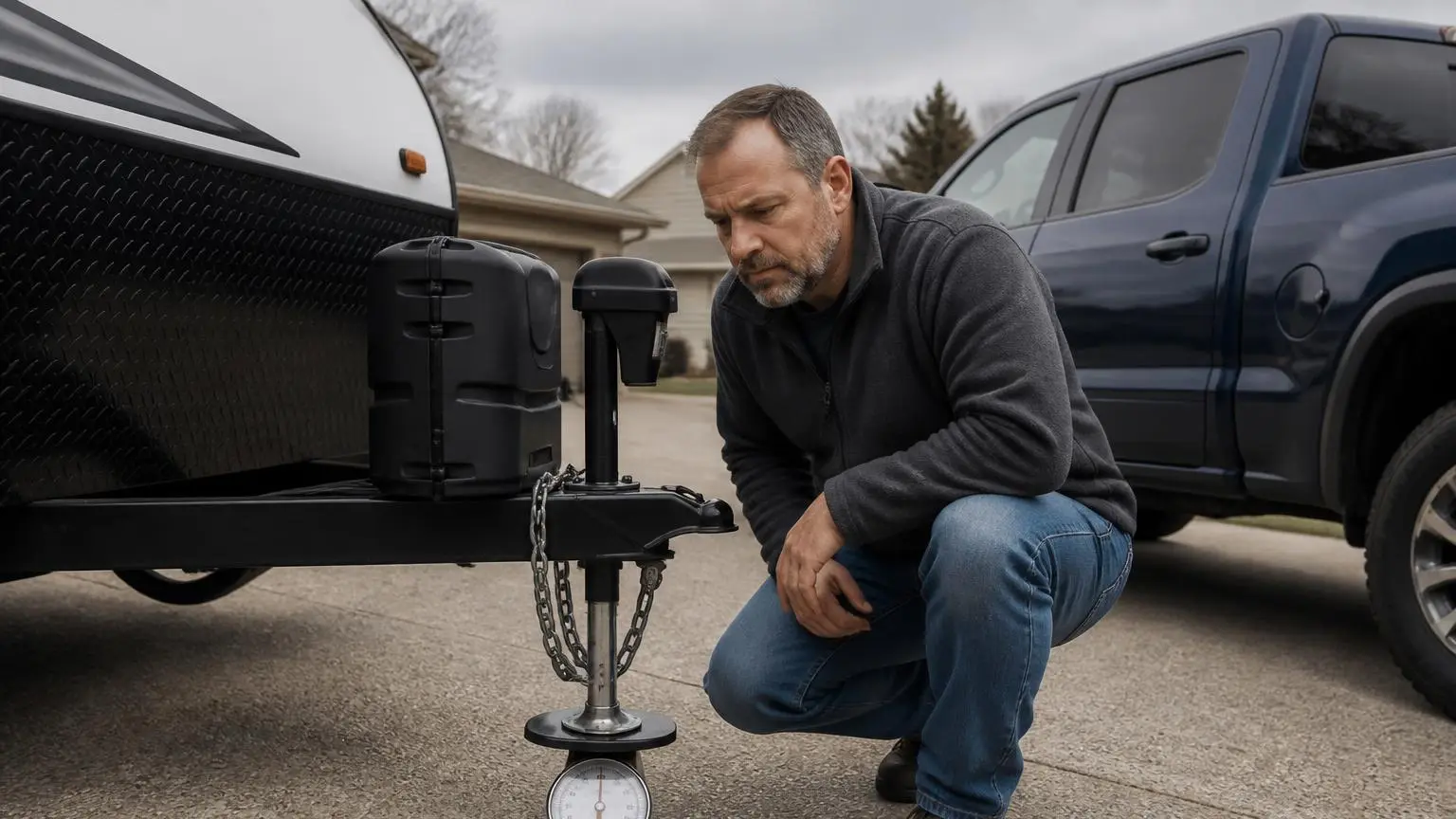
A tongue weight scale measures how much of a loaded trailer’s weight presses on the hitch ball. That number decides whether the trailer will tow steadily, how much of the truck’s payload it uses, and what size weight-distribution hitch fits. The picks below are either standalone hydraulic scales (Sherline, in three gauge ranges) or a ball mount with a scale built in (Weigh Safe). They are ranked from published manufacturer specifications and aggregated owner reviews, not first-hand testing.
At a Glance
| Expected tongue weight | Scale to choose | Why |
|---|---|---|
| Up to about 500 lbs (small utility and single-axle trailers) | 0–1,000 lb gauge (Sherline LM-1000) | Keeps the reading near mid-scale, where the gauge is most accurate |
| About 500–1,000 lbs (most travel trailers) | 0–2,000 lb gauge (Sherline LM-2000) | Sherline’s own example: about 1,000 lbs calls for the 2,000-lb gauge |
| Over 1,000 lbs, or a 5th-wheel king pin | 0–5,000 lb gauge (Sherline LM-5000) | 5th-wheel pin weight can reach 25% of the trailer |
| You tow often and the load changes | Ball mount with a built-in scale (Weigh Safe) | Reads every time you hitch up, with no separate tool |
What Tongue Weight Should Be
| Trailer type | Share of loaded weight on the hitch |
|---|---|
| Single-axle (Sherline) | 10% minimum, 15% maximum |
| Tandem-axle (Sherline) | 9% to 15% |
| Travel trailer (Sherline) | 11% to 12% |
| 5th-wheel (Sherline) | 15% to 25% |
| Ford’s rule for its trucks | 10% for conventional trailers over 2,000 lbs (no more than 200 lbs on trailers up to 2,000 lbs); 15% king pin weight for 5th-wheels |
Sherline calls 12% the ideal figure for bumper-pull trailers. Too little tongue weight can cause dangerous oscillation, or fishtailing, and too much can damage the tongue, hitch or tow vehicle. Worked example: a travel trailer weighing 6,000 lbs loaded should put about 600–900 lbs on the hitch at 10–15%. That whole amount counts against the truck’s payload, which is why the reading matters as much as the trailer’s weight. See what is tongue weight.

The Rankings

Best for Owners who want a single-purpose, purpose-built tool rather than a bathroom-scale workaround.
- Hydraulic gauge reads directly in pounds.
- Rated to 2,000 lb tongue weight.
- No batteries required.

Best for Lighter utility and small travel trailers with a tongue weight well under 1,000 lb.
- Same hydraulic gauge design as the LM-2000, lower-rated for smaller trailers.
- Rated to 1,000 lb tongue weight.

Best for Heavier trailers whose tongue weight exceeds the LM-2000’s rated ceiling.
- Rated to 5,000 lb tongue weight.
- Same simple hydraulic-gauge design as the rest of the Sherline line.

Best for Owners who want both pound and kilogram readouts on one gauge.
- Displays both 0-5,000 lb and 0-2,250 kg.
- Hydraulic gauge, no batteries required.

Best for Owners who want tongue weight read at every hookup, without a separate tool to store and remember.
- Built-in scale reads tongue weight directly at the hitch.
- Adjustable drop/rise, 2 in receiver.
- 12,500 lb GTW rating.
How a Hydraulic Tongue Scale Works
Sherline’s scale is a piston in a fluid-filled cylinder with a pressure gauge. Sherline says the gauge’s reading in pounds per square inch is read directly as pounds of weight. Sherline says any PSI gauge can be swapped in to cover a different range, and it sells replacement gauges for 0–1,000, 0–2,000 and 0–5,000 lbs. Its stated accuracy is about 2% in the middle of the gauge and about 3% near either end. That is why it recommends a gauge that puts your reading near mid-scale: for a tongue weight of about 1,000 lbs, the 2,000-lb gauge. There are no batteries or electronics, and the gauge shows pounds on the outer ring and kilograms on the inner ring.

Taking an Accurate Reading
Sherline’s procedure: level the trailer and chock its wheels. Set the scale on strong, secure blocking (or on a floor jack) under the coupler, using the screw-in extension so the coupler sits where the ball would. Then raise the tongue jack until the full tongue weight is on the scale and read the gauge. Measure with the coupler at about the height it will ride when hitched; Ford’s towing guide gives the same instruction (hitch-ball height). Weight-distribution bars or chains must be loose or disconnected, because Sherline notes a weight-distribution hitch doesn’t change tongue weight, it only redistributes it. The scale must sit level: a side load on the piston can make it bind and read low.
Once you know the true figure at the coupler, Sherline suggests a quicker reading under the tongue jack foot. Compare the two once, and the jack reading is often close enough for later checks, depending on how far the jack is from the coupler. For 5th-wheels, the scale is blocked up in the truck bed behind the hitch and the king pin is lowered onto it.
Standalone Scale vs a Ball Mount With a Built-In Scale
Weigh Safe builds the scale into an adjustable ball mount. The trailer’s weight pushes the ball down onto a piston sitting in oil, and a glycerin-filled gauge on the mount shows the pressure as tongue weight. You see the figure whenever you hitch up. Weigh Safe rates its 2-inch-shank drop hitch at 7,500–12,500 lbs gross trailer weight (depending on ball size) and 1,500 lbs tongue weight. The 2.5-inch shank is rated 18,500 / 2,200 lbs and the 3-inch 21,000 / 2,200 lbs. It comes in 4-, 6-, 8- and 10-inch drops that adjust in 1-inch steps and can be flipped to a rise. The trade-off is that it replaces your ball mount, while a standalone Sherline scale works with any hitch and can weigh a 5th-wheel pin.
Using a Commercial Truck Scale Instead
A certified truck scale gives axle weights rather than a direct tongue reading. Ford’s method: with the trailer attached, put only the truck’s front wheels on the scale for front axle weight, then all four truck wheels for the truck total; the difference is rear axle weight. Compare both figures with the GAWRs on the door-edge label. Weighing the truck with and without the trailer attached shows how much tongue weight it is carrying.
Care and Storage
Sherline says not to lift the scale by its piston, because that can draw air past the seal and throw off readings. If the scale has sat unused, rotate the piston slightly to free the O-ring before loading it, and don’t leave weight on it longer than it takes to read.
When to Reweigh
Tongue weight changes whenever cargo, water or propane moves forward or back in the trailer. Ford’s fix is to shift cargo rearward if tongue weight is over the limit and forward if under, and to keep about 60% of the cargo in the front half of the trailer. Reweigh after any change in how the trailer is packed, not just once when the hitch is bought.
How We Rank Tongue Weight Scales
Each scale is weighed against its manufacturer rating, gauge range and design, and cross-referenced with owner reports. We don’t buy or use this hardware ourselves. See how we rank and our affiliate disclosure.
Sources
- Sherline Products — Hydraulic Trailer Tongue Weight Scale: Instructions and Trailer Loading Guide — Recommended tongue-weight percentages by trailer type, 12% ideal; PSI read as pounds; 0–1,000, 0–2,000 and 0–5,000 lb gauges; about 2% accuracy mid-range and 3% at the ends; placement, level and hitch-height procedure; WD bars loose; jack-point readings; 5th-wheel method; care precautions.
- Sherline Products — Trailer Tongue Weight Scale — Sherline’s hydraulic trailer tongue weight scale product line.
- Weigh Safe — Drop Hitch with built-in tongue weight scale — Weigh Safe drop hitch reads tongue weight on a built-in glycerin-filled gauge; 2-in shank rated 7,500–12,500 lbs GTW and 1,500 lbs tongue; 2.5-in and 3-in shank ratings; 4–10 in drops in 1-in steps.
- Ford — 2026 RV & Trailer Towing Guide — Tongue load 10% for conventional trailers (200-lb cap under 2,000 lbs) and 15% for 5th-wheels; measure with the tongue on a scale at hitch-ball height; axle-weight method at a commercial scale; shift cargo to correct tongue load; 60/40 loading.