
Affiliate disclosure: As an Amazon Associate, we earn from qualifying purchases, at no extra cost to you. We research rather than test, and commissions never change our rankings. This site is reader-supported: those commissions pay for hosting, research and keeping every guide up to date, so if a guide helped you, buying through our links is an easy way to support it. How we rank · Full disclosure
TL;DR
- Classes 1–2 use a 1-1/4-inch receiver (up to 2,000 and 3,500 lbs); Classes 3–4 use 2-inch (up to 8,000 and 10,000 lbs weight-carrying).
- With weight distribution, CURT rates Class 3 and 4 up to 12,000 lbs trailer and 1,200 lbs tongue.
- Class 5 runs 16,000–20,000 lbs, with a 2-1/2-inch receiver at the top.
- Individual hitches are often rated below their class: CURT’s Class 3 for the RAV4 is 3,500 / 525 lbs.
- The lowest-rated part (receiver, ball mount, ball, coupler or vehicle) sets your limit.
A trailer hitch’s class (1 through 5) sets its receiver opening and the most it may be rated for. Each individual hitch then carries its own rating, often lower than the class ceiling, and the vehicle’s tow rating can be lower still. CURT puts it plainly: towing capacity is always limited to the lowest-rated component.
At a Glance
| Class | Receiver opening | Weight-carrying: trailer / tongue | With weight distribution: trailer / tongue |
|---|---|---|---|
| Class 1 | 1-1/4 in | Up to 2,000 / 200 lbs | — |
| Class 2 | 1-1/4 in | Up to 3,500 / 350 lbs | — |
| Class 3 | 2 in | Up to 8,000 / 800 lbs | Up to 12,000 / 1,200 lbs |
| Class 4 | 2 in | Up to 10,000 / 1,000 lbs | Up to 12,000 / 1,200 lbs |
| Class 5 Xtra Duty | 2 in | 16,000–17,000 / 2,400–2,550 lbs | 17,000 / 2,400–2,550 lbs |
| Class 5 Commercial Duty | 2-1/2 in | 18,000–20,000 / 2,700 lbs | 18,000–20,000 / 2,700 lbs |
Figures are from CURT’s hitch class chart. Tongue ratings are 10% of the trailer ratings in Classes 1–4 and about 15% in Class 5. CURT’s installation sheets state that its receivers comply with SAE J684, the industry standard for trailer couplings and hitches, and New York’s V-5 towing regulation.
Class 1 and Class 2: 1-1/4-Inch Receivers
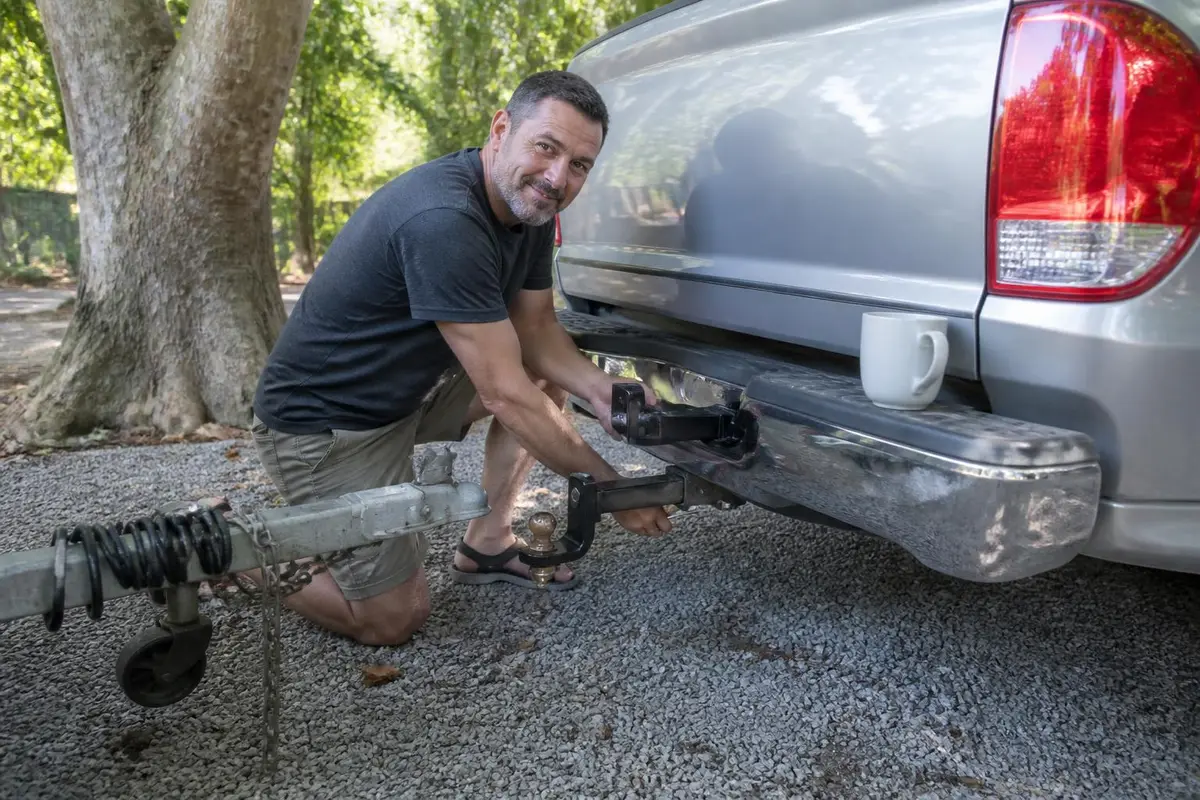
Classes 1 and 2 share a 1-1/4-inch receiver. CURT rates Class 1 up to 2,000 lbs trailer / 200 lbs tongue and Class 2 up to 3,500 / 350 lbs. Neither is rated for weight distribution.
Class 3: The Common 2-Inch Receiver
Class 3 moves to a 2-inch receiver, which CURT says takes a 5/8-inch hitch pin at least 3 inches long. The class ceiling is 8,000 lbs trailer / 800 lbs tongue weight-carrying, or 12,000 / 1,200 lbs with weight distribution. Real Class 3 hitches span a wide range below that. CURT’s Class 3 for the 2006–2018 Toyota RAV4 is rated 3,500 lbs / 525 lbs weight-carrying and 4,000 / 525 lbs with weight distribution. Its Class 3 #13146 is rated 6,000 / 900 lbs weight-carrying and 8,000 / 900 lbs with weight distribution. In that case weight distribution raises the trailer limit but not the tongue limit.

Class 4: Same 2-Inch Opening, Higher Rating
CURT’s Class 4 hitches use the same 2-inch receiver as Class 3. The difference is the rating: up to 10,000 lbs trailer / 1,000 lbs tongue weight-carrying and up to 12,000 / 1,200 lbs with weight distribution. So a 2-inch receiver alone doesn’t tell you the class. Factory truck receivers often exceed a generic class figure. Ford’s F-150 receiver chart lists 5,000 / 500 lbs weight-carrying and up to 13,500 / 1,400 lbs weight-distributing (with the Tow/Haul Package and Max Tow Axle), which is why the label matters more than the class name.
Class 5: Xtra Duty and Commercial Duty
CURT splits Class 5 in two. Xtra Duty keeps a 2-inch receiver and is rated 16,000–17,000 lbs trailer and 2,400–2,550 lbs tongue. Commercial Duty moves to a 2-1/2-inch receiver rated 18,000–20,000 lbs trailer and 2,700 lbs tongue. Ford notes that some industry sources call trailers over 10,000 lbs “Class V” trailers, a trailer weight category rather than a hitch class.
Trailer Classes Are Not Hitch Classes
Ford’s towing guide groups trailers by loaded weight: Class I up to 2,000 lbs, Class II 2,001–3,500 lbs, Class III 3,501–5,000 lbs and Class IV over 5,000 lbs. Ford says weight distribution is required for certain Class III and all Class IV trailer applications, and that most Class IV applications need a weight-distributing or 5th-wheel hitch. Those trailer classes line up with hitch Classes 1 and 2 at the light end but not above: a 6,000-lb trailer is a Ford Class IV trailer yet can sit within a Class 3 hitch’s rating.
Gooseneck, 5th-Wheel, Pintle and Bumper Hitches
These fall outside the receiver classes. CURT rates its 5th-wheel hitches up to 30,000 lbs and goosenecks up to 38,000 lbs, both for pickups only, mounted in the bed. Ford says a 5th-wheel hitch should sit at least 2 inches forward of the rear axle centerline. Pintle hitches, a hook and ring, are rated up to 60,000 lbs in CURT’s line. A bumper hitch is a receiver on the bumper itself, and CURT says its capacity is limited to the bumper’s rating. Oregon DOT adds that when the towed load is over 5,000 lbs, the receiver must be attached to the frame, not just the bumper.
Matching a Hitch to Your Trailer
Start with the loaded trailer weight and tongue weight (Ford uses 10% of the loaded trailer for conventional trailers). Pick a receiver whose label covers both, check whether weight distribution is required at that weight, then confirm the ball mount and ball ratings. Example: a 7,000-lb loaded travel trailer puts about 700 lbs on the hitch. A Class 3 receiver labeled 8,000 / 800 lbs covers it weight-carrying, but CURT’s #13146 (6,000 / 900 lbs weight-carrying) needs weight distribution to reach 7,000 lbs. See what is payload capacity and the towing and payload hub.
How We Cover This Topic
This explainer is built from CURT’s published class ratings and installation sheets, Ford’s 2026 towing guide and Oregon DOT’s towing brochure. We don’t buy, install or tow with this hardware ourselves. See how we rank.
Recommended gear
Towing gear worth knowing
Affiliate disclosure: As an Amazon Associate, we earn from qualifying purchases, at no extra cost to you. Purchases through these links help keep this site running and up to date. Learn more



We research products from manufacturer specs and owner feedback; we don't test them ourselves. How we choose.
Sources
- CURT Manufacturing — Types of Trailer Hitches and Hitch Classes — Class 1–5 receiver sizes and weight-carrying and weight-distribution ratings, including Class 5 Xtra Duty and Commercial Duty; 5th-wheel, gooseneck, pintle and bumper hitch capacities; towing capacity limited to the lowest-rated component.
- CURT Manufacturing — The Complete Guide to 2" Receiver Hitches — Class 3, 4 and 5 XD 2-inch ratings; a 2-in receiver takes a 5/8-in pin at least 3 in long.
- CURT Manufacturing — Class 3 Trailer Hitch #13149 (2006–2018 Toyota RAV4) — CURT’s Class 3 hitch for the 2006–2018 RAV4 is rated 3,500/525 lbs weight-carrying and 4,000/525 lbs with weight distribution.
- CURT Manufacturing — Installation manual, hitch #13146 — CURT #13146 is rated 6,000/900 lbs weight-carrying and 8,000/900 lbs with weight distribution.
- CURT Manufacturing — Installation instructions, hitch #13295 (2014+ RAM ProMaster) — CURT receivers are stated to comply with SAE J684 and New York V.E.S.C. Regulation V-5.
- Ford — 2026 RV & Trailer Towing Guide — Factory receiver labels show weight-carrying and weight-distributing capacity; F-150 receiver ratings; Ford trailer classes I–IV by weight and ‘Class V’ over 10,000 lbs; weight distribution required for certain Class III and all Class IV; 5th-wheel placement; 10% tongue load.
- Oregon DOT — Towing a Trailer: Being Equipped for Safety (developed in part from NHTSA material) — Loads over 5,000 lbs require a receiver attached to the frame, not just the bumper.