
Affiliate disclosure: As an Amazon Associate, we earn from qualifying purchases, at no extra cost to you. We research rather than test, and commissions never change our rankings. This site is reader-supported: those commissions pay for hosting, research and keeping every guide up to date, so if a guide helped you, buying through our links is an easy way to support it. How we rank · Full disclosure
TL;DR
- Cape Hatteras National Seashore's permit kit is a solid baseline: tire gauge, shovel, jack and jack board, plus a spare, first-aid kit, extinguisher, flashlight and tow strap.
- A hooked tow strap is for towing, not for pulling out a stuck vehicle. For that, use a recovery strap rated at 2–3× the vehicle's gross weight (ARB), shackled to rated recovery points.
- Air down for traction (under 20 psi on sand at Cape Hatteras), but carry a way to air back up before pavement (BFGoodrich).
- Transmitting on GMRS needs a $35, ten-year FCC license that covers your immediate family. FRS and CB need none.
- A hitch skid fits 2-inch Class III/IV receivers. A tow ball is never a recovery point.

Best for Owners who want shackles, a snatch block and a strap in one bag — use the hooked strap for towing only, never to pull out a stuck vehicle.
- Rated tow strap included.
- Hooks and connection hardware included.
- Hooked strap: for towing, not stuck-vehicle recovery.

Best for Owners who air down for sand, mud or snow and want a repeatable, adjustable pressure.
- Adjustable 10–30 PSI range.
- Set of 4 (one per tire).
- Screw-on design.

Best for Owners who want to see rocks, ruts and obstacles at night without relying on headlights alone.
- 4-pod set.
- High-power white LEDs.
- Marketed for off-road undercarriage use.

Best for Owners wheeling in a group who need reliable vehicle-to-vehicle communication.
- 2-pack with headsets.
- GMRS band (a license is required to transmit).
- Long-range rating per Midland’s listing.

Best for Owners who want a low-cost way to protect the receiver hitch on rutted trails.
- Fits standard 2-inch receivers.
- Marketed for off-road use.
What a Land Manager Actually Requires
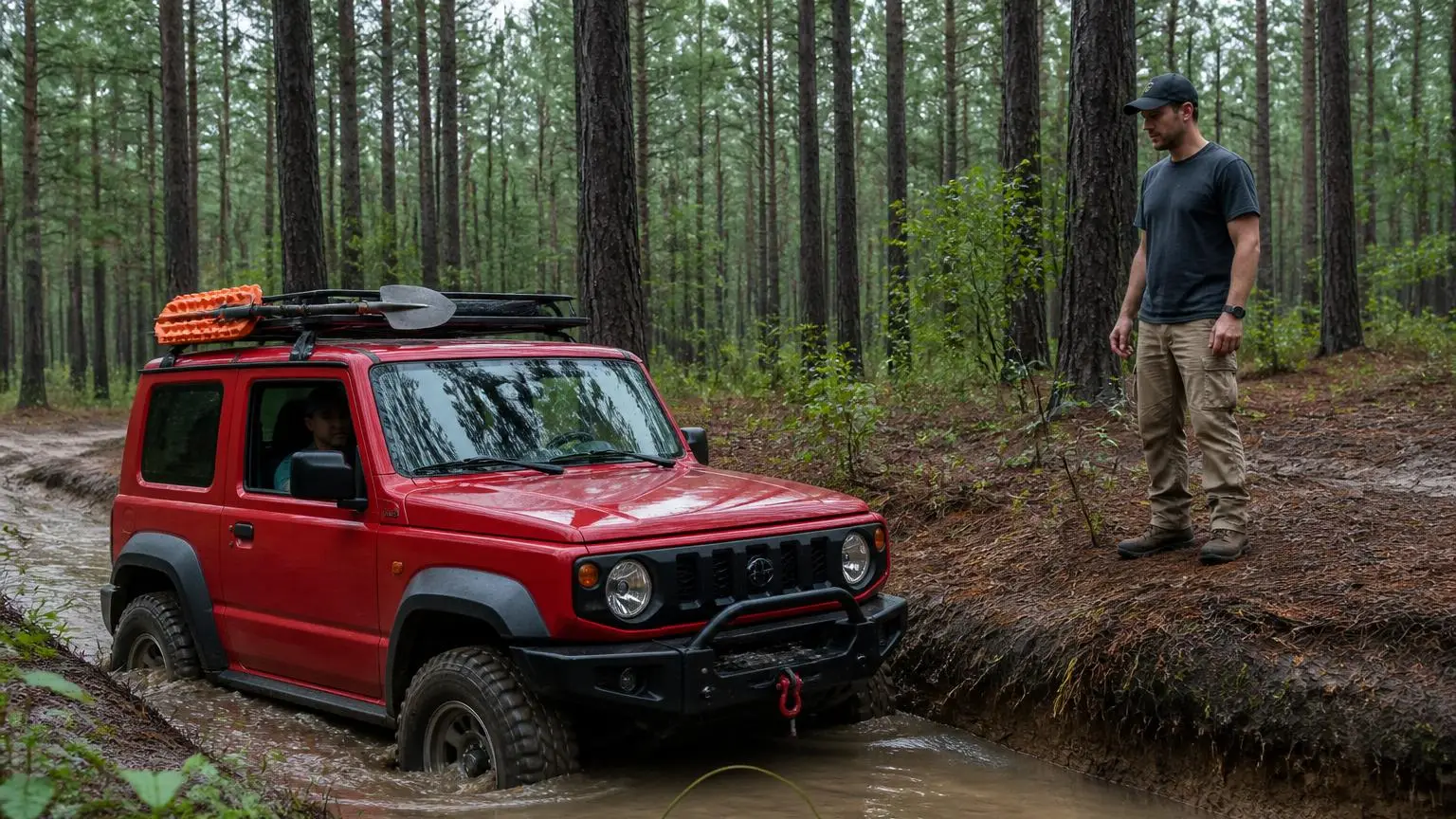
Cape Hatteras National Seashore offers a published example of a baseline kit. Its off-road vehicle permit requires four items and recommends six more:
| Required for the permit | Recommended |
|---|---|
| Low-pressure tire gauge | Full-size spare tire |
| Shovel | First-aid kit and fire extinguisher |
| Jack | Tow strap |
| Jack support board | Flashlight (for night driving) and a trash bag |
That list is for sand, but the logic holds on any trail: you need to be able to change tire pressure, lift the vehicle on soft ground and get unstuck. See the recovery gear checklist for a full kit.
Recovery Straps vs. Tow Straps
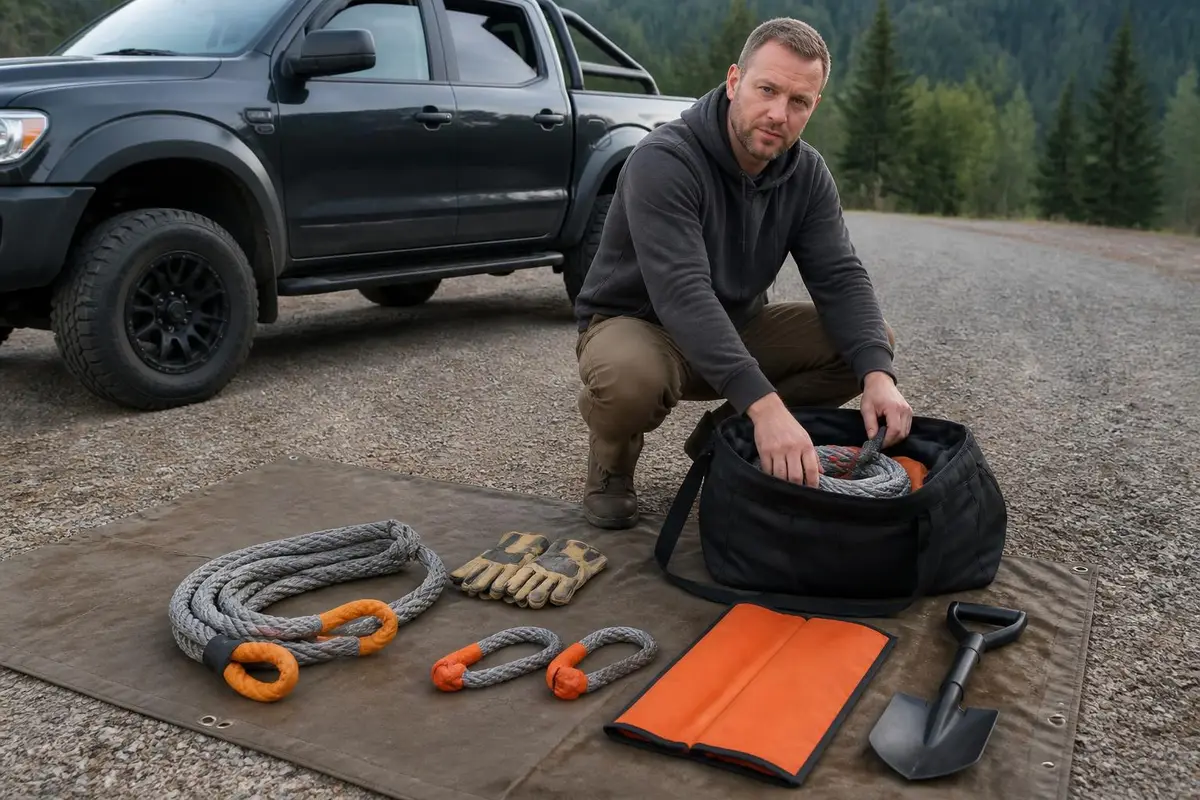
The two look alike but do different jobs. Factor 55 describes a tow strap as low-stretch webbing for steady towing, while recovery straps and kinetic ropes are designed to stretch. Factor 55's kinetic rope stretches up to 30% of its length, storing energy that pulls a stuck vehicle free. Rhino USA warns never to use a tow strap with metal hooks for recovery, because a hook can break and become a projectile. A strap with sewn loop ends, joined with a soft or bow shackle, is the recovery tool. The VEVOR kit above is a hooked tow strap, so use it for towing a rolling vehicle, not for snatch recoveries.
ARB's sizing rule for a snatch strap is a minimum breaking strength of two to three times the vehicle's gross vehicle mass. For a truck with a 6,000 lb GVWR, that means a strap rated 12,000–18,000 lb. ARB also says:
- use only rated, correctly mounted recovery points, never a tow ball or tie-down point;
- use load-rated bow shackles of at least 3.25 t;
- drape a damper or heavy blanket over the strap to reduce rebound if something fails.
Airing Down and Airing Back Up
BFGoodrich describes airing down as one of the most important off-road techniques because it enlarges the tire's footprint for traction on soft or uneven ground. It gives no universal pressure, since the right number depends on the tire, the terrain and the vehicle's weight. Cape Hatteras recommends under 20 psi for most vehicles on sand, lower in softer sand, and reinflating as soon as you return to pavement. BFGoodrich warns that going too low can unseat the tire from the rim (beadlock wheels prevent this) and that underinflated tires on pavement handle worse and risk a blowout. An adjustable deflator set, like the 10–30 psi kit above, repeats the same target pressure on all four tires. Pair it with a compressor, because BFGoodrich's rule is never to head off-road without a way to air back up.

Rock Lights: Rated for Where They Mount
Rock lights mount under the vehicle, where water, mud and pressure washing hit them directly. Under IEC 60529, the second digit of an IP rating covers water: 7 covers temporary immersion to 1 meter, and the scale runs to 9, which covers high-pressure hot water. The first digit rates dust, where 6 means dust-tight. For lights this low, IP67 is a sensible minimum. Beam patterns, wiring and legality are covered in the off-road lighting hub.
Trail Radios: GMRS, FRS and CB
| Service | License | Power limit |
|---|---|---|
| GMRS (462/467 MHz) | Individual FCC license, $35, normally 10 years, covers immediate family | Up to 50 W on main channels (mobile and base); 5 W on 462 MHz interstitials; 0.5 W for handhelds on 467 MHz interstitials |
| FRS (shares GMRS frequencies) | None | 2 W on channels 1–7 and 15–22; 0.5 W on channels 8–14 |
| CB (27 MHz) | None (licensed by rule) | 4 W AM/FM; 12 W PEP SSB |
GMRS has 30 channels: 16 main and 14 interstitial. The 467 MHz main channels are repeater inputs, so mobiles and handhelds transmit on them only through a repeater. A GMRS licensee must be at least 18. Under 47 CFR 95.1705, family members from a spouse and children to in-laws may operate under that license.
Hitch Receivers and Hitch Skids
A hitch skid slides into the receiver to protect it and the rear bumper when the tail drags on a ledge or ditch exit. It fits 2-inch receivers, which CURT's class chart assigns to Class III (up to 8,000 lb trailer weight and 800 lb tongue weight) and Class IV (up to 10,000 lb and 1,000 lb). Your hitch's own label and the vehicle's towing rating set the real limit. Remove the skid before you hitch a trailer. Per ARB, a tow ball is not a recovery point.
Sources
- NPS — Cape Hatteras National Seashore: Off-Road Vehicle FAQ — ORV permit requires a low-pressure tire gauge, shovel, jack and jack support board; recommends a full-size spare, first-aid kit, fire extinguisher, flashlight, trash bag and tow strap; under 20 psi recommended on sand and reinflate on pavement.
- Factor 55 — Tow Strap vs. Recovery Strap/Kinetic Rope — Tow straps are low-stretch webbing for steady towing; recovery straps and kinetic ropes are designed to stretch, up to 30% for Factor 55's kinetic rope.
- Rhino USA — Recovery Strap vs. Tow Strap — Never use a tow strap with metal hooks for recovery; connect recovery straps with soft shackles, D-ring shackles or a shackle hitch receiver.
- ARB — Getting Started: Recovery Techniques & Equipment — Snatch strap minimum breaking strength of 2–3× gross vehicle mass; tow balls and tie-downs are not recovery points; load-rated bow shackles of at least 3.25 t; damper or blanket over the strap.
- BFGoodrich — 4x4 Driving Guide: Off-Road Tire Selection — Airing down enlarges the footprint; no universal pressure (depends on tire, terrain, weight); too low can unseat the bead, beadlocks prevent it; reinflate before pavement and never go off-road without a way to air up.
- IEC — Ingress Protection (IP) ratings (IEC 60529) — IP code structure: first numeral for solids (6 = dust-tight), second for liquids up to 9 (high-pressure hot water).
- 47 CFR § 95.1705 — GMRS individual licenses (Cornell LII) — GMRS operation requires an individual license; applicants must be 18 or older; ten-year term; immediate family members listed as eligible operators.
- 47 CFR § 1.1102 — Wireless application fees (Cornell LII) — $35 application fee for a new GMRS license.
- 47 CFR § 95.1767 — GMRS transmitting power limits (Cornell LII) — 50 W on main channels for mobile, base and repeater stations; 5 W on 462 MHz interstitials; 0.5 W for handhelds on 467 MHz interstitials.
- 47 CFR § 95.1763 — GMRS channels (Cornell LII) — 30 GMRS channels (16 main, 14 interstitial) at 462 and 467 MHz; 467 MHz main channels are repeater inputs.
- 47 CFR § 95.567 — FRS transmitting power limits (Cornell LII) — FRS capped at 2 W ERP on channels 1–7 and 15–22 and 0.5 W on channels 8–14.
- 47 CFR § 95.905 — Authority to operate CB stations (Cornell LII) — CB stations may be operated without an individual license.
- 47 CFR § 95.967 — CB transmitter power limits (Cornell LII) — CB limited to 4 W mean carrier power (AM/FM) and 12 W peak envelope power (SSB).
- CURT Manufacturing — Types of Trailer Hitches and Hitch Classes — Class III (2-inch, up to 8,000 lb GTW / 800 lb TW) and Class IV (2-inch, up to 10,000 lb / 1,000 lb) receiver ratings.