

Affiliate disclosure: As an Amazon Associate, we earn from qualifying purchases, at no extra cost to you. We research rather than test, and commissions never change our rankings. This site is reader-supported: those commissions pay for hosting, research and keeping every guide up to date, so if a guide helped you, buying through our links is an easy way to support it. How we rank · Full disclosure
Quick answer: an onboard compressor is not a bigger portable. It is a permanent install — compressor, wiring, relay, pressure switch and air lines, sometimes a tank — that is always ready and can run things a portable cannot, like air lockers. The picks below are ranked from aggregated owner reviews and manufacturer listings, not first-hand testing. If you only air up a few times a year, a portable off-road compressor is usually the smarter buy.

Who Actually Needs Onboard Air
Owners who report an onboard system as worth the cost and install time tend to share one of three situations. They run an air-actuated locker, which needs a reliable air supply every time it engages. They air down and up several times per trip, where unpacking and connecting a portable becomes a chore. Or they run large tires where a portable’s fill time gets long. If none of those describes you, the install is a lot of work for convenience alone.

Top Onboard Air Compressor Picks

Best for Owners running ARB air lockers or large tires who want a twin-motor unit with a wide parts and service network.
- 12V onboard twin compressor per the listing title.
- Designed for permanent mounting.
- Compatible with air-actuated lockers and accessories.

Best for Builds needing fast fill from a dual-compressor kit, such as air suspension or larger tanks.
- Dual 12V compressors in one kit.
- 200 PSI rating stated in the listing title.
- Chrome finish, marketed as fast fill.

Best for Owners who want an onboard system packaged as a kit rather than sourcing parts separately.
- Onboard air system from VIAIR (model 20001).
- Marketed as ultra duty.
- Packaged system for permanent install.

Best for A single-compressor onboard setup for tire inflation on mid-size trucks and SUVs.
- VIAIR 400C compressor kit (40040).
- Single-compressor kit format.
- A frequently recommended option in aggregated owner reviews for this category.

Best for Air horns, air lockers and air suspension where stored air on demand matters.
- Includes a 2-gallon air tank.
- 150 PSI rating stated in the listing title.
- Listed for air horns, suspension and air lockers.

Best for Owners who want tank-backed air but are not ready to hard-mount a system.
- 12 or 24 volt operation per the listing.
- 1/4 HP motor, 1-gallon tank, 120 PSI per the listing title.
- Listed as portable — a bridge between portable and onboard.
CFM and Duty Cycle: Where Onboard Units Pull Ahead
Airflow at working pressure (CFM) sets how fast tires fill; duty cycle sets how long the compressor can run before it must rest. Onboard units are typically chosen because the better ones publish both figures and are designed to cool in an engine bay or bed mount, which lets owners plan a four-tire air-up rather than guess. Twin and dual designs — the ARB twin and the VIAIR 444C here — use two motors to move more air, which matters most on 35-inch and larger tires or when filling a tank. Manufacturer specs bear this out: ARB rates its CKMTA12 twin at 6.16 CFM at 0 PSI (dropping to 4.68 CFM at 29 PSI) with a 100% duty cycle rated continuous, and VIAIR rates its 444C dual-head kit at a combined 7.06 CFM at 0 PSI with a 100% duty cycle at 100 PSI — both well above VIAIR's single-head 400C-class portables. Always compare CFM at a similar pressure, since a figure quoted at zero pressure flatters every unit.
Power Draw, Wiring and the Alternator
A permanently mounted compressor draws serious current, which is why a proper install uses a relay, correctly sized cable, an inline fuse or breaker and a dedicated switch rather than a socket plug. Twin-motor units draw more than single ones: ARB rates the CKMTA12's max draw at 68.6 amps, and VIAIR rates the 444C's combined max continuous draw at 46 amps across its two heads, both figures that call for heavy-gauge wire and a properly rated fuse rather than a standard accessory circuit. Owners with a smaller battery or a heavily loaded electrical system — fridge, lights, winch — often run the engine during inflation and check the alternator’s headroom before adding a large compressor. If you are unsure about the wiring, this is a job many owners hand to an auto electrician.
Tank or Tankless?
A tank stores compressed air so you get an instant burst — useful for engaging a locker mid-obstacle, sounding train horns or seating a tire bead. Tankless systems compress on demand, which is simpler and lighter but slower to respond. For pure tire inflation, owners report the tank matters less, since filling a tire is a sustained job. The VIAIR Air Source Kit with its 2-gallon tank and the 95c with its 1-gallon tank are the tank-backed options on this list; the 95c is sold as a portable, so it suits owners who want stored air without committing to a hard mount yet.

Mounting Location
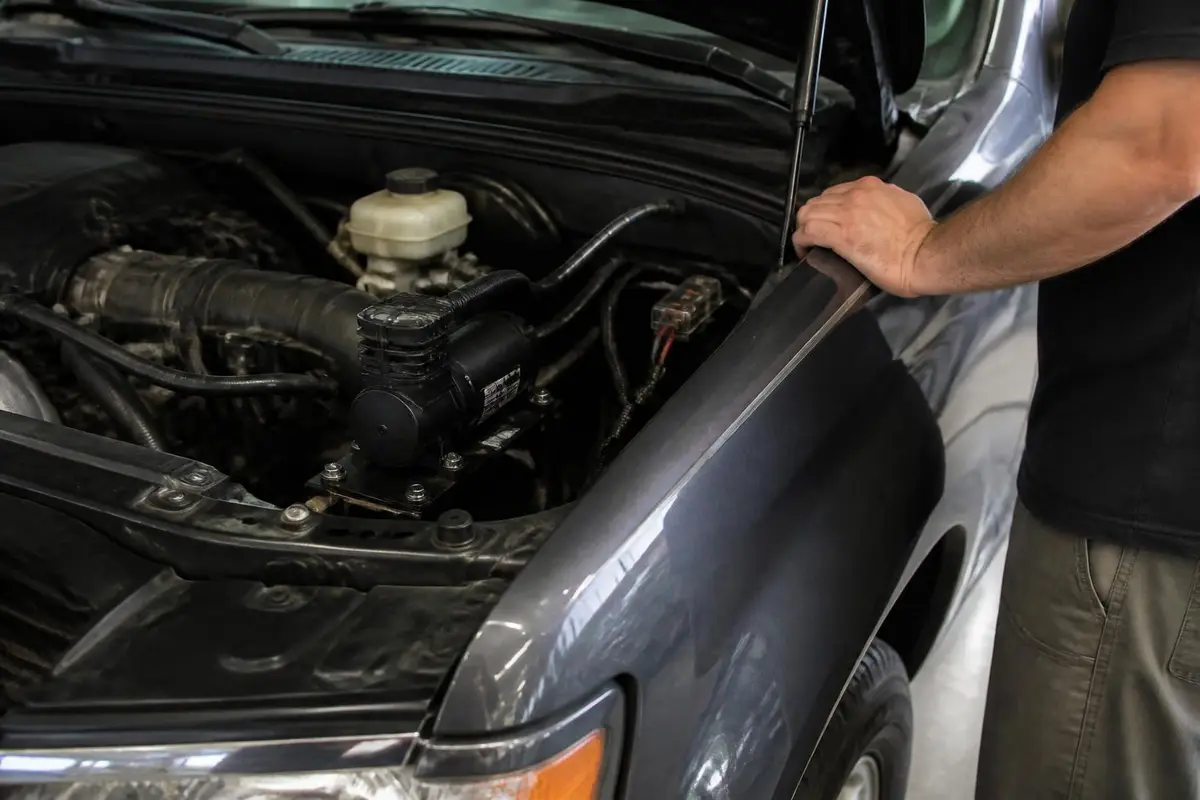
Under-hood mounting keeps air lines short to the front tires but competes for space and heat. Bed, cargo-area or under-seat mounting avoids engine-bay constraints at the cost of longer lines. Keep the intake away from water crossings and dust, and use the manufacturer’s remote-intake option if one exists for your unit. Measure the actual space before ordering — footprints vary.
About the ARB Pick
ARB sits at the premium end of this category, and whether that premium is justified depends on how you use it. We have a dedicated breakdown of single vs twin cylinder, tank vs tankless and used-market buying in is an ARB compressor worth it, so we will not repeat it here.
How We Rank Onboard Compressors
Every system on this page is weighed against its manufacturer listing — compressor count, pressure rating, tank capacity and intended use — cross-referenced with aggregated owner reviews on fill time, reliability and install experience. We do not buy or physically test this gear ourselves — see how we rank for the full method and affiliate disclosure for how the site is funded.
Sources
- ARB USA — Twin Motor Onboard Air Compressor (CKMTA12) Specifications — ARB CKMTA12 twin onboard compressor specifications: 100% duty cycle, 6.16 CFM at 0 PSI, 4.68 CFM at 29 PSI, 68.6-amp maximum draw.
- VIAIR — Compressor Comparison Chart — VIAIR onboard compressor duty-cycle and CFM ratings, including the 444C and 400C.
- VIAIR — 444C Dual Performance Value Pack — 444C combined 7.06 CFM at 0 PSI (3.53 per head), 200 PSI max, 100% duty cycle at 100 PSI (50% at 200 PSI), 46-amp combined max draw.
- ARB — Air Locker — Air Lockers are actuated by compressed air from an onboard compressor.
- ARB USA — Single Motor Onboard 12V Air Compressor (CKMA12) Specifications — Single-motor onboard compressor spec for comparison: lower CFM, pressure, duty cycle and amp draw than the twin CKMTA12.