

Affiliate disclosure: As an Amazon Associate, we earn from qualifying purchases, at no extra cost to you. We research rather than test, and commissions never change our rankings. This site is reader-supported: those commissions pay for hosting, research and keeping every guide up to date, so if a guide helped you, buying through our links is an easy way to support it. How we rank · Full disclosure
Quick answer: a portable 12V compressor is the right tool if you air down a few times a year and want something that stores in a bag, not bolted to the truck. The picks below are all portable units, ranked from aggregated owner reviews and manufacturer listings — not first-hand testing. If you air up every trip or run air lockers, a permanent system is usually the better buy; see our best onboard air compressors instead.

Max PSI Is Not the Number That Matters
Most portable listings lead with maximum pressure — 150 PSI appears on several units here. For airing trail tires back up to road pressure, you rarely need more than about 35 to 50 PSI, so the maximum is almost never the limit. What decides how long you stand beside the truck is airflow, measured in CFM (cubic feet per minute), ideally quoted at a working pressure rather than at 0 PSI. VIAIR's own spec sheets show the gap that matters: the 88P is rated 1.97 CFM at 0 PSI with a 25-minute duty cycle at 30 PSI, while the mid-tier 300P and 400P EF are both rated 2.30 CFM at 0 PSI with a 150 PSI ceiling — a real, published step up, not just a marketing claim. A unit with a high maximum and a low CFM will get there — slowly. When a listing does not publish CFM at working pressure, owner reviews about real fill time for your tire size are the best available proxy.
Match the Compressor to Your Tire Size
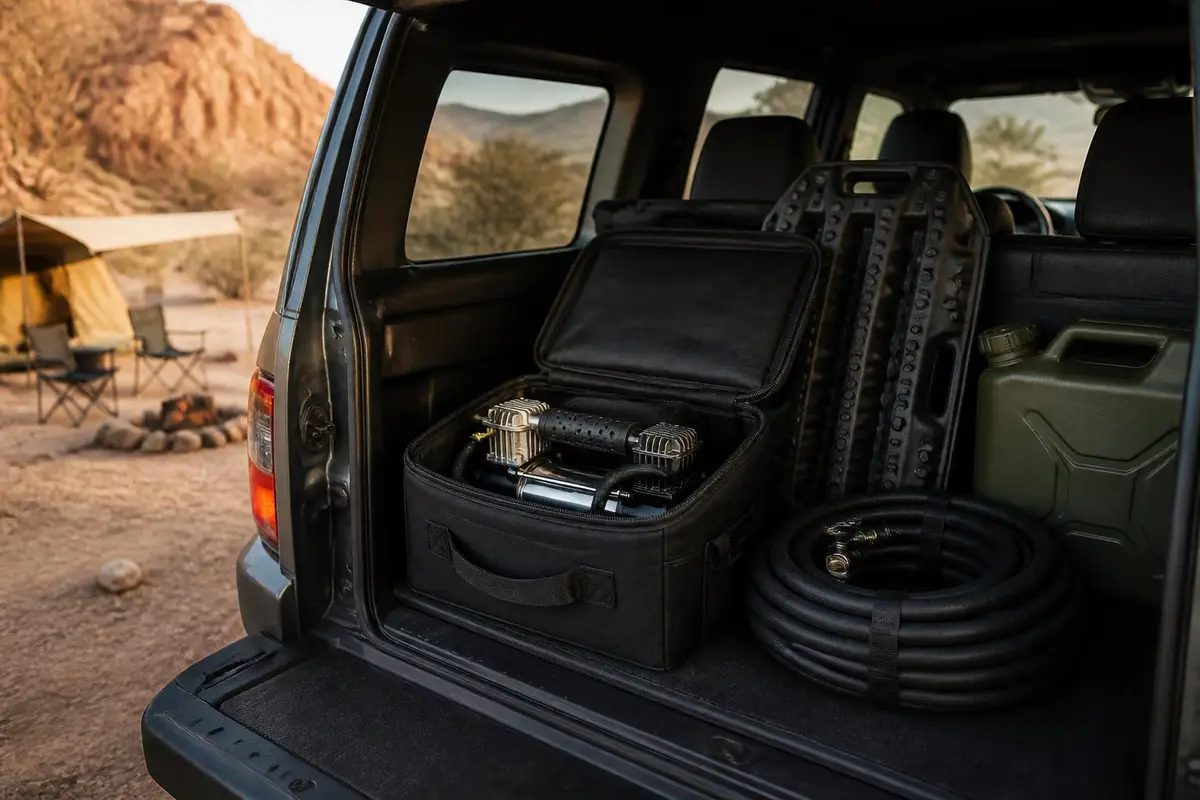
A stock 30-inch tire and a 35-inch mud-terrain hold very different volumes of air, and a small compressor that feels fine on the first can feel painfully slow on the second. Owners running larger tires consistently point toward dual-cylinder portables, like the UUP and Asani units listed here, because two cylinders generally move more air than one of similar size. Owners on stock-size tires often find a single-cylinder unit perfectly adequate. Cordless inflators, like the OlarHike, suit quick top-ups and small tires far better than a full four-tire air-up on a lifted rig.
Best Portable Off-Road Compressors

Best for Owners of stock-size car and light-truck tires who want an established compressor brand in a compact kit.
- 12V portable compressor kit from VIAIR (model 88P, 00088).
- Listed for car and truck tires.
- A frequently recommended option in aggregated owner reviews for this category.

Best for Owners with larger tires who want a twin-cylinder portable unit.
- Dual-cylinder design.
- 150 PSI maximum pressure stated in the listing.
- 12V portable tire inflator.

Best for Buyers comparing twin-cylinder portables on value.
- Double-cylinder design.
- 150 PSI maximum pressure stated in the listing.
- 12V portable tire inflator.

Best for Owners who prefer reading a digital display over an analog dial.
- Digital tire inflator per the listing title.
- Heavy-duty metal construction.
- 12V portable compressor.

Best for Buyers who want a simple metal-bodied 12V pump without extra electronics.
- Heavy-duty metal construction.
- 12V portable tire inflator.
- Straightforward analog-style unit.

Best for Top-ups and small tires where not needing a cable matters more than full air-up speed.
- Built-in 12000mAh battery per the listing title.
- Heavy-duty portable inflator.
- No vehicle connection required for use.

Duty Cycle and Heat
Every compressor produces heat, and most portables are rated to run for a limited time before needing to cool. That rating is the duty cycle: VIAIR rates the 88P at 25 minutes of continuous run time at 30 PSI before it needs to rest, while the higher-output 300P and 400P EF are rated 33% duty cycle at 100 PSI (meaning roughly a third running to two-thirds cooldown once pressure climbs that high). Owners who report failures on budget units commonly describe running them continuously through four large tires without a break. A practical habit is to rest the compressor between tires, keep it off hot sand or dark rock, and keep the air intake clear of dust — trail dust drawn into the cylinder is a common wear point. Metal-bodied units are often chosen because they are perceived to shed heat better, though the manufacturer’s duty-cycle figure is the more reliable guide than the housing material alone.
Power Connection: Socket vs Battery Clamps
A compressor that plugs into a 12V accessory socket is convenient but limited by that socket’s fuse, which caps how much current the pump can draw. Heavier-duty portables connect directly to the battery with clamps, which removes that ceiling. Check how your chosen unit connects before buying, and run the engine while inflating so the pump is not drawing the battery down. Also check hose length: you need to reach all four tires, and ideally a trailer, from wherever the compressor sits.
Build the Full Air-Down Kit
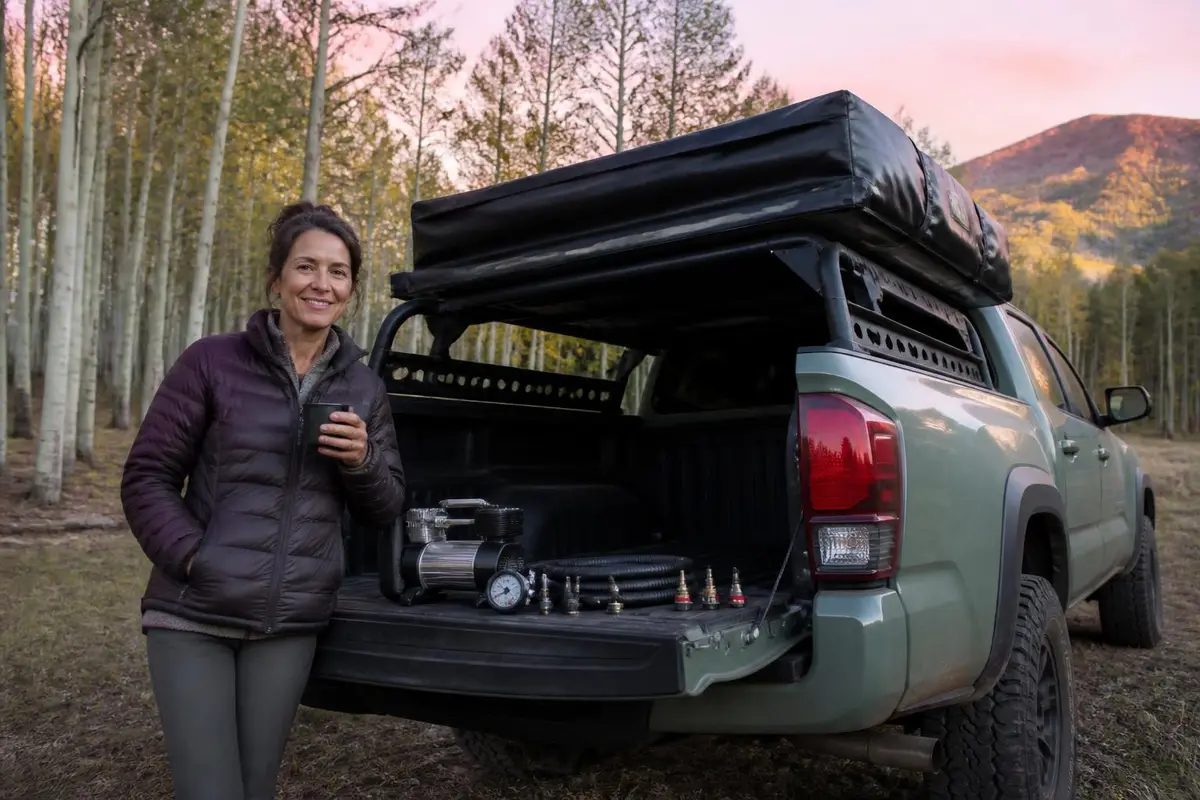
A compressor is only half the job. Pair it with a set of deflators — see our best tire deflators — and read the airing down guide for pressure starting points by terrain. If you are still deciding between portable and permanent, the 12V tire inflator vs onboard air system comparison walks through the decision.
How We Rank Portable Compressors
Every compressor on this page is weighed against its manufacturer listing — cylinder count, pressure rating and power source — cross-referenced with aggregated owner reviews on real-world fill time and overheating reports. We do not buy or physically test this gear ourselves — see how we rank for the full method and affiliate disclosure for how the site is funded.
Sources
- VIAIR — 88P Portable Compressor Specifications — VIAIR 88P: 1.97 CFM at 0 PSI, 120 PSI max, 25-minute duty cycle at 30 PSI, 20-amp draw, IP53, 9.8 x 3.2 x 5.6 in, 4.75 lb.
- VIAIR — Compressor Comparison Chart — Why CFM and duty cycle, not max PSI, separate compressors; ratings and max tire size by model.
- VIAIR — 300P Portable Compressor Specifications — VIAIR 300P: 2.30 CFM at 0 PSI, 150 PSI max, 33% duty cycle at 100 PSI, 30-amp draw, IP54.
- VIAIR — 400P EF Portable Compressor Specifications — VIAIR 400P EF: 150 PSI max, 100% duty cycle at 40 PSI (33% at 100 PSI), 30-amp draw, IP54.
- NHTSA — Tire Safety — General guidance that trail tires are reinflated to a manufacturer-recommended road pressure, well under a portable compressor's rated maximum.