

Affiliate disclosure: As an Amazon Associate, we earn from qualifying purchases, at no extra cost to you. We research rather than test, and commissions never change our rankings. This site is reader-supported: those commissions pay for hosting, research and keeping every guide up to date, so if a guide helped you, buying through our links is an easy way to support it. How we rank · Full disclosure
VIAIR built the 444C around a dual-compressor-head design, sold in the brand's own catalog for both tire-inflation and air-suspension applications. This review is based on the product's listed specifications and VIAIR's broader lineup positioning — not a first-hand fill-time test.

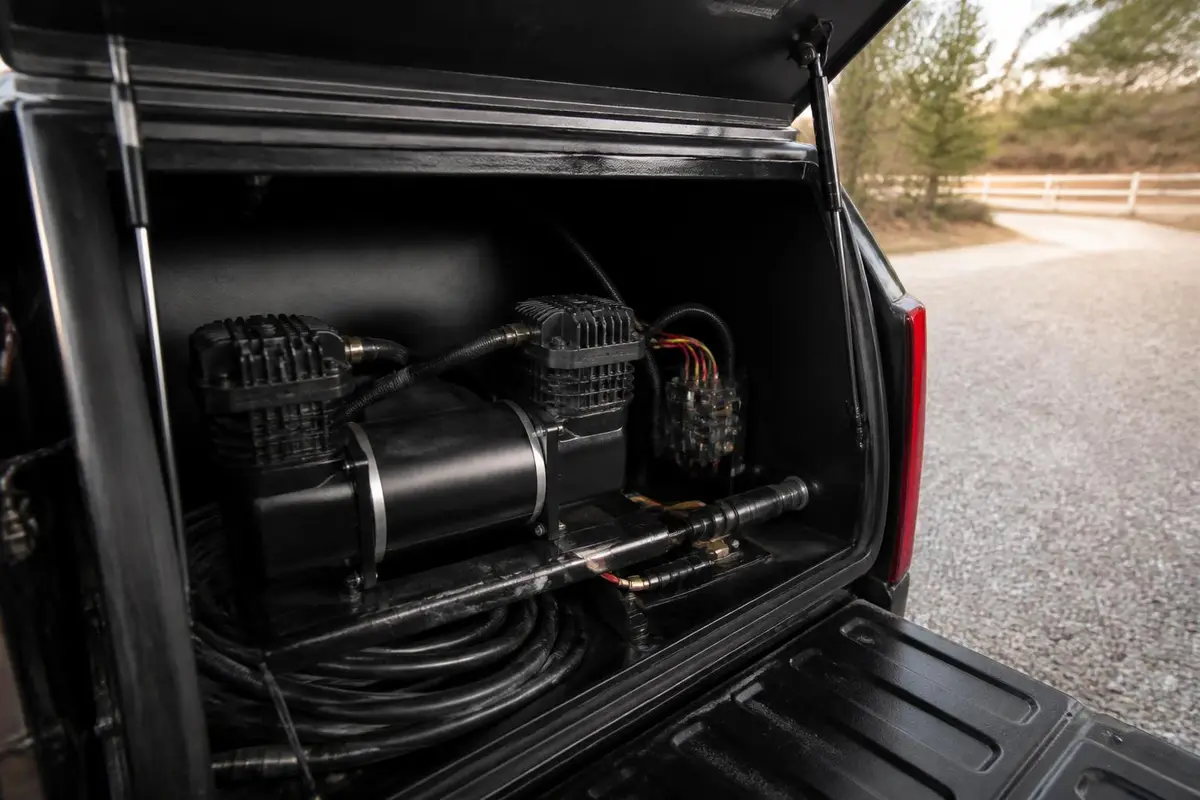
The 444C pairs two compressor heads in one housing, listed at a 200 PSI max working pressure — a design VIAIR also sells for air-suspension applications, where a dual-head unit fills faster and shares the workload across two smaller motors instead of one larger one.
Why You Should Get This
Running two compressor heads in parallel is the 444C's whole reason for existing: it's built to cut total fill time versus a comparable single-head unit, at the cost of a larger footprint and a two-motor wiring job instead of one.
Benefits
- Two compressor heads working together, listed to shorten total air-up time versus a single-head unit at a comparable price point.
- 200 PSI max working pressure per the listing, well above what's needed for tire inflation alone.
- Available in single or dual-pack configurations depending on the build's air demand.
Pros and Cons
- Dual-head design is a genuine fill-speed advantage over VIAIR's smaller single-head portables (88P, 300P) for a full 4-tire job.
- 200 PSI-rated max pressure gives real headroom for air-suspension or air-locker circuits, not just tire inflation.
- Sold in a Stealth Black finish and other variants, letting an owner match a specific mounting look.
- Two compressor heads mean two motors to wire, mount and fuse correctly — more installation complexity than a single-head portable.
- Larger physical footprint than a single-head unit, a real constraint on tight under-hood or under-seat mounting.
- Built for a permanent or semi-permanent mount rather than the toss-in-the-glovebox convenience of a small portable like the 88P.
Confirm with the seller for your exact year/trim and mounting-space clearance before ordering.

Why Two Compressor Heads Instead of One
The 444C's defining feature is running two compressor heads in one kit rather than a single, larger motor. VIAIR rates each head at 3.53 CFM at 0 PSI, for a combined 7.06 CFM — roughly triple the single-head 88P's 1.97 CFM and about three times the 300P/400P EF's 2.30 CFM, per VIAIR's own published specification sheets. VIAIR positions dual-head units like this one specifically for jobs where total fill time or sustained air output matters more than compact size — airing up a full set of large tires back-to-back, or feeding an air-suspension or air-locker circuit that needs a steady air supply rather than one short burst.

200 PSI Max Pressure and Duty Cycle
The 444C is listed at a 200 PSI max working pressure — far beyond the roughly 35-45 PSI a typical off-road tire runs. VIAIR rates its duty cycle at 100% at 100 PSI, dropping to 50% at 200 PSI, well above the single-head 300P and 400P EF's 33% duty cycle at 100 PSI. That headroom is the point for an air-suspension or air-locker application, which can call for higher line pressure and more sustained run time than a tire ever needs. For tire-only use, that extra pressure capability goes largely unused, which is why VIAIR also sells lower-pressure, single-head portables for buyers who only need to air up tires.
Mounting and Wiring: A Bigger Job Than a Portable
Running two compressor heads means wiring two motors: VIAIR rates each head's inrush current at 92 amps at 0 PSI, with a combined max continuous draw of 46 amps across both — well beyond what a socket or single-fuse circuit can carry, which calls for its own relay and fuse planning rather than a simple cigarette-lighter connection. The same wiring-safety principle covered in our guide to wiring a light bar applies here: size the fuse and wire gauge to the combined draw of both heads, not one. Each compressor head measures 10.87 by 4.2 by 7.06 inches and weighs 21.6 lbs, for a combined 43.2 lbs — physically larger and heavier than a single-head portable, a real constraint worth measuring against available mounting space before ordering.
Who the 444C Actually Fits
An owner running a full set of large off-road tires who wants to cut total air-up time, or a build with an air-suspension or air-locker circuit that needs sustained air supply at up to 200 PSI, is the better fit for a dual-head unit like the 444C. An owner who only occasionally tops off stock-size tires is better served by one of VIAIR's simpler, single-head portables like the 88P or 300P, reviewed separately on this hub.

How We Research This Review
This review is drawn from VIAIR's own published specification sheet for the 444C, cross-referenced against the 88P, 300P and 400P EF for lineup comparison, and general wiring-safety guidance for multi-motor 12V circuits. We do not buy or physically test compressors ourselves — see how we rank for the full method and affiliate disclosure for how the site is funded.
Reported failures & warranty
No widespread failures documented in the sources we checked; see the maker's warranty terms.
VIAIR — 444C Dual Performance Value Pack — see warranty/spec terms
Research log
- 2026-09-26:Specs and claims for VIAIR 444C dual air compressor researched from VIAIR — 444C Dual Performance Value Pack and the other sources cited below.
Sources
- VIAIR — 444C Dual Performance Value Pack — VIAIR 444C: 3.53 CFM at 0 PSI per head (7.06 combined), 200 PSI max, 100% duty cycle at 100 PSI (50% at 200 PSI), 92-amp inrush per head, 46-amp combined max draw, 10.87 x 4.2 x 7.06 in and 21.6 lb per head; marketed for tires, air suspension, horns and onboard air systems.
- VIAIR — 88P Portable Compressor Specifications — VIAIR 88P: 1.97 CFM at 0 PSI — the single-head comparison point for the 444C's combined output.
- VIAIR — 300P Portable Compressor Specifications — VIAIR 300P: 2.30 CFM at 0 PSI, 33% duty cycle at 100 PSI — comparison point against the 444C's 100% duty cycle at the same pressure.
- VIAIR — 400P EF Portable Compressor Specifications — VIAIR 400P EF: 150 PSI max, 30-amp draw — single-head comparison point.
- VIAIR — Compressor Comparison Chart — Why CFM and duty cycle, not max PSI alone, separate compressor models.