

Affiliate disclosure: As an Amazon Associate, we earn from qualifying purchases, at no extra cost to you. We research rather than test, and commissions never change our rankings. This site is reader-supported: those commissions pay for hosting, research and keeping every guide up to date, so if a guide helped you, buying through our links is an easy way to support it. How we rank · Full disclosure
TL;DR
- Follow the vehicle's schedule. Tire makers suggest 5,000–7,000 miles (Michelin) or 6,000–8,000 miles (BFGoodrich), and Michelin says 4WD usually needs more frequent rotation.
- For non-directional tires on a 4x4, BFGoodrich recommends a rearward cross or X pattern.
- Directional tires stay on the same side and move front-to-back only.
- Ford warns that uneven front-to-rear tread depth can hurt 4WD engagement and damage the system, and says to replace all four tires together on 4WD.
- A worn tire is smaller around, so it turns faster than a new one over the same distance. Rotation keeps all four tires the same size.
Why Rotation Matters More on a 4x4
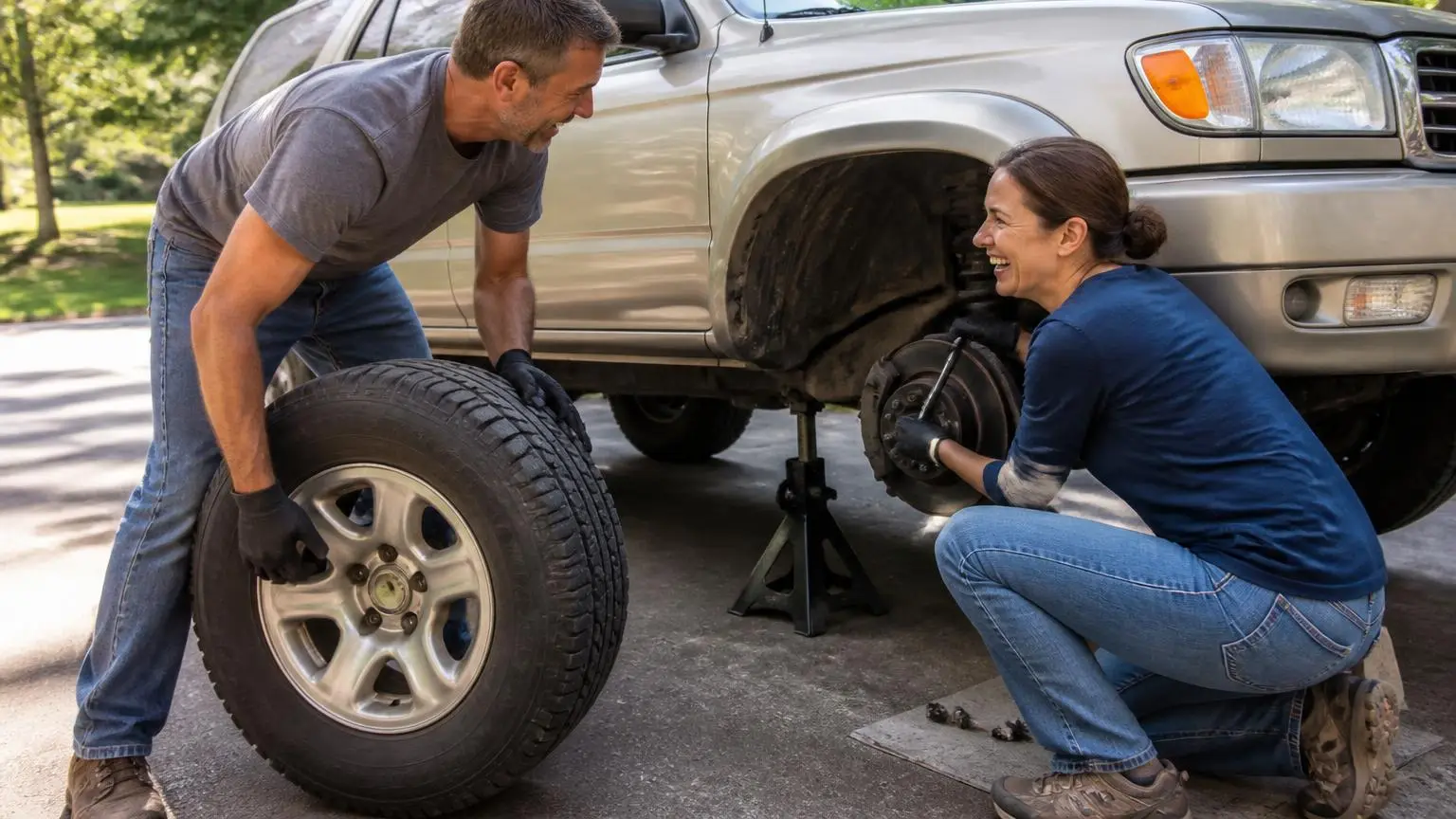
Every tire covers its circumference in one turn, so a tire that's smaller around must turn faster to keep up. Tread wear shrinks the circumference. A tire with 10/32 inch less tread than the one beside it is 2 × 10/32 = 0.625 inch smaller in diameter. On a 33-inch tire, that makes it about 1.9% smaller around, so it turns about 1.9% faster. In a part-time 4WD system engaged in 4WD, the transfer case locks the front and rear driveshafts together, so a front-to-rear size difference has nowhere to go except the tires scrubbing and the driveline winding up. Full-time and AWD systems use a center differential or clutch that absorbs some difference, but they're designed around matched tires too. Ford's owner's manual says uneven front-to-rear tread depth can degrade 4WD engagement and disengagement, add noise from the 4WD system, or cause damage. BFGoodrich says even wear matters more on AWD than on other drivetrains because of how sensitive the system is to differences in rolling circumference.
How Often
| Source | Interval |
|---|---|
| Your vehicle's maintenance schedule | Takes priority (Michelin and BFGoodrich both say so) |
| Michelin | Every 5,000–7,000 miles, or every other oil change. AWD and 4WD vehicles usually need rotation more often. |
| BFGoodrich | Every 6,000–8,000 miles (10,000–12,000 km) |
Rotation Patterns
| Pattern | How the tires move | Use it for |
|---|---|---|
| Rearward cross | Rear tires move straight to the front; front tires cross to the opposite side at the rear | Non-directional tires on 4WD and AWD (BFGoodrich) |
| X pattern | Every tire moves to the other axle and the other side | Non-directional tires on 4WD and AWD (BFGoodrich) |
| Front-to-back, same side | Each tire swaps axles but stays on its side | Directional tires |
| Five-tire | A matching full-size spare joins the rotation | Vehicles with an identical full-size spare (BFGoodrich) |
A directional tire has an arrow molded into the sidewall showing which way it must turn. BFGoodrich and Michelin both say it can move only front to back on the same side. Crossing it to the other side would make it turn backward unless it's taken off the wheel and remounted. If a tire already shows uneven wear, Ford's manual says to have alignment, balance and mechanical problems checked and fixed before rotating.
Parts and Recommended Gear
- Floor jack rated for the vehicle's weight — confirm rating against the truck's actual corner weight
- Jack stands (at least two) — never work under a vehicle supported by a jack alone
- Torque wrench — for correct lug nut re-torque to the manufacturer's spec
- Wheel chocks — for the wheels remaining on the ground during the rotation
The Rotation, Step by Step
- Park on level, hard ground and chock the wheels that stay down.
- Loosen each lug nut slightly while the tire is still on the ground.
- Raise the vehicle at the jacking points in the owner's manual and support it on jack stands, never on the jack alone.
- Move each wheel to its new position using the pattern above.
- Snug the nuts in a star (criss-cross) pattern.
- Lower the vehicle and torque the nuts to the vehicle maker's spec with a torque wrench.
- Reset each tire's pressure to the door-placard figure, since fronts and rears can differ.
Check Tread Depth While the Wheels Are Off
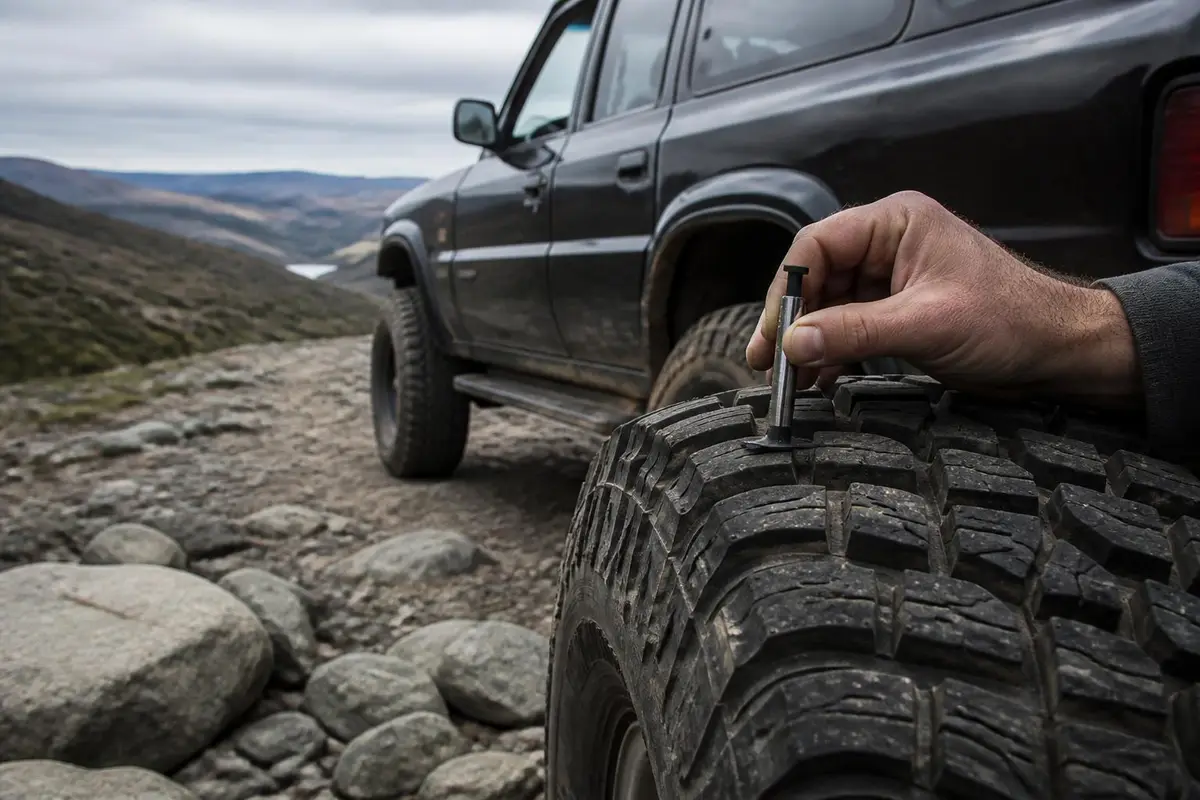
Measure each tire's tread with a gauge at every rotation. Michelin says a tire is worn out at 2/32 inch, when the tread is level with the wear bars molded in its grooves. Write the four readings down. A tire wearing faster than the others points to alignment, pressure or a mechanical fault, which is easier to correct while the gap is still small.
When Rotation Isn't Enough: Replacing Tires on a 4x4
Ford's owner's manual says two-wheel-drive vehicles can generally replace tires in pairs, but vehicles with four-wheel drive should have all four replaced at once. It also says replacement tires should match the original size, load index, speed rating and type, meaning P-metric vs LT-metric and all-season vs all-terrain. Replacing one or two tires on a 4x4 with worn tires elsewhere recreates the size mismatch rotation exists to prevent.
Related Reading
See all-terrain and mud tires for load range and sizing, and part-time vs full-time 4WD for how each system handles tire size differences. This guide uses tire-maker and vehicle-maker guidance; we don't service vehicles ourselves (how we rank).
Recommended gear
Gear for airing down and back up
Affiliate disclosure: As an Amazon Associate, we earn from qualifying purchases, at no extra cost to you. Purchases through these links help keep this site running and up to date. Learn more

Best for airing all four tires down to a set pressure at once.
- Automatic deflators preset between 6 and 30 PSI.
- Air all four tires down at once, then stop at the set pressure.

Best for budget-friendly airing down before sand or rock.
- Adjustable 4-pack of deflators, 10–30 PSI.
- Screw on, set the pressure, and they stop automatically.

Best for airing back up before you hit pavement.
- Portable 12V compressor rated to 150 PSI.
- Sized for truck and SUV tires.

Best for fast inflation of larger off-road tires.
- Heavy-duty 12V off-road compressor.
- Built for inflating larger off-road tires quickly.
We research products from manufacturer specs and owner feedback; we don't test them ourselves. How we choose.
Sources
- Michelin — Tire Rotation Guide — Rotate every 5,000 to 7,000 miles or every other oil change unless the vehicle maker specifies otherwise; AWD and 4WD usually need more frequent rotation and a crisscross pattern; directional tires stay on the same side.
- BFGoodrich — Tire Rotation — Rotate every 6,000 to 8,000 miles; rearward cross or X pattern for 4WD/AWD; five-tire rotation with a spare; directional tires front-to-back only; even wear matters more on AWD because of rolling-circumference sensitivity.
- Ford Owner's Manual — Tire Care (Ford Service Content) — Uneven front-to-rear tread depth can degrade 4WD engagement and disengagement, add 4WD system noise or cause damage; 4WD vehicles should have all four tires replaced at once; replacements should match size, load index, speed rating and type.
- Ford 2014 Escape Owner's Manual — Tire Care (Ford Service Content) — A dissimilar spare should not be used in a rotation; have alignment, balance and mechanical problems corrected before rotating tires that show uneven wear.
- Michelin — When Do I Need New Tires? — Tread worn level with the wear bars, 2/32 inch, is the minimum tread depth.