

Affiliate disclosure: As an Amazon Associate, we earn from qualifying purchases, at no extra cost to you. We research rather than test, and commissions never change our rankings. This site is reader-supported: those commissions pay for hosting, research and keeping every guide up to date, so if a guide helped you, buying through our links is an easy way to support it. How we rank · Full disclosure
TL;DR
- Size the hitch to loaded tongue weight: 10–15% of the loaded trailer. A 7,500-lb trailer needs a 1,200-lb-class hitch.
- Tongue ratings run one-tenth of trailer ratings: CURT’s TruTrack 2P is 10,000 / 1,000 lbs, and its 17063 is 10,000–14,000 / 1,000–1,400 lbs.
- Don’t oversize: Equal-i-zer and Fastway both say bars must match the working load.
- Your receiver needs a weight-distributing rating. On an F-150, Ford requires weight distribution above 5,000 lbs.
- Set it up with Ford’s fender-height method: restore 50% of the front-end rise on an F-150.
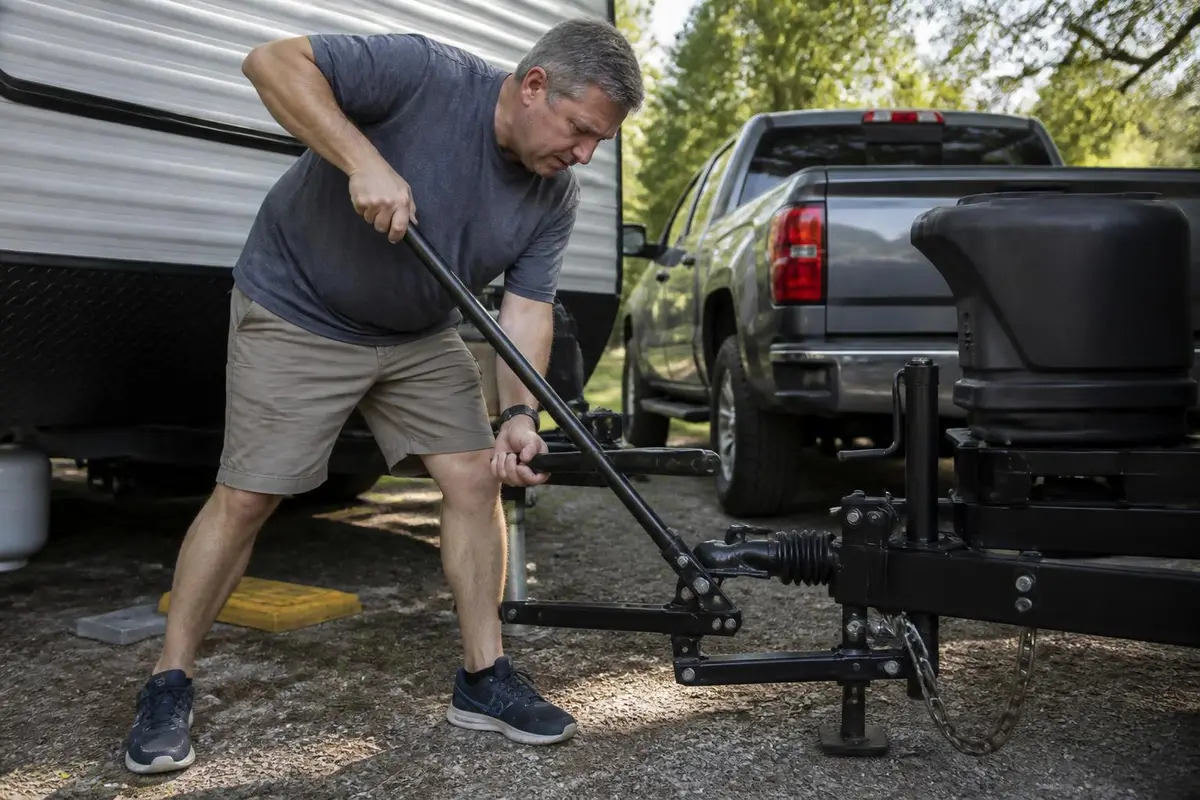
A weight-distribution (WD) hitch replaces the ordinary ball mount with a hitch head and two spring bars. The bars are tensioned against brackets on the trailer frame so they lift some of the tongue load off the truck’s rear axle and move it to the front axle and the trailer’s axles. Ford calls them equalizing arms. Most current WD hitches also resist sway. Choosing one means matching its tongue-weight range to your loaded trailer, confirming your receiver is rated for weight distribution, and picking a sway-control design. These hitches are ranked from manufacturer ratings and aggregated owner reviews; we have not installed or towed with them.

At a Glance
| Hitch | Maker’s rating (trailer / tongue) | Bars | Sway control |
|---|---|---|---|
| CURT TruTrack 2P (17601) | Up to 10,000 / 1,000 lbs | Round | Two-point friction brackets |
| CURT round bar (17063) | 10,000–14,000 / 1,000–1,400 lbs | Round | Included sway control unit (#17200) |
| Fastway e2 line | 4,500 to 12,000 lbs trailer (e.g. 10K: 1,000 lbs tongue; 12K: 1,200 lbs) | Round or trunnion by model | Built in |
| Equal-i-zer line (for comparison) | 400 series 4,000 / 400 lbs up to 1600 series 16,000 / 1,600 lbs | — | Built in |
The pattern across makers is that the tongue rating is one-tenth of the trailer rating. A number in a listing title, like “10K” or “1,000 lb,” may be either one.

Best for Travel trailer owners who want weight distribution and sway control designed as one system.
- Weight distribution with integrated sway control per the listing.
- Listed with a 10K rating — confirm on CURT’s spec sheet which capacity this refers to.
- TruTrack 2P model from CURT.

Best for Heavier trailers where a higher listed rating and round spring bars are the priority.
- Round spring bar design per the listing.
- Listed at 14,000 lb — confirm whether that is gross trailer weight and check the matching tongue-weight range.
- Sway control included per the listing.

Best for First-time WD hitch buyers who want the hitch ball, sway ball, U-bolts and chains in one box.
- Listed at 1,000 lb — confirm on the spec sheet which rating this refers to.
- Manually adjusted sway control per the listing.
- Ready-to-tow kit with pre-installed hitch ball, sway control ball, U-bolts and chain package.

Best for Owners comparing options from Fastway, a brand frequently discussed in aggregated owner reviews of towing gear.
- Weight distribution hitch from Fastway.
- Check the listing for available capacity ranges and included sway control.
- Confirm tongue-weight rating against your loaded trailer before choosing a size.

Best for Budget-conscious owners of lighter trailers who have confirmed the rating matches their tongue weight.
- Listed at 1,500 lbs capacity — confirm on the listing which rating this refers to.
- 2-inch solid steel shank and 2-5/16 inch alloy steel ball per the listing.
- Powder-coated, with sway control.

Best for Owners willing to verify ratings and hardware directly on the listing before buying.
- Weight distribution hitch with a sway control bar per the listing.
- Listing title does not state a capacity — verify ratings before purchase.
- Compare included hardware against the kits above.
Sizing: Start From Your Loaded Tongue Weight
Equal-i-zer’s sizing method is to take the loaded trailer weight (with water, gear and cargo, not the brochure’s dry weight), estimate tongue weight at 10–15% of it, and pick the series that covers that figure. Worked example: a travel trailer weighing 7,500 lbs loaded puts roughly 750–1,125 lbs on the hitch. That is past a 1,000-lb series at the high end, so the 1,200-lb class of hitch fits it. Weighing the tongue with a scale narrows the range. See tongue weight scales.
Bigger is not safer. Equal-i-zer says a hitch that is too large can’t be tensioned to deliver its engineered performance. Fastway says a higher-rated hitch “is not a workaround for an overloaded truck, trailer, receiver, axle, or tire,” because the spring bars are matched to a working load. CURT’s 17063 is rated for a range of 1,000–1,400 lbs of tongue weight, so it isn’t meant for a trailer that puts only 600 lbs on the hitch.
Your Receiver Must Be Rated for Weight Distribution
The receiver carries two ratings, and Ford says its factory receivers show both on a label. On an F-150, Ford’s chart lists 5,000 lbs / 500 lbs weight-carrying and up to 13,500 lbs / 1,400 lbs weight-distributing (with the Tow/Haul Package and Max Tow Axle). Ford also says not to tow more than 5,000 lbs on an F-150 without weight distribution. Aftermarket receivers vary. CURT’s Class 3 receiver #13146 is rated 6,000 / 900 lbs weight-carrying and 8,000 / 900 lbs with weight distribution, so the WD rating raises the trailer limit but not the tongue limit. CURT’s class ceilings are 12,000 / 1,200 lbs with weight distribution for Class 3 and Class 4. Whichever is lowest (receiver, WD hitch, ball or vehicle) sets the limit.

Sway Control: Friction vs Cam
Weight distribution levels the rig; sway control resists the trailer yawing behind the hitch. CURT describes two approaches in its TruTrack line. The 2P uses two brackets that resist sideways movement by friction. The 4P uses springs and cams for what CURT calls active sway control. Fastway builds permanent sway control into the e2. Sway control doesn’t cure a badly loaded trailer: Ford and Oregon DOT both say too little tongue weight causes sway. If a trailer does sway, Ford says to apply the trailer brakes by hand with the brake controller rather than the truck’s brakes. Our weight distribution vs sway control hitch comparison goes further.
Round Bars vs Trunnion Bars
Round bars slide into sockets under the hitch head. CURT lists them as suited to lighter and medium loads, with lower ground clearance because of their curved shape. Trunnion bars are square and slide into the sides of the head, which CURT says gives better ground clearance and higher capacities at a higher cost. That clearance matters on steep driveway entries, dips and rough roads. The CURT 17601 and 17063 both use round forged-steel bars.

Setup: Ford’s Fender-Height Method
Ford’s towing guide sets out how to adjust a WD hitch:
- Load the trailer as for the trip with about 10% tongue load, and park on level ground with the trailer level or slightly nose-down.
- Set the ball height to match the coupler height when unhitched.
- Measure the front fender lip height above the wheel center (H1).
- Hitch up without the bars and measure again (H2).
- Tension the bars to bring the fender back up by Ford’s correction factor.
For the F-150, F-250/F-350 Super Duty and Expedition, that factor is 50%. Ford’s example: H1 of 37 inches and H2 of 38 inches give a 1-inch drop, so the target is 37.5 inches. The F-450 Regular Cab uses 25%. Then latch the coupler and connect the wiring, safety chains and breakaway cable. Setup is covered in more depth in is a weight distribution hitch worth it.
How We Rank Weight Distribution Hitches
Each hitch is weighed against its manufacturer ratings, bar type, sway-control design and included hardware, and cross-referenced with owner installation and fitment reports. We don’t buy, install or tow with this equipment ourselves. See how we rank and our affiliate disclosure.
Sources
- CURT Manufacturing — TruTrack 2P Weight Distribution Hitch #17601 — TruTrack 2P is rated up to 10,000 lbs GTW and 1,000 lbs tongue weight, uses round forged-steel bars and two-point friction sway control.
- CURT Manufacturing — Round Bar Weight Distribution Hitch #17063 — CURT 17063 is rated 10,000–14,000 lbs GTW and 1,000–1,400 lbs tongue weight, uses round forged-steel bars and includes sway control unit #17200.
- Fastway Trailer Products — Weight Distribution Ranges on Fastway e2 Hitches — e2 10K and 12K tongue ratings; a higher-rated hitch isn’t a workaround for an overloaded vehicle; spring bars matched to the working load; the lowest-rated component controls.
- Fastway Trailer Products — e2 Weight Distribution Hitch with Sway Control — The e2 line comes in ratings from 4,500 to 12,000 lbs with built-in, permanent sway control.
- Equal-i-zer — What Weight Distribution Hitch Size Do I Actually Need? — Estimate tongue weight at 10–15% of loaded trailer weight; Equal-i-zer series from 400 to 1,600 lbs tongue; an oversized hitch can’t be tensioned correctly; use loaded, not dry, weight.
- CURT Manufacturing — How to Choose the Best Weight Distribution Hitch — Round bars suit lighter to medium loads with lower clearance; trunnion bars give more clearance and capacity at higher cost; TruTrack 2P friction and 4P spring-and-cam sway control.
- Ford — 2026 RV & Trailer Towing Guide — Equalizing arms transfer load; F-150 receiver weight-carrying and weight-distributing ratings; 5,000-lb F-150 limit without weight distribution; fender-height setup procedure and correction factors; sway response.
- CURT Manufacturing — Installation manual, hitch #13146 — CURT #13146 is rated 6,000/900 lbs weight-carrying and 8,000/900 lbs with weight distribution.
- CURT Manufacturing — Types of Trailer Hitches and Hitch Classes — Class 3 and Class 4 weight-distribution ceilings of 12,000/1,200 lbs.
- Oregon DOT — Towing a Trailer: Being Equipped for Safety (developed in part from NHTSA material) — Too little tongue weight causes sway.