

Affiliate disclosure: As an Amazon Associate, we earn from qualifying purchases, at no extra cost to you. We research rather than test, and commissions never change our rankings. This site is reader-supported: those commissions pay for hosting, research and keeping every guide up to date, so if a guide helped you, buying through our links is an easy way to support it. How we rank · Full disclosure
These picks cover lighting, radios, portable power and a phone mount. Each one comes with rules or numbers worth knowing before you install it: how much current a light bar draws, what the law allows on public roads, who needs a radio license, and how long a battery will actually last.
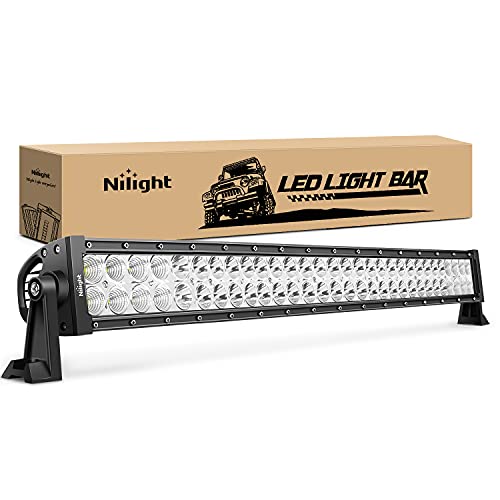
Best for Owners wanting a visually striking, functional roof or bumper-mounted light bar.
- 32-inch, 180W per listing.
- Spot/flood combo beam pattern.

Best for Owners wanting undercarriage lighting for both style and trail visibility.
- 4-pod set per listing.
- High-power white LEDs.

Best for Owners wanting a feature-rich handheld radio option for group trips.
- 2-pack per listing.
- GMRS band (a license is required to transmit).

Best for Owners wanting a compact power option for camp electronics and charging.
- 292Wh capacity per listing.
- Portable, no install required.

Best for Owners wanting a longer-reach phone mount for a taller dash or seating position.
- 16.9-inch mount arm per listing.
- Dash pad included.
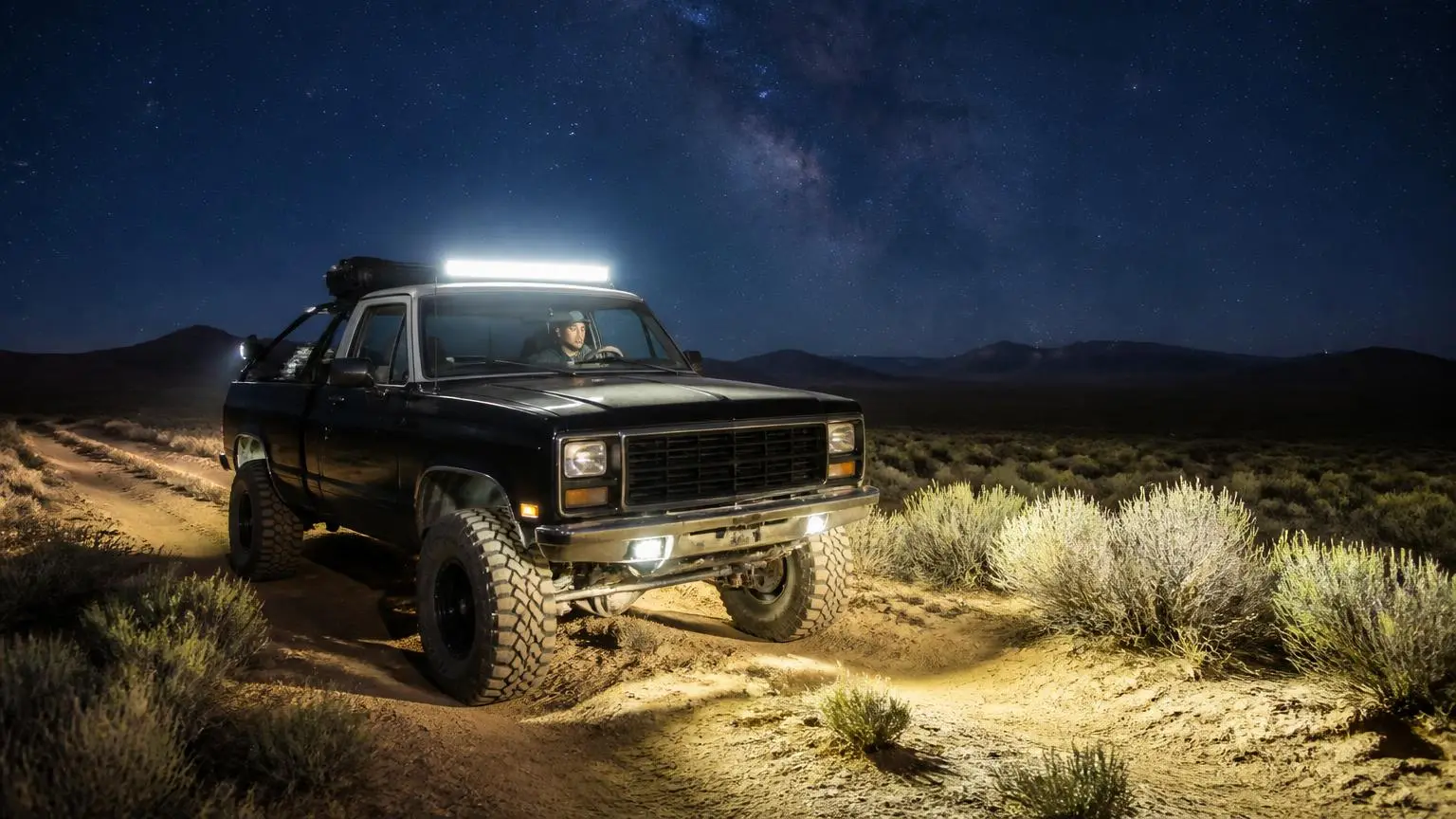
Light Bar Current, Fuses and Relays
The Department of Energy's formula, watts = volts × amps, turns a light's wattage into the current your wiring has to carry. Worked through for the lights on this page:
| Load (listed wattage) | Current at 12 V |
|---|---|
| 180 W light bar | ≈ 15 A |
| 120 W light bar | ≈ 10 A |
| Two 40 W pods | ≈ 6.7 A |
At those currents the bar runs through a relay: the dash switch carries only the small coil current, and a fused line from the battery feeds the lamp. KC HiLiTES sells relay harnesses and inline fuses for this. Add up every light on one circuit before choosing a harness, and size the fuse to the harness wire. The full step-by-step is in how to wire a light bar.
What the Lighting Rules Say
Federal standard FMVSS 108 (S6.2.1) says no added lamp may impair the effectiveness of the lighting a vehicle is required to have. States then regulate auxiliary lamps directly. California's code is a typical example:
- no more than two auxiliary driving lamps on the front, mounted 16 to 42 inches high, and never lit with the low beams (CVC §24402);
- diffused, nonglaring accessory lights, which is where underbody and rock lights usually fall, are capped at 0.05 candela per square inch, may not show red to the front and may not sit within 12 inches of a required lamp (CVC §25400).
A 32-inch combo bar is off-highway equipment under rules like these. Wire it on its own switch so it can't come on with the headlights, and check your state's code before using it on a public road.
GMRS Radios Need a License to Transmit
Under 47 CFR 95.1705, operating a GMRS station requires an individual FCC license. It is issued to applicants 18 or older, normally lasts ten years and covers immediate family members. The application fee is $35 (47 CFR 1.1102), with no exam. GMRS allows up to 50 watts on its main channels for mobile and base stations, far more than license-free FRS radios, which are capped at 2 watts. The truck gadgets page compares GMRS, FRS and CB.
Portable Power: Sizing by Watt-Hours
Jackery rates the Explorer 300 at 293 Wh and 300 W of output. The listing on this page says 292 Wh. Jackery's runtime formula is capacity × 0.85 ÷ the device's wattage, with the 0.85 covering conversion losses. Worked examples for a 293 Wh station:
| Load | Estimated runtime |
|---|---|
| 20 W (phone and camera charging) | ≈ 12.5 hours |
| 45 W (a small 12 V appliance or laptop) | ≈ 5.5 hours |
| 180 W (the light bar above, if run from the station) | ≈ 1.4 hours |
A station this size suits charging devices and short camp loads. Continuous loads like a fridge running for days are better served by a second battery charged from the alternator; see the dual battery & portable power hub.
Phone Mounts and State Law
Hands-free and mounting rules vary by state. California's are a clear example. A phone may be mounted on the windshield only in a 7-inch square in the lower corner farthest from the driver, or a 5-inch square in the lower corner nearest the driver, outside the airbag deployment zone (CVC §26708). It may also be mounted on the dashboard or console where it does not block the view of the road. A driver may touch it only with a single swipe or tap (CVC §23123.5). A long-arm dash mount like the one above falls under the dashboard rule, so place it low enough that it doesn't block your view.
Sources
- U.S. Department of Energy — Estimating Appliance and Home Electronic Energy Use — Watts = volts × amps, used to work out current draw (amps = watts ÷ volts).
- KC HiLiTES — Light Bar Wiring Support — Relay harnesses and inline fuses for auxiliary lighting.
- 49 CFR 571.108 (FMVSS 108) — Lamps, reflective devices and associated equipment (Cornell LII) — S6.2.1: no additional lamp may be installed that impairs the effectiveness of required lighting.
- California Vehicle Code §24402 — Auxiliary driving lamps — No more than two auxiliary driving lamps on the front, mounted 16 to 42 inches high, not lit with the lower beam.
- California Vehicle Code §25400 — Diffused nonglaring lights — Diffused lights capped at 0.05 candela per square inch, no red to the front, not within 12 inches of a required lamp.
- 47 CFR § 95.1705 — GMRS individual licenses (Cornell LII) — GMRS operation requires an individual license; applicants must be 18 or older; ten-year term; immediate family members listed as eligible operators.
- 47 CFR § 1.1102 — Wireless application fees (Cornell LII) — $35 application fee for a new GMRS license.
- 47 CFR § 95.1767 — GMRS transmitting power limits (Cornell LII) — 50 W on main channels for mobile, base and repeater stations; 5 W on 462 MHz interstitials; 0.5 W for handhelds on 467 MHz interstitials.
- 47 CFR § 95.567 — FRS transmitting power limits (Cornell LII) — FRS capped at 2 W ERP on channels 1–7 and 15–22 and 0.5 W on channels 8–14.
- Jackery — Explorer 300 Portable Power Station — Explorer 300 rated at 293 Wh capacity and 300 W output.
- Jackery — What Can the Explorer 300 Plus Run? — Runtime formula: capacity (Wh) × 0.85 ÷ appliance wattage, with 0.85 allowing for power loss.
- California Vehicle Code §26708 — Windshield obstructions — Device may be mounted in a 7-inch square in the lower windshield corner farthest from the driver or a 5-inch square in the corner nearest the driver, outside the airbag deployment zone.
- California Vehicle Code §23123.5 — Handheld wireless devices — Phone may be mounted on the windshield per §26708 or on the dashboard or console without blocking the view; operated only by a single swipe or tap.